


2026 is a pivotal year of compliance and transition for the food packaging industry. EU mandatory regulations are about to take effect, and North American buyers have intensified supply chain scrutiny across the board. Packaging manufacturers face mounting pressure, while advances in mono-material systems and plant fiber molding technology are bridging the gap between environmental standards and commercial viability.
Below is a summary of the latest global regulatory developments and technology trends.
1. Global Regulatory Deadlines: The Shift from Voluntary to Mandatory Green Standards
The defining themes in 2026 global food contact material (FCM) regulation are: PFAS bans, greenwashing penalties, and safety reviews for recycled content.
EU PPWR Mandatory Enforcement Begins in August
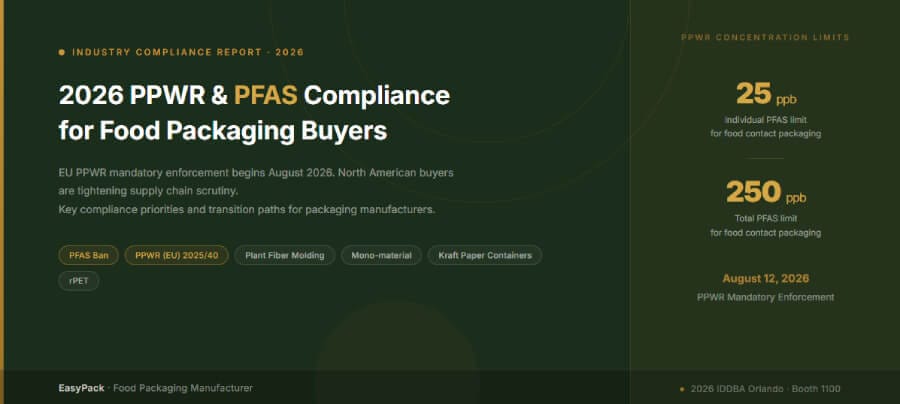
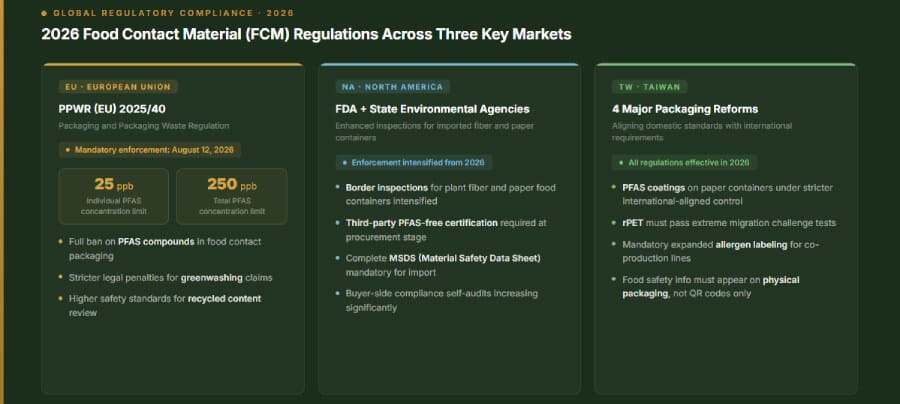
The EU Packaging and Packaging Waste Regulation (PPWR, (EU) 2025/40) enters mandatory enforcement on August 12, 2026. The provision drawing the most attention is its comprehensive restriction on per- and polyfluoroalkyl substances (PFAS), commonly known as “forever chemicals.” Under the new rules, individual PFAS concentrations in food contact packaging must remain below 25 ppb, with total PFAS content not to exceed 250 ppb.
North America Moves to Active Inspection and Dual-Track Compliance
The U.S. Food and Drug Administration (FDA) and state environmental agencies have stepped up border inspections of imported plant fiber and paper food containers this month. For North American B2B buyers, third-party PFAS-free test certificates and complete Material Safety Data Sheets (MSDS) are now standard requirements at the sourcing stage.
Four Major Food Packaging Reforms Now in Effect in Taiwan
The domestic market has introduced stricter requirements as well:
- PFAS coatings on paper food containers are now governed in line with international standards
- rPET (recycled PET pellets) must pass stringent migration testing
- Allergen labeling for shared-line production is now mandatory
- Critical food safety information must be printed directly on physical packaging. A QR code alone is no longer sufficient.
2. Materials and Technology Advances: Mono-Material Systems and Physical Structure Engineering
With regulations tightening on conventional plastic laminate coatings and PFAS treatments, the global packaging industry has reached a structural turning point in 2026.
Mono-Material Design Takes Center Stage for Recyclability
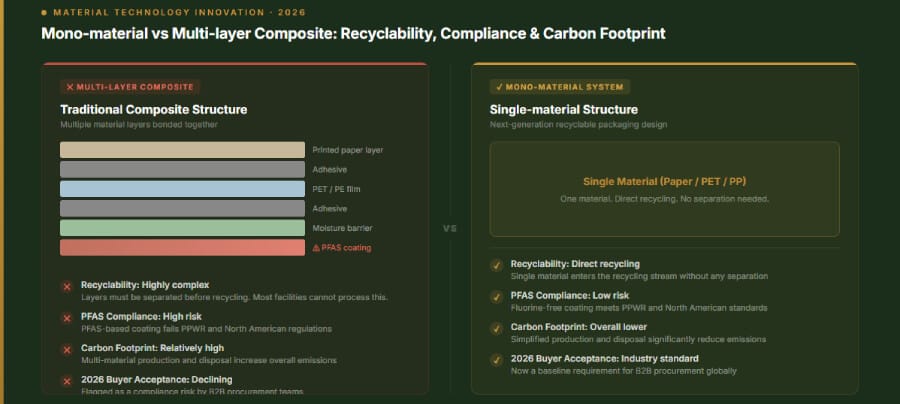
Multi-layer composite materials, long used to achieve multiple barrier properties, are being replaced by mono-material systems. Eliminating composites significantly simplifies downstream sorting and recycling operations, while helping B2B brands reduce their overall carbon footprint.
Plant Fiber Molding Reaches Commercial Scale with Improved Aesthetics
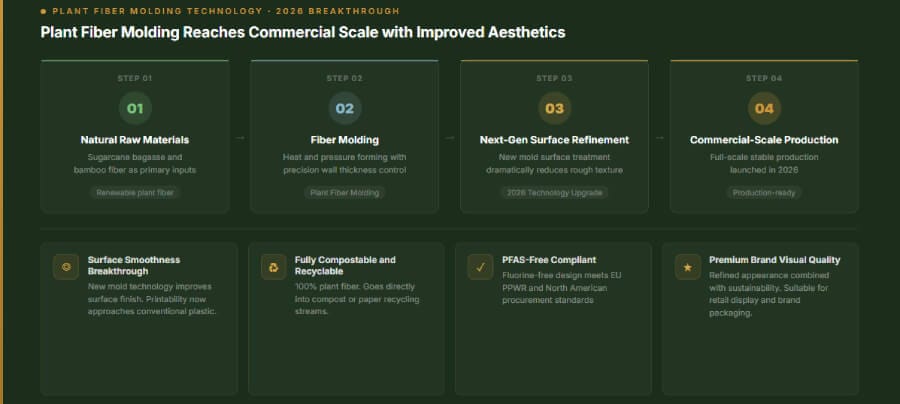
Plant fiber technologies using sugarcane bagasse, bamboo fiber, and similar raw materials have entered full-scale commercial production in 2026. Next-generation mold surface treatments have resolved the surface roughness that was a longstanding limitation of plant fiber substrates. The resulting improvement in smoothness also enhances printability, allowing these materials to deliver the premium visual finish that high-end brands demand, while remaining fully compostable and recyclable.
Kraft Paper Food Containers: Structural Reinforcement and Ambient-Display Optimization
Fluorine-free water-based oil-resistant coatings have achieved highly stable production yields. Current R&D focus across the industry has shifted toward optimizing paper basis weight and three-dimensional folding structures to reinforce the compression resistance and board stiffness of kraft paper containers. These designs target ambient-temperature display and prepared food presentation specifically, improving shelf presence and visual appeal while remaining fully compliant.
3. Competing in the 2026 North American Buying Season: Compliance and Data Are Non-Negotiable
As the 2026 North American buying season approaches, buyer priorities have become clear: compliance and data are the baseline for winning B2B contracts. Food packaging suppliers can no longer rely on environmental claims alone. They must come to the table with documented carbon reduction figures, internationally recognized certifications, and packaging that holds its structure in real-world display conditions.
EasyPack has been advancing the structural engineering of its plant fiber and kraft paper container lines in direct response to these global trends. Product development is focused on meeting EU and U.S. PFAS standards while delivering the board stiffness that North American buyers require for premium display applications in 2026.
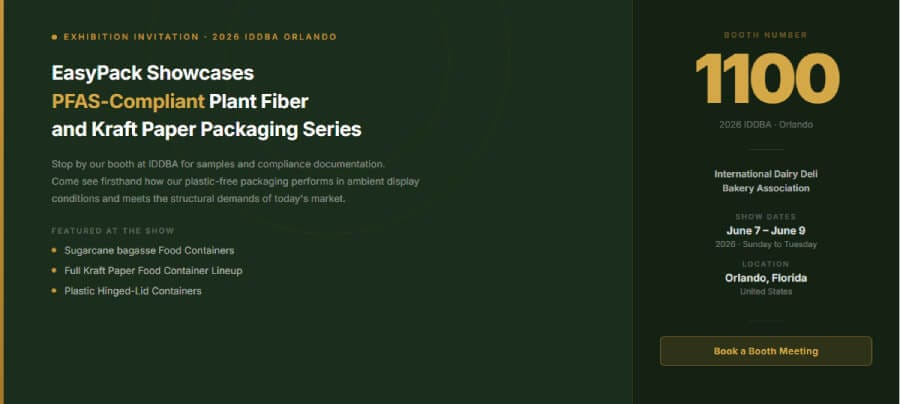
Join Us at IDDBA 2026 in Orlando
We will be exhibiting our plant fiber and kraft paper packaging lines at this year’s International Dairy Deli Bakery Association show (IDDBA). Come see firsthand how our plastic-free packaging performs in ambient display conditions and meets the structural demands of today’s market.
- Show: 2026 IDDBA (International Dairy Deli Bakery Association)
- Location: Orlando, Florida, USA
- Dates: June 7 (Sunday) – June 9 (Tuesday), 2026
- Booth: 1100
Advance appointment requests are welcome. EasyPack looks forward to meeting you in Orlando to discuss the next steps in sustainable packaging.