


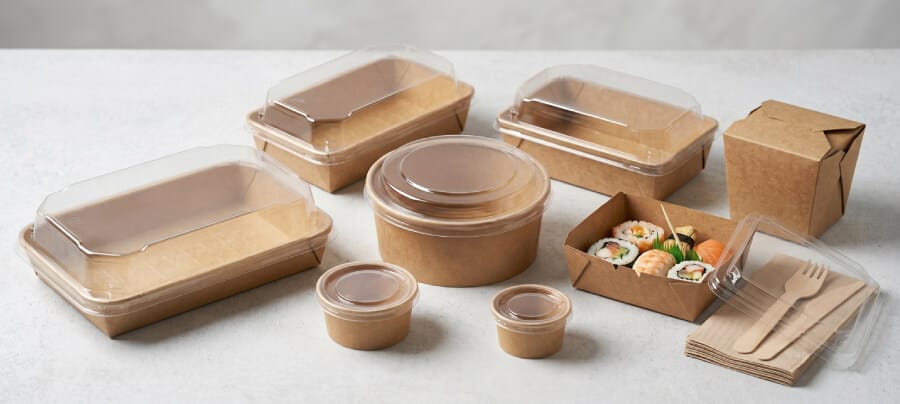
Kraft paper containers suit most takeout and delivery applications, with clear advantages in regulatory compliance, brand presentation, and print flexibility. For high-temperature dishes, laminate-coated versions or plant fiber alternatives are recommended. EasyPack takes a procurement-focused approach to help you determine whether kraft paper containers align with your restaurant’s positioning.
Why Choosing Takeout Packaging Is More Complex Than It Used to Be
In the past, most restaurants evaluated takeout packaging on two criteria: whether it could hold food and whether the cost was low enough. Market conditions have fundamentally shifted in recent years, and procurement decisions must now account for three dimensions simultaneously:
- Regulatory Pressure: Taiwan’s Environmental Protection Administration has announced a phased restriction on disposable utensils and single-use plastic foodware. The EU’s Single-Use Plastics Directive (2019/904/EU) places outright bans on specific plastic products. Restaurants with export operations or international brand partnerships need to prepare in advance.
- Delivery Platform Trends: Orders through Foodpanda, Uber Eats, and similar platforms continue to grow. The first impression consumers have when unboxing their delivery directly affects ratings and repeat purchases, making packaging quality an extension of brand management.
- ESG Procurement Pressure: Chain retailers and corporate catering clients increasingly require suppliers to provide carbon footprint data and documentation on eco-friendly materials. Packaging choices directly affect tender eligibility, and inquiries about biodegradable materials such as corn-starch-based substrates and PLA continue to rise year on year. Against this backdrop, kraft paper containers have become an option the foodservice industry is taking a fresh look at. The following section provides a broad overview through a cross-material comparison.
Cross-Material Comparison of Mainstream Takeout Packaging
The following table uses chain restaurant takeout entree containers as the reference point, with evaluation criteria ranked by importance in procurement decision-making.
| Evaluation Criteria | Kraft Paper | PP Plastic | PET Clear | EPS Foam | Plant Fiber |
|---|---|---|---|---|---|
| Regulatory Risk | Low – aligns with sustainable packaging trends | Moderate – restricted in some markets | Moderate – recyclable but still plastic | High – banned in multiple countries | Low – meets the strictest standards |
| Print & Branding Flexibility | Excellent – highly suitable for custom printing | Moderate – requires special treatment | Moderate – transparent substrate limits color | Poor – high printing cost | Excellent – finish comparable to kraft paper |
| Consumer Eco Perception | Positive – natural texture is apparent | Neutral | Neutral | Negative – image is widely degraded | Most Positive |
| Heat Resistance | Laminate-coated: 90°C | 120°C and above | 60–70°C (not suitable for hot food) | 80°C | Dry heat: 220°C |
| Relative Procurement Cost | Low to Moderate | Low | Low to Moderate | Lowest | Moderate to High |
| Stackable Storage Efficiency | Excellent – flat-fold design saves space | Excellent | Excellent | Poor – bulky | Excellent |
Five Core Advantages of Kraft Paper Containers
As the table shows, kraft paper containers perform consistently across multiple key criteria. The following section details the five advantages most frequently cited in procurement decisions.
Advantage 1: Least Resistance to Regulatory Trends
Under Taiwan’s Act Governing Food Safety and Sanitation and Environmental Protection Administration announcements, food contact materials must comply with hygienic standards for food utensils, containers, and packaging. Restrictions on disposable foodware continue to expand. Paper-based materials such as kraft paper face significantly less regulatory pressure than EPS and certain plastics – a distinction that carries particular weight for restaurants with export operations or international brand licensing arrangements.
Advantage 2: High Brand Print and Customization Flexibility
Kraft paper’s ink absorption properties make it well suited for custom printing of logos, color systems, and seasonal artwork using water-based inks, with a finish that visibly outperforms clear plastic boxes or cups. A distinctive branded packaging design strengthens brand recall and visibility. Digital proofs can be confirmed within 3 to 5 business days after artwork sign-off – a clear advantage for chain brands that need to turn around seasonal packaging quickly.
Advantage 3: Positive Consumer Perception
Research shows that consumers rate paper-based eco-friendly packaging higher than plastic containers on attributes such as “natural,” “fresh,” and “thoughtfully presented.” In the competitive delivery platform market, packaging appearance at the moment of unboxing directly influences ratings and first-repeat-order intent – an effect that is especially pronounced for restaurants positioned at higher price points.
Advantage 4: Strengthens ESG Reporting and Sustainable Procurement Credentials
Paper-based packaging typically performs better than petroleum-based plastic in carbon footprint calculations and corporate sustainability reporting. For foodservice operators pursuing environmental labeling or sustainable procurement certification, this consideration carries increasing weight in procurement decisions. The choice of packaging material is a direct expression of a brand’s commitment to packaging reduction and environmental responsibility.
Advantage 5: Better Storage Efficiency and Lower Logistics Costs
Most kraft paper containers are designed to stack, fitting more units per carton than rigid PP or EPS structures. At bulk order volumes, this translates to meaningful reductions in both warehouse space requirements and freight costs.
Food Service Type Packaging
Kraft paper containers are not the right fit for every dish. The following provides sourcing guidance by food type. If you’ve already decided to go with kraft paper containers and want to pick the right spec by meal type, see “Kraft Paper Container Selection by Menu Item: Soup Bowls, Salad and Burger Containers.”
| Food Type | Recommended Packaging | Rationale |
|---|---|---|
| Bento / Dry Entrees | Laminate-coated kraft paper bento box | Sufficient heat resistance, premium appearance, high stacking efficiency |
| Salads / Light Meals | PET clear container or kraft paper box | Clear PET recommended for salads requiring visual display; kraft paper suitable for cold items as well |
| Soup Bowls / Hot Soup | Laminate-coated kraft paper soup bowl or plant fiber bowl | Verify lid seal and heat retention; recommend pairing with a paper lid |
| Beverages / Coffee | Kraft paper cup + lid | Hot drinks require double-wall insulation; cold drinks can use a straw-hole lid; delivery orders should include an insulated bag to reduce heat loss |
| High-Heat Grilled / Braised Foods | Plant fiber container | Applications exceeding 120°C should use higher-heat-rated materials; frozen food applications require separate low-temperature tolerance verification |
| Carry-Out Paper Bags | Kraft paper bag + carrier bag | Serves as the outer carry bag, reinforcing consistent brand presentation |
Kraft Paper Containers Practical Limitations
- Relatively Low Heat Ceiling: Standard laminate-coated kraft paper has a heat resistance of approximately 90°C. Prolonged exposure may still cause softening. High-temperature soups or grilled items warrant evaluation of plant fiber alternatives.
- PE-Laminated Versions Are Difficult to Recycle: The waterproof and oil-resistant PE liner makes it difficult for these containers to enter standard paper recycling streams. Brands whose environmental message centers on recyclability should opt for PLA-lined versions and clearly label the material on the packaging.
- Non-Standard Shapes Carry Higher Customization Costs: Specialty structures such as deep bowls and multi-compartment configurations involve higher tooling and development costs. Confirm mold development fees before finalizing a quotation.
EasyPack Remind: The Most Overlooked Food-Grade Liner Detail For Procurement Managers
Based on direct conversations with procurement teams at multiple chain restaurant groups, the following point is consistently underestimated during material selection:
“For kraft paper containers, the choice of food-grade liner material directly affects food safety compliance and the credibility of any environmental claim.”
PE liners are cost-effective but not compostable. PLA liners are biodegradable but have lower heat resistance. Liner-free versions offer the best environmental profile but limited oil resistance. Before placing an order, request a food-grade material safety declaration from your supplier with the liner material clearly identified, to avoid scrutiny during ESG reporting or green procurement audits.
Maintaining a structured supplier evaluation process also strengthens your negotiating position at annual contract renewals.
Frequently Asked Questions
How much more expensive are kraft paper containers compared to plastic for restaurant takeout?
Unit pricing for kraft paper containers typically runs 10–30% above comparable PP plastic containers, with the gap narrowing at bulk order volumes. When storage costs, spoilage rates, and brand premium benefits are factored in, the total cost is not necessarily higher. A total cost of ownership (TCO) analysis is recommended before making a final decision.
Are kraft paper containers suitable for delivery platform orders?
Yes, very much so. Delivery platform operations place high demands on lid security and packaging consistency. Kraft paper containers’ stackable design supports efficient meal prep, and the unboxing experience is well received by consumers. Versions with a snap-lock closure are recommended to prevent spills in transit.
How do I verify the food-grade safety of kraft paper containers?
Under Taiwan’s Act Governing Food Safety and Sanitation, food packaging must comply with hygienic standards for food utensils, containers, and packaging. Before purchasing, request a material safety declaration from your supplier confirming that the paper substrate, liner, and printing inks are all food-grade. Verify whether the products meet international food contact standards such as FDA 21 CFR or EU 10/2011.
Do kraft paper containers contribute to ESG scores for chain restaurants?
Yes, but supporting documentation is required. Kraft paper packaging helps reduce carbon footprint, but to be recognized in ESG reporting or green procurement audits, suppliers must provide documentation such as FSC certification and material safety declarations.
What are the current regulatory restrictions on disposable foodware in Taiwan?
Taiwan’s Environmental Protection Administration has announced phased restrictions on disposable foodware, including EPS containers, plastic boxes, and plastic bags. Bento shops, restaurants, and other foodservice operators are required to offer paper bowl and paper bag alternatives, and consumers are expected to bring their own utensils for dine-in meals. Confirm that your supplier can provide material safety declarations, and monitor the latest announcements from the Environmental Protection Administration.
The choice of takeout and delivery food packaging is fundamentally a balance between brand positioning, regulatory compliance, and cost efficiency. Kraft paper containers offer a well-rounded option in terms of regulatory direction, brand printing, and supply stability, making them suitable for most bento, soup bowl, salad box, and paper bag applications. High-temperature dishes require specification of the appropriate laminate grade.
We recommend selecting 1 to 2 core menu items from your current takeout lineup and requesting physical samples from your supplier to test against heat resistance and oil resistance requirements. A structured decision framework ensures better long-term procurement outcomes than price comparison alone. Contact the EasyPack team for container recommendations and custom quotations tailored to your foodservice positioning.