



Most articles about FDA and EU food contact material compliance are written by testing and consulting firms, aimed at manufacturers applying for certification, covering how a company builds out a compliance process internally.
That’s useful if you’re the manufacturer. But if you’re buying kraft paper containers, the real question is different: once a supplier hands you a document, how do you tell whether it actually meets the requirement, and what should you be asking for when you request it in the first place?
This guide focuses on the request step itself. Verifying a document’s authenticity once you have it in hand (for instance checking a PFAS-free claim) is a separate topic we’ll cover in a future article.
What to Check for FDA vs EU Requirements on Kraft Paper Containers
What Is an FDA Food Contact Material Declaration
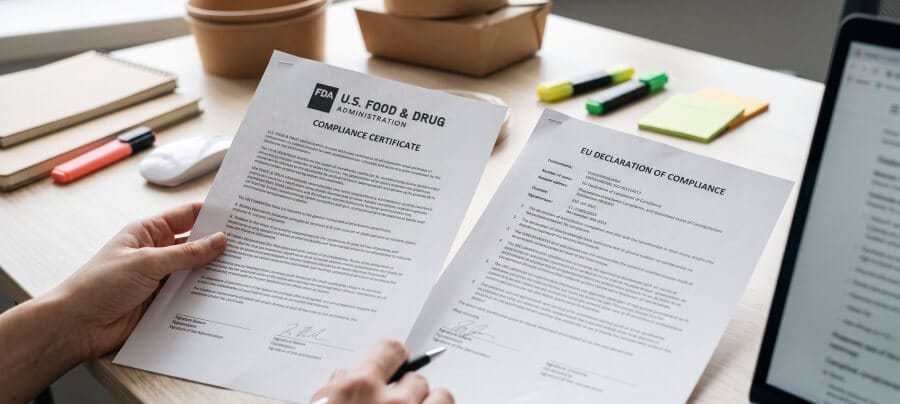
US regulation of food contact materials mainly falls under the relevant sections of 21 CFR. If kraft paper containers are headed for the US market, suppliers typically provide a declaration stating that the container’s materials (the paper itself and any coating) meet FDA requirements for food contact materials.
This declaration isn’t a registration certificate issued by a government agency. It’s the supplier’s own written statement, usually backed by a third-party lab test report.
When you receive this declaration, check whether it cites specific section numbers and test items, rather than a vague line like “meets FDA requirements.”
An EU DoC Isn’t the Same Document Format as FDA’s
EU food contact material regulation requires suppliers to provide a DoC (Declaration of Compliance). This document is more structured than the FDA declaration, typically listing the applicable EU regulation numbers, test methods, material composition, and conditions of use (food type, temperature range).
The EU DoC format is fairly standardized, so once you have it, you can check it against that format for missing fields. That’s different from the FDA declaration, which has no single standard format and varies by supplier.
What to Ask When You Request Documents From a Supplier
If this is your first order with a given supplier, it’s worth asking exactly which product and which batch of raw material the declaration or DoC was tested against.
A single factory’s different container lines don’t always share the same material formula or coating, so one document doesn’t necessarily cover every product line.
If you’re reordering from an existing supplier, the question changes: ask whether the raw material source or coating formula has changed. If the supplier switched pulp sources or coating suppliers, the existing document may no longer apply, and you’ll want to confirm whether retesting has happened.
Many buyers assume that because they’ve worked with a supplier before, the documents are still valid. Suppliers don’t always volunteer small formula changes, so it’s worth asking again before every order.
Does Every Shipment Need Retesting
There’s no universal answer here.
If the supplier’s raw material source, formula, and process stay stable, most of the time you don’t need third-party retesting for every shipment. Reusing the same declaration is standard practice.
But if the supplier switches pulp suppliers, adjusts the coating formula, or your target market updates its regulations, that’s when retesting and an updated document are worth requiring, rather than stretching an old document to cover a new situation.
What matters isn’t how much time has passed. It’s whether anything material actually changed on the supplier’s end.
The 2 Most Common Document-Request Mistakes
The first mistake is treating a supplier’s verbal or email assurance, “we meet FDA standards,” as a formal document.
A verbal assurance and a written declaration are two different things. The former carries no legal weight and no test report behind it, and if a client or customs asks for proof, a verbal assurance alone won’t hold up.
The second mistake is applying a document for a different material to kraft paper containers. If a supplier also makes plastic containers, for example, and points to the plastic line’s FDA declaration to claim “we have FDA documents,” the test items and migration risks for plastic and paper aren’t the same.
The document needs to be tested against the kraft paper container itself, not borrowed from another material.
For a general framework on evaluating a supplier’s overall qualifications, see How Do You Evaluate a Food Container Supplier? 8 Questions That Apply Across Materials. Folding certification document requests and verification into that existing checklist makes it more complete.
Requesting FDA and EU certification documents from a supplier doesn’t end once a document lands in your inbox. The product scope, test items, and whether anything’s changed on the material side all need to get asked at the point of request, not after a client or customs official pushes back.