



Most articles on the EU’s SUP Directive explain the general background, things like which plastic products are directly banned and the rollout timeline across EU member states.
That information has some value, but for a buyer sourcing kraft paper containers for the European market, the real question is more specific: does the kraft container you’re currently using actually comply with the SUP Directive, or is there a classification trap hiding underneath that gets easy to miss?
What the SUP Directive Actually Covers, and How It Relates to Kraft Paper Containers
The Directly Banned Items, and Why Kraft Paper Containers Usually Aren’t Among Them
The SUP Directive directly bans a specific set of single-use plastic products, things like plastic cutlery, straws, stirrers, balloon sticks, and food and beverage containers made of expanded polystyrene (EPS).
This ban list targets items where an alternative material is readily available, and kraft paper containers, as one of those alternative materials, generally don’t fall on this direct ban list.
That’s exactly why kraft paper containers get marketed so often as “SUP-compliant alternatives.” But that phrase is only half true.
What Actually Matters Is Whether It “Contains Plastic,” Not the Material Name
The SUP Directive’s definition of “plastic” is based on whether a polymer has been chemically modified, not on whether a material sounds natural. That means a kraft paper container with no coating at all generally does fall outside the Directive’s plastic definition.
But most kraft paper containers carry a coating for grease and water resistance, and what that coating is made of is what actually determines whether the container gets classified as a plastic-containing product.
This detail is easy to overlook, since buyers often see “kraft paper” as the material name and assume that alone means compliance.
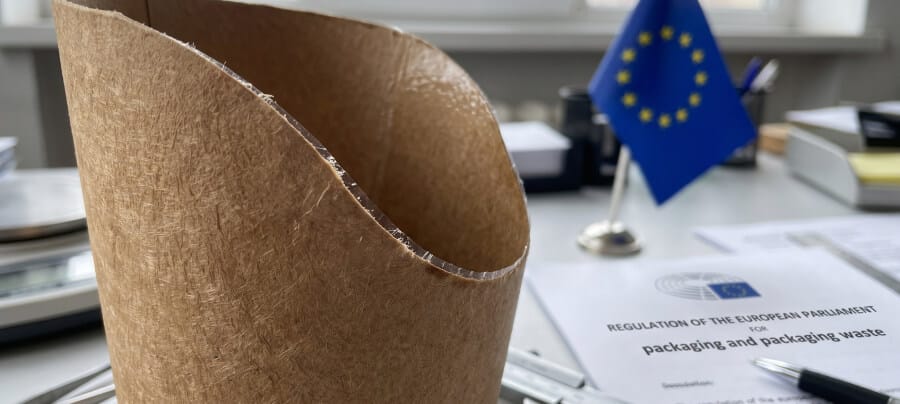
Does a Coated Kraft Paper Container Count as a Plastic-Containing Product
If the coating is a traditional PE (polyethylene) or PP (polypropylene) coating, that coating is itself a chemically modified polymer. It counts as plastic under the SUP Directive’s definition, and the container gets classified as a plastic-containing product, with the matching marking and reporting obligations that come with it.
Where buyers tend to get this wrong is with bio-based coatings like PLA that carry a “compostable” label.
Compostable and bio-based describe how a material breaks down. That’s a completely different question from whether the SUP Directive counts it as plastic, which only looks at whether the polymer has been chemically modified. PLA is itself a chemically modified polymer, so even with a compostable label, it still counts as plastic under the Directive’s definition.
What can genuinely sit outside the plastic definition is a water-based barrier coating that hasn’t gone through polymer chemical modification. Different suppliers’ water-based coating formulas vary quite a bit though, so you can’t just take the word “water-based” at face value and assume compliance. It still comes down to the supplier’s coating composition statement.
Here’s an honest caveat worth stating plainly: the SUP Directive sets EU-level rules, but actual enforcement and classification still sit with each member state’s regulator, and how strictly they check can vary from one country to another.
If you’re not sure where you stand, it’s worth consulting a regulatory advisor in your target market directly rather than deciding based on a general explanation in an article like this one.
What Documents You Actually Need to Comply
The first is the supplier’s coating composition statement, specifying which category the container’s coating falls into (PE, PP, PLA, or a water-based barrier coating). This document is the starting point for determining whether the container gets classified as plastic-containing.
Second, if the container does fall within plastic-containing scope, you’ll need packaging designed to meet marking requirements, a clear, identifiable mark on the container stating that it contains plastic and the matching disposal guidance.
This touches packaging design and print specs, not just a document you can bolt on afterward, so it needs to be confirmed with the supplier at the sampling stage.
Third is extended producer responsibility (EPR) registration. If the container is classified as plastic-containing, importers or brand owners typically need to complete EPR registration in the target market, and the registration process and fee structure vary by member state.
Beyond these three, the coating’s PFAS-free test report is also worth preparing alongside everything else. For how to verify a supplier’s document once you have it, How to Request and Verify FDA and EU Food Safety Certification Documents From Kraft Paper Container Suppliers covers the verification logic, and it applies here the same way.
The 2 Most Common Mistakes
The first mistake is assuming “it’s paper” automatically exempts a product from SUP rules. This mistake comes from treating the material’s surface impression as the regulatory standard, overlooking that the coating is the actual deciding factor, already covered above and not worth repeating here, but it’s genuinely the trap buyers fall into most often.
The second mistake is confusing the SUP Directive with the PPWR (Packaging and Packaging Waste Regulation), treating them as the same set of rules.
The SUP Directive governs the ban on specific single-use plastic products and the marking and reporting obligations for plastic-containing products. The PPWR governs recyclability, waste reduction, and circular design requirements for packaging overall, regardless of material.
The scope and requirements of the two don’t overlap, and a kraft paper container buyer who’s only prepared the documents PPWR requires hasn’t also covered SUP’s marking and EPR obligations.
This same compliance logic applies just as well to other materials. If you’re also weighing European compliance for plant fiber containers, or need a reference for state-level plastic restrictions in the US, we’ll be putting together pieces on those to round out the picture.
Getting a kraft paper container compliant with the EU’s SUP Directive doesn’t come down to the material name. It comes down to the coating’s chemical makeup and the documentation that follows from it. Confirming the coating type first, then deciding which document path applies, is a lot safer than assuming “it’s paper, so it must be fine.”