



Most articles on plastic container FDA compliance stay at the level of explaining the regulatory background, or they’re a testing lab’s own service pitch page listing “we offer FDA certification services,” without telling buyers what to actually check once a supplier hands over a document.
This guide skips the background and goes straight to the verification SOP once you have the document in hand.
Step 1: Identify Whether DoC or FCN Applies to This Container
FDA compliance for food contact materials mainly runs through two routes. Check which one applies first, since the verification method differs for each.
A DoC (Declaration of Compliance) is the supplier’s or manufacturer’s own statement that the substances used in the material are all on FDA’s existing list of approved food contact substances, with no additional filing required.
An FCN (Food Contact Notification) is the premarket notification process a supplier must complete when the material contains a “new” substance not yet on FDA’s approved list, before that substance can be legally used.
If a supplier only hands over a self-signed DoC, but the container uses a fairly novel additive or coating formula, it’s worth asking directly: what FCN number corresponds to this formula, rather than assuming the DoC automatically covers every situation.
This same logic, identifying the right compliance route first and then checking item by item, is the same approach covered in How to Request and Verify FDA and EU Food Safety Certification Documents From Kraft Paper Container Suppliers for kraft paper containers. The only difference is that plastic containers need extra attention to component breakdown and material type.
Step 2: Check Every Component Listed in the DoC, Not Just the Finished Product
FDA’s compliance logic for food contact materials determines the regulatory status of each individual food contact substance, not the finished product as a whole.
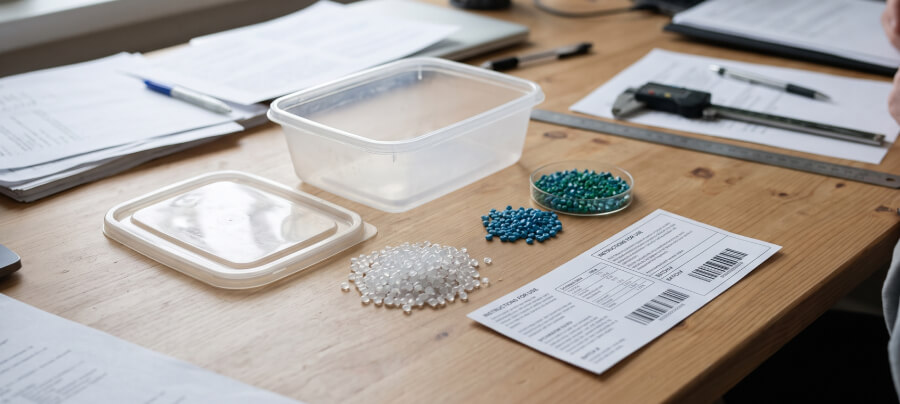
A plastic container usually isn’t a single material. It might be a resin base plus colorant, additives, and printed ink, several components, and each one in principle needs its own regulatory basis.
When you receive a DoC, check whether it lists these components separately with the specific CFR section each one corresponds to, rather than a single vague line like “this product complies with FDA food contact material regulations.”
That kind of blanket statement looks like a compliance document, but it doesn’t actually point to a specific clause or component, and if a client or customs official asks for detail, the supplier may not be able to answer either.
Step 3: A BPA-Free Claim Needs Checking Against Material Type, Not Taken at Face Value
This is the step most often misunderstood. BPA (bisphenol A) is mainly found in polycarbonate (PC). Common food-grade plastics like PP and PET don’t contain BPA by their basic chemical structure, so a supplier saying “our PP container is BPA-free” is, to some extent, just describing a property the material already has, not a claim backed by some extra BPA-free process or test.
The cases that genuinely need a test report behind them are when the container uses PC, or when a supplier claims to use a BPA substitute formula (BPS, for example), since those are the materials where BPA residue risk is actually worth verifying.
When checking a BPA-free claim, confirm the container’s resin type first, then judge whether that claim actually needs a test report behind it, rather than treating the words “BPA-free” as an automatic point in the supplier’s favor.
Step 4: Verify Authenticity With the Issuing or Testing Body
FDA’s FCN approval list is a public database (the Inventory of Effective Food Contact Substance Notifications). If a supplier provides an FCN number, you can look it up directly on the FDA’s website to confirm it’s actually on the active list.
Verifying a third-party test report follows the same logic covered elsewhere in our guides: look up the report number directly with the issuing lab’s online system to confirm the report actually exists and the details match.
This cross-check doesn’t take long, but it rules out a forged or mismatched number, which is a lot cheaper than finding out a number doesn’t exist after a client asks for proof.
The 2 Most Common Mistakes
The first mistake is confusing a DoC with an FCN, assuming one document from a supplier settles everything. The two cover different compliance situations. A DoC applies when the materials are all on the existing approved list, while an FCN is the process required before a new substance goes to market. A buyer who only gets a DoC without confirming whether any new substance is involved has missed half the check.
The second mistake is assuming that PP and PET, materials that don’t contain BPA to begin with, also need a separate “BPA-free certificate” to be considered compliant.
The FDA’s official position on BPA is that its current approved uses are considered safe under existing regulations, and there’s no separate BPA-free certification scheme required. A supplier labeling something “BPA-free” is largely marketing language, not a document category the regulation itself calls for.
If a buyer insists on a “BPA-free certificate” for a PP container, that’s likely the wrong question to ask. What’s actually worth asking is the resin type and its existing regulatory basis.
Paired with our Food-Grade Plastic Containers: A Complete Buying Guide to PP, PET, and PS in the same series, it’s faster to work out which verification path a given container should follow. If you’re also weighing state-level plastic restrictions in the US, we’ll be putting together a comparison piece on that to round out the picture.
Getting a supplier’s FDA or BPA-free document doesn’t mean verification is done the moment it lands in your inbox. Identify the applicable compliance route first, break the components apart, then decide whether further verification is needed, which is a lot safer than accepting a document just because it looks official.