



Search “PFAS-free” and most of what comes up explains what PFAS is, why countries are banning it, and what the health risks are. That information is already everywhere online, and repeating it here wouldn’t add much.
The real sticking point for buyers is the next step: once a supplier hands over a PFAS-free document, how do you actually confirm it’s genuine, rather than taking a piece of paper at face value?
We covered the request step itself in How to Request and Verify FDA and EU Food Safety Certification Documents From Kraft Paper Container Suppliers. This guide picks up from there and focuses entirely on verifying a document once you have it.
The Two Common Forms a PFAS-Free Statement Comes In
A Third-Party Test Report and a Supplier’s Own Written Statement Are Not the Same Tier of Document
A third-party test report comes from an independent lab. It lists the test method used, the specific PFAS compounds tested, and the detected result for each one, usually measured in ppb (parts per billion).
A supplier’s own written statement is just a paragraph the supplier wrote themselves, and it may or may not be backed by actual test data.
The gap between the two isn’t just format, it’s how much weight the document carries. If a client or customs official later asks for proof, a test report with a traceable lab reference number holds up very differently than a line that just says “we don’t use PFAS.”
Test Methods and Substance Lists Vary From One Report to the Next
PFAS is a catch-all term for thousands of compounds. No report tests for all of them, and none needs to. Labs typically test a set of representative indicator compounds, commonly ones like PFOA and PFOS.
US labs mostly run LC-MS/MS (liquid chromatography-mass spectrometry) under methods like EPA 537.1. The EU works against the individual-substance and total-substance thresholds set out in the PPWR.
What matters here is that the substance list varies by report. Some test a dozen or so representative compounds, others test over a hundred, and that range directly affects whether a report can really back up a claim of “PFAS-free.”
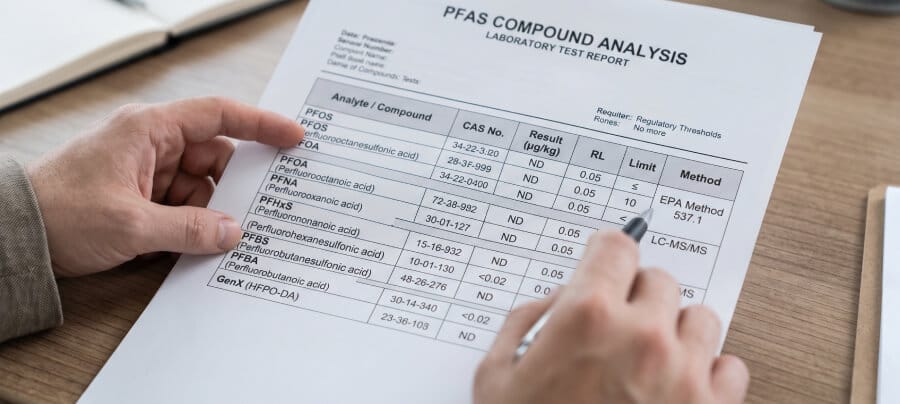
What to Check Once You Have the Report
The first thing to check is the scope of the tested substance list.
If a report only tests two or three of the most common compounds, PFOA and PFOS for instance, and the supplier claims “completely PFAS-free” off the back of that, the claim doesn’t hold up. The PFAS family includes hundreds of other long-chain and short-chain compounds that test simply didn’t cover.
The second thing to check is the test matrix, and this is the detail most often missed.
The real PFAS risk on a kraft paper container usually isn’t the paper itself, it’s the coating. Traditional grease- and water-resistant coatings are exactly where PFAS has historically been added.
If the tested sample was just raw paper with no coating included, the part of the product that actually carries the risk never got tested.
If you’re also weighing plant fiber containers against kraft paper for a given order, the coating-risk logic applies the same way across both, and our other piece, Plant Fiber Containers vs Kraft Paper Containers: Which One Fits Your Procurement Needs?, covers that comparison in more depth.
Third, check the batch number and date.
A test report corresponds to a specific batch of material or product. If the supplier has since switched coating formulas or pulp sources, the old report technically no longer applies. Before placing an order, it’s worth asking directly whether the report on file actually matches the batch you’re about to buy.
From a compliance-risk angle, missing any one of these three checks leaves you without real proof if a client or auditor pushes back later.
From a procurement-efficiency angle, turning these three checks into a routine habit is faster than re-studying a report’s format from scratch every time, and far faster than fixing the problem after it’s already surfaced downstream.
How to Verify Directly With the Testing Lab
Most major testing bodies, SGS and TÜV Rheinland among them, run an online lookup system where you can enter a report number and check whether it’s actually registered.
If the lookup comes back empty, or the registered details (test date, product name) don’t match what the supplier gave you, that’s worth raising directly with the supplier rather than assuming it’s a system glitch.
This cross-check usually takes under ten minutes, and it rules out a forged report, a report reused for a different product, or an expired report still being passed off as current. Ten minutes upfront is a lot cheaper than finding out there’s a problem after a client already has.
The 2 Most Common Verification Mistakes
The first mistake is a supplier reusing an old report for a new batch or a different spec.
This tends to happen in existing supplier relationships, where buyers assume that because a supplier was verified once, the document stays valid indefinitely.
But once the raw material source or coating formula changes, the old report no longer represents the current product. Checking the batch number and date is the most direct way to catch this.
The second mistake is a supplier testing only a handful of representative compounds and then claiming “completely PFAS-free” based on that narrow result.
That phrasing shows up a lot in marketing copy, but it doesn’t hold up under scrutiny. It’s worth paying extra attention when only the paper itself was tested and the coating wasn’t included in scope, since the coating is still the likelier source of risk even when the paper comes back clean.
That detail gets easy to miss once a report shows the word “PFAS-free” and the reader stops reading closely.
Document verification is only one piece of quality control. Kraft paper containers also come with their own common physical defects, leaking and warping among them, and our piece on that, 5 Common Kraft Container Defects When Buying: How to Avoid and Handle Leaking, Warping, is worth a look too.
A PFAS-free claim isn’t something to take at face value just because a supplier wrote it down. What was actually tested, whether the right part of the product was tested, and whether it matches the batch you’re buying, checking those three things is what verification actually means.
For the specifics on what to ask when requesting the document in the first place, the piece linked earlier covers that step, and the two together make up the full process.