


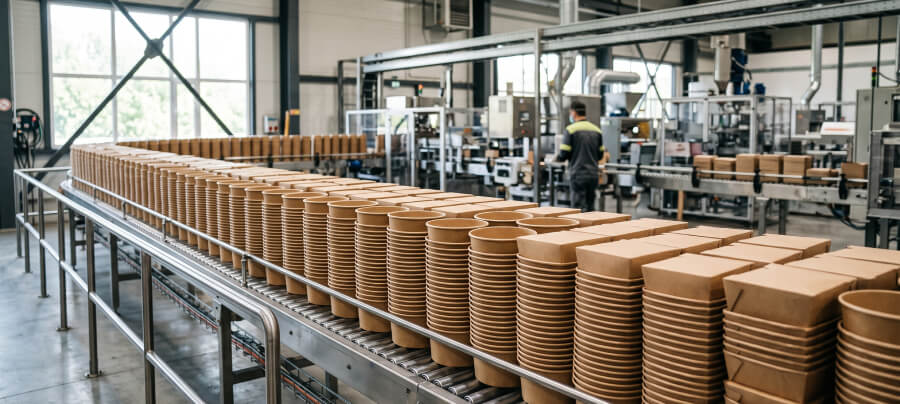
A product catalog tells you what a kraft container manufacturer makes. It doesn’t tell you whether they can back it up with real certifications, real capacity, and a lead time you can actually plan around, and those gaps are usually where a wholesale order runs into trouble after the fact rather than before.
Before committing to a supplier for a wholesale order, these are the five things worth checking, including how kraft paper bowls fit into the picture, and where EasyPack stands on each.
1. Certifications That Actually Matter
FDA food-contact clearance and FSC chain-of-custody certification are the two documents worth asking for by name, not just a general claim of “food safe” or “eco-friendly” on a product page.
FDA clearance confirms the material is safe for direct food contact, and FSC certification confirms the paper pulp traces back to responsibly managed forests, with a documented chain of custody from the forest through to the finished container, a requirement more importers are being asked to prove further down their own supply chain by retailers and regulators alike. For buyers shipping into the EU, LFGB compliance is worth confirming as well, since it covers additional migration testing that FDA clearance alone doesn’t address.
Ask any manufacturer to send the actual certificate with the certifying body’s name and a valid registration number, not a logo pasted on their website, and check that the certificate is issued to the entity you’re actually ordering from rather than a parent company or an affiliated factory.
2. Production Capacity and MOQ
A manufacturer’s stated capacity matters most when an order needs to repeat reliably every month, not just once. Ask what the minimum order quantity is for standard sizes versus custom specs, and how that MOQ changes once custom printing is involved, since printing setup usually raises the minimum order needed to make a production run worthwhile.
A manufacturer whose MOQ jumps sharply for custom work, without a clear explanation of why, is often subcontracting that part of the order to a separate print shop rather than running it on their own line, which adds a layer buyers can’t directly verify.
It’s also worth asking how a manufacturer handles a reorder that falls between their regular production cycles, since a supplier with genuine in-house capacity can usually slot in a smaller repeat order faster than one juggling multiple subcontractors.
What About Kraft Paper Bowls Specifically?
Buyers searching for a kraft container manufacturer are often sourcing a specific product line rather than containers in general, and kraft paper bowls are one of the most commonly requested.
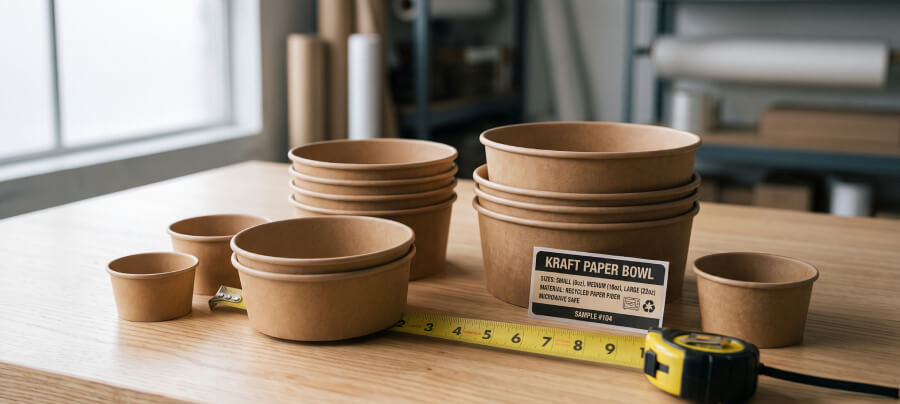
A round kraft bowl needs its own set of checks beyond the general certification and capacity criteria above: seam strength at the base, since a bowl shape puts more stress on the seam than a flat-bottomed box does, consistent wall thickness for stacking without crushing, and a lid fit that holds up during transit rather than popping open in a delivery bag.
EasyPack’s kraft paper bowl line covers a full size range for salads, soups, and grain bowls, manufactured on the same certified production line as the company’s other kraft containers, so the certification and capacity points above apply to the bowl line as well. For the full size and spec range, see the kraft paper bowls wholesale line.
3. Lead Time You Can Plan Around
Lead time on a kraft container order typically breaks down into three stages: sample approval, production, and shipping, and a manufacturer who only quotes one combined number is usually leaving out at least one of those stages.
Sample approval alone can take anywhere from a few days for a standard spec to two weeks or more for a custom shape or print, and that clock doesn’t start until the buyer signs off, so delays on the buyer’s side extend the total timeline just as much as delays on the factory floor.
Standard-spec orders typically ship faster than custom-printed runs, since custom printing adds plate-making time before production even starts, and buyers who need a fast turnaround are often better served sticking with an in-stock spec rather than a fully custom one for a first order. Ask for a written lead time estimate broken out by stage, not just a single figure quoted verbally, so there’s something concrete to hold the manufacturer to if a shipment starts slipping.
4. Custom Printing and Brand Consistency
Most wholesale buyers eventually move from stock kraft containers to custom-printed ones, and this is where a manufacturer’s actual printing capability starts to matter more than their price sheet. Ask what printing method the manufacturer uses in-house, flexographic printing is standard for kraft paper and holds color well across large runs, and ask to see a color match sample before committing to a full production run rather than approving color based on a digital proof alone, since screen colors and printed colors on kraft stock don’t always match.
It’s also worth asking whether the plate fee is a one-time charge or gets billed again on reorders, and whether the same plates get reused for repeat orders or need to be remade each time. A manufacturer that keeps client plates on file for future reorders saves buyers both money and lead time on every order after the first, a detail that rarely shows up on a quote sheet unless a buyer asks about it directly.
5. A Quick Checklist Before You Commit
Before placing a wholesale order with a new kraft container manufacturer, confirm the following:
- Certification documents received directly from the manufacturer, with a registration number you can look up, not just referenced on their website
- MOQ and pricing confirmed in writing for both standard and custom-printed specs, including how MOQ changes with custom printing
- Lead time broken out by sample approval, production, and shipping stages, rather than a single combined estimate
- A physical sample approved and kept on hand to check against the production batch when it arrives
- Payment terms and deposit percentage agreed before the order is placed, including what happens if a shipment is delayed
Working through this checklist before committing takes a day or two, and it’s a lot less costly than discovering a gap in certification or a missed lead time after the order is already placed and a deposit is already down. A supplier that answers every item on this list without hesitation, and backs it up with documents rather than reassurances, is usually the one worth building a long-term relationship with, since the same responsiveness at the quoting stage tends to carry over into how they handle a problem once an order is already in production.
EasyPack works through each of these points directly with buyers during the quoting stage, so there are no surprises once an order is confirmed. Request a quote to get started, or reach out with your kraft container or paper bowl specs for a same-week response.