



Buying kraft paper containers for the first time, the process itself usually isn’t what trips people up, that part is searchable online. What actually trips people up is judgment: whether the MOQ a supplier quotes is reasonable, whether a price that runs higher than other quotes means you’re being taken for a ride, whether the production batch will match the sample, questions with no track record to judge them against, so you end up guessing.
This guide covers the decision points that trip up first-time kraft container buyers, what a spec sheet needs to include, where the real room to negotiate MOQ actually is, and what to watch for during sampling. The goal is building the judgment a first-timer is missing, not repeating a standard procurement checklist or handing over one more box to tick.
Where Do First-Time Kraft Container Buyers Get Stuck Most Often?
The biggest risk on a first purchase isn’t taking a wrong step in the process, it’s not knowing what you don’t know, unable to tell which line items on a quote sheet are standard and which ones deserve a follow-up question, so a mismatch only surfaces once the order has already arrived, or a buyer realizes after the fact they paid above market rate.
Why Is “Not Knowing What You Don’t Know” the Biggest Risk on a First Order?
An experienced buyer looking at a kraft container quote sheet notices right away whether a heat range is specified, whether the print color count is folded into the unit price, whether the sample fee is refundable, details a first-time buyer has no way of knowing to flag.
Suppliers aren’t going to volunteer every detail either, the vaguer a quote stays, the more room it leaves for negotiation. The fix isn’t memorizing a checklist, it’s understanding the cost logic behind each spec line, so a quote sheet actually makes sense once it’s in front of you.
Take unit price as an example. A first-time buyer sees one number and assumes that number is the whole story, but the same unit price can hide very different terms underneath, deposit percentage, whether the plate fee is bundled in or billed separately, whether freight is included.
Two quotes with an identical unit price can end up with a meaningfully different total cost once those terms are factored in, and a first-time buyer without a reference point has no way to catch that just by scanning the number at the top of the sheet.
Should You Get Quotes From Several Suppliers at Once?
Getting quotes from at least three suppliers is worth doing, but the point isn’t picking whichever quotes the lowest unit price, it’s laying all three spec sheets, MOQs, and lead times side by side and seeing where they actually differ.
If one quote comes in noticeably lower than the other two, it’s worth asking directly whether the spec itself is different, a lower paper weight or a simpler printing method, since a price gap rarely appears out of nowhere.
Payment terms are another detail first-time buyers tend to overlook, the deposit percentage, when the balance is due, whether full payment is required before shipment, these vary a lot between suppliers, and comparing quotes on unit price alone easily misses that payment terms are part of the real total cost too.
Spec Confirmation: Settle These Before Negotiating MOQ
Rushing into MOQ and pricing negotiations before the spec is nailed down usually means the gap surfaces at the sampling stage instead, by which point sample time and cost are already spent, and adjusting the spec means starting the whole process over.
What Does a Kraft Container Spec Sheet Need to Cover at Minimum?
Paper weight (commonly 250 to 350 gsm depending on the container’s use), capacity and dimensions, whether a grease or moisture-resistant coating is needed, print color count and print area, and estimated monthly volume, these are the baseline for a kraft container spec sheet.
Paper weight in particular gets overlooked easily, two kraft food boxes can look identical but hold up completely differently depending on weight, which directly affects both load capacity and cost, and without a weight specified in the inquiry, a supplier is likely to quote whatever weight they have the most stock of, which may not match the actual load the container needs to handle.
Use case matters just as much as the numbers on the spec sheet. A container meant for a hot, sauce-heavy entree needs a different coating and wall structure than one meant for cold salads or dry bakery items, and a first-time buyer who just says “food container” without describing what actually goes inside it leaves the supplier guessing, which usually means the sample comes back wrong on the first attempt and the whole cycle has to run again.
Where Does the Gap Between Sample Cost and the Final Quote Come From?
Sample fees are usually a one-time charge, landing anywhere from a few hundred to over a thousand New Taiwan dollars, and if the order moves into production afterward, some suppliers credit that fee against the bulk order, worth asking about upfront.
It’s also worth checking whether the printing plate used for the sample is the same one used in production, if the sample runs on a separate proofing plate and production uses a different one, color can come out slightly different, a detail worth confirming with the supplier before assuming the sample color is final.
MOQ Negotiation: Where Is There Actually Room to Move on Kraft Containers?
MOQ isn’t a fixed number that can never move, but understanding why a supplier quoted that number in the first place is the starting point for knowing where the real room to negotiate actually is.
Which Parts of a Supplier’s MOQ Are Actually Negotiable?
A kraft container’s MOQ is mostly driven by two cost structures: the minimum production batch for cutting the paper stock, and the fixed cost of setting up a custom print plate.
For an in-stock spec with no custom printing, MOQ tends to have more flexibility, since the supplier isn’t setting up anything new, just pulling a batch from an existing production run. Insisting on custom printing usually means the MOQ won’t come down to in-stock levels no matter how hard you push, worth accepting that going in, and putting negotiating energy into how the plate fee is structured instead of trying to force an unreasonable MOQ number.
A first-time buyer pushing hard on MOQ without understanding this distinction often ends up negotiating against the wrong line item, spending the whole conversation trying to shave a few hundred units off a custom order when the bigger win was available on payment terms or plate fee amortization instead. Knowing which cost is actually fixed and which one has give changes where the negotiating energy goes.
What Leverage Actually Brings MOQ Down?
If a supplier already has a paper weight or size close to your spec in stock, choosing that spec instead of a fully custom one brings MOQ down noticeably, since no extra material needs to be sourced.
It’s also worth asking whether the supplier has slower-season capacity, ordering outside peak season sometimes gets a lower MOQ or better pricing, since the supplier is trying to fill a gap in their own production schedule too.
Bundling a custom print run with a larger standard-spec order is another angle worth raising, since a supplier weighing whether a custom setup is worth the plate cost is more willing to accommodate a lower MOQ on the custom portion if it’s attached to a bigger overall order rather than standing alone.
Committing to repeat orders rather than a one-time purchase is another common bargaining chip, some suppliers will offer a lower MOQ on a first order in exchange for the likelihood of a long-term relationship, but a verbal commitment like that is worth putting in writing rather than leaving as an assumption on either side.
For a first-time partnership where judging negotiating room is hard to do with no track record, see Evaluating Kraft Paper Container Suppliers: 6 Key Indicators, which covers how to confirm a supplier is worth a long-term relationship before deciding how much ground to give on MOQ.
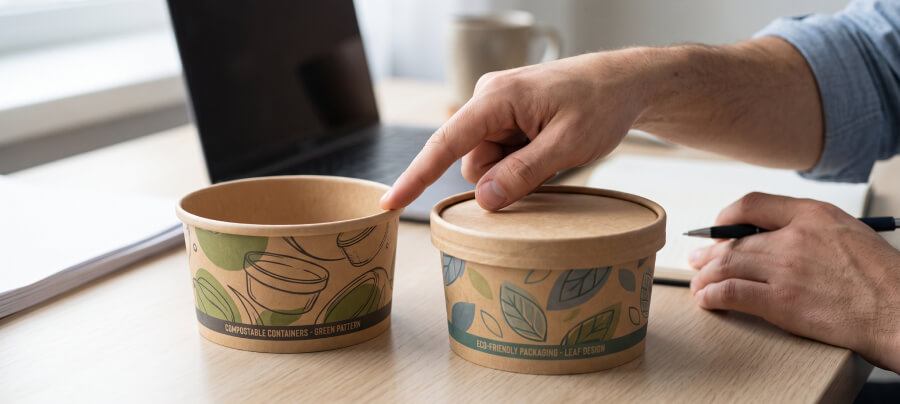
Sampling: What to Watch For on a First Sample Run
Sampling is the step most likely to get rushed on a first order, and it’s also the most important one, since the quality of the approved sample sets the baseline for the entire production run.
How Long Should Sampling Reasonably Take?
An in-stock kraft container spec typically samples in 3 to 5 days, a custom-printed one usually takes 1 to 2 weeks once plate-making time is factored in.
If a supplier promises a sample turnaround well under that range on a first order, it’s worth asking directly how the process is actually being handled, so sample quality isn’t quietly cut to hit a faster number.
It’s also worth asking what happens if the first sample doesn’t pass, whether a second round of sampling adds another full cycle to the timeline or whether adjustments get folded into the same round. A supplier who can’t answer that question clearly on a first order is one worth watching closely once production actually starts.
Will the Production Batch Match the Sample, or Will Quality Slip?
This is a common worry on a first order, and the practical fix is keeping the approved sample on hand, then comparing it directly against the production batch on arrival for material thickness, print color, and seal quality, rather than relying on memory.
If a gap turns up between the sample and the production batch, flagging it with the supplier immediately is a lot easier to resolve than discovering it after the stock has already been used.
For the full procurement process from inquiry through delivery, see B2B Food Container Procurement SOP: 8 Steps from RFQ to Delivery, which walks through what happens at each stage after the inquiry.
What a first kraft container purchase actually needs isn’t a standard process checklist, it’s a baseline for judging whether a quote is reasonable and whether there’s real room to negotiate MOQ. Nailing down the spec sheet upfront, getting quotes from a few suppliers, and keeping a sample on hand to compare against production, building these habits means the second purchase won’t start from zero again, and each of those habits gets easier to apply the next time around, since a first purchase leaves behind a reference point that didn’t exist before.
For a distributor role, there’s also the question of evaluating an OEM factory’s potential as a long-term partner, production scale, exclusivity clauses, a topic a future guide will cover in more detail.