


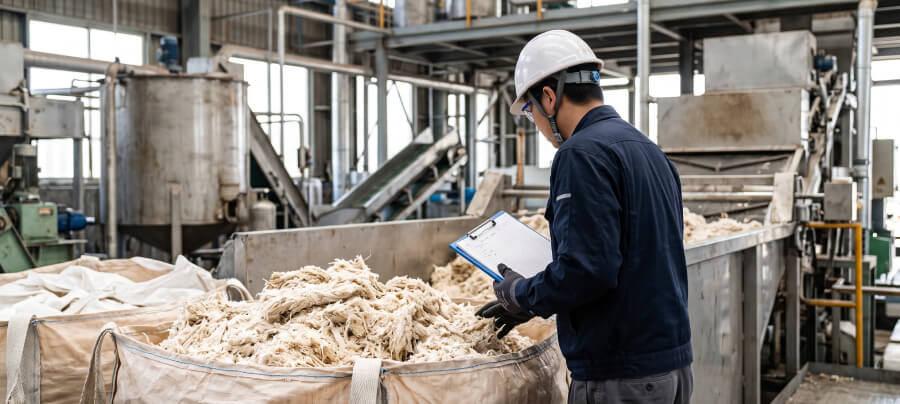
A phone call or an email with a handful of standard questions isn’t enough to gauge a plant fiber container factory’s real manufacturing capability.
Plant fiber materials, bagasse, rice husk, bamboo fiber, are agricultural byproducts, and the batch-to-batch variation in raw material quality runs far higher than with kraft paper or plastic. That’s exactly why a plant fiber container factory audit needs a different checklist than a remote supplier evaluation.
For a general framework on the questions to ask any supplier, see How Should You Evaluate Food Container Suppliers? 8 Cross-Material Questions to Ask, which is a framework that works entirely by phone or email.
This guide focuses on what to check specifically during the on-site audit: raw material consistency, quality and food safety checks, and certification verification, turned into a checklist specific to plant fiber containers.
Auditing a Plant Fiber Factory Is Different From Auditing a Kraft Paper or Plastic Factory
The nature of plant fiber raw material is what sets the audit priorities apart from other materials, and it’s worth understanding this before planning the checklist itself.
Raw Material Consistency Is the Core of a Plant Fiber Audit
Bagasse and rice husk are agricultural byproducts, so harvest season, region of origin, and storage conditions all affect fiber quality.
The gap in raw material quality between batches at the same factory can run far wider than with plastic pellets or kraft base paper.
Worth asking directly whether the factory’s raw material sourcing is stable (a fixed relationship with a sugar mill or rice mill, versus switching suppliers by season), and whether the factory runs incoming material inspections to screen out unstable batches, rather than feeding raw material straight into production the moment it arrives.
Worth also asking how the factory handles a seasonal supply gap, since sugarcane and rice harvests aren’t year-round. A factory that stockpiles enough processed pulp to bridge the off-season, or that has a backup supplier lined up, tends to hold quality more consistently than one that scrambles for whatever raw material is available once its usual source runs dry.
Under Taiwan’s Sanitation Standards for Food Utensils, Containers, and Packaging, plant fiber containers made primarily from agricultural materials like sugarcane, rice husk, or bamboo can’t use recycled material, they’re restricted to virgin raw material, and can’t contain harmful substances.
Worth asking directly during the audit whether the material is virgin stock and whether there’s any chance of recycled material mixing in, this isn’t just a quality question, it’s a regulatory compliance checkpoint too.
What Raw Material Pre-Processing Equipment to Check On-Site
Before molding, plant fiber raw material typically goes through washing, crushing, and fiber extraction stations, and how well-maintained that equipment is directly affects the fiber uniformity in the finished product.
Worth noticing during the audit whether pre-processing equipment shows visible buildup of leftover material and how often it gets cleaned, aging or poorly cleaned equipment makes it easier for different batches to cross-contaminate, which then shows up as inconsistency in the finished product.
Water usage and wastewater handling at the washing station are worth a look too. Plant fiber processing uses a fair amount of water to clean and separate the fiber, and a factory with a proper wastewater treatment setup, rather than water just draining off untreated, tends to reflect a more serious overall approach to production standards, not just an environmental compliance checkbox.
Quality and Food Safety Checkpoints
Plant fiber containers are a food-contact material, so quality checks can’t stop at appearance, they need to confirm food safety testing and labeling actually hold up.
Can the Factory Provide a PFAS-Free Test Report On the Spot
Some plant fiber container factories add a fluorinated coating to the raw material or surface to boost grease and water resistance, and if that coating contains PFAS (per- and polyfluoroalkyl substances), it directly affects whether the product can meet PFAS-free regulations in US and EU markets.
Worth requesting a third-party lab’s PFAS test report directly during the audit, and checking the report date against the actual product batch, rather than accepting a verbal assurance that “our product is PFAS-free.”
It’s worth asking what alternative the factory uses in place of a fluorinated coating too, since grease resistance still has to come from somewhere.
A factory that can name a specific alternative, a bio-based coating or a denser fiber structure, for example, and explain how it holds up under oily food, is giving a more credible answer than one that just repeats “PFAS-free” without describing what’s actually doing the work.
Is There Test Data Behind Heat and Freezer Resistance Claims
Common heat-resistance and freezer-safe claims on plant fiber containers need actual test data behind them, how long the container holds up at a given temperature without warping or leaking, for instance.
Worth requesting the raw test reports or testing conditions from the factory rather than taking the claim printed on the packaging at face value, so the claimed temperature range doesn’t turn out to be broader than what was actually tested.
Testing conditions matter as much as the number itself. A heat-resistance claim tested with a dry food sample doesn’t necessarily hold for a high-moisture or high-oil dish, so worth asking whether the test used a condition close to the actual intended use, rather than a generic lab setup that doesn’t reflect how the container will actually be filled.

QC Checkpoint Placement and Retained Sample Practices
If QC only happens right before shipping, tracing a problem back to a specific production batch becomes difficult.
A more stable setup has the factory running spot checks at key stations, molding, drying, and packaging, and retaining a sample from every production batch, so if a complaint comes in later, the retained sample can be compared directly against the defective piece. Worth asking directly how long the factory keeps retained samples and how batch numbers are tracked.
The drying stage deserves particular attention for plant fiber containers, since incomplete drying is one of the more common sources of downstream problems, mold growth during storage or warping after the container reaches a customer, for instance.
Worth asking what moisture content the factory targets after drying and whether that gets checked on a sample basis, or only assumed based on how long the drying cycle runs.
How to Verify Certification Documents On-Site
Scanned copies of certifications are easy to obtain, but checking the original documents and their details on-site is what actually confirms these certifications apply to the factory being audited.
What to Check on a Compostability Certificate
If a product claims compostability, the certificate usually references a standard code (ASTM D6400 or EN 13432, for instance).
Worth checking whether the factory address and product line on the certificate match the actual facility and the product being sourced, rather than a certificate borrowed from a different entity within the same corporate group. Also worth checking the certificate’s expiration date, so an expired certificate doesn’t slip through still in use.
It’s also worth asking whether the certificate covers the exact product configuration being sourced, or just a similar item in the same product family.
A compostability certificate tested on a plain container doesn’t automatically extend to a version with printed ink or a coated lining added on top, since either of those can change how the material breaks down.
Factory Registration and Food Business Registration Number
Basic documents like factory registration and a food business registration number are worth requesting on the spot during the audit, checking whether the address matches the facility actually being audited rather than only reviewing a scanned copy.
For evaluating a kraft paper supplier, the financials, contract terms, and complaint handling side of a supplier evaluation is covered in Evaluating Kraft Paper Container Suppliers: 6 Key Indicators, that framework applies to plant fiber suppliers just as well.
What to Prepare Before and After the Audit
What an audit turns up on the day depends heavily on how thorough the preparation was beforehand, and the follow-up documentation afterward matters just as much.
A common approach to supplier audits in the industry breaks it into three stages, desk review, on-site assessment, and post-audit follow-up. The on-site visit is just the middle stage, and the stages before and after it shouldn’t get skipped either.
What to Request Before the Audit
Before scheduling an audit, worth requesting a list of raw material suppliers, recent third-party test reports, and a copy of the compostability certificate from the factory ahead of time, then checking those documents against what’s actually observed on-site.
Bringing a written list of what to confirm also helps avoid getting steered by the sales rep and missing something originally planned to check.
Worth deciding ahead of time who from the buyer’s side needs to be on the audit too. A quality or food safety specialist reading a PFAS test report will catch details a general procurement staffer might miss, so for a first-time supplier relationship, it’s worth bringing that expertise along rather than relying on a single generalist to evaluate everything at once.
How to Organize Audit Notes for Comparing Across Materials
Right after the audit, worth writing up the key observations the same day, raw material sourcing stability, PFAS test report dates, certificate expiration dates, sample retention practices, rather than relying on memory later.
When comparing plant fiber, kraft paper, and plastic suppliers side by side, a consistent note format makes cross-material comparison easier, instead of trying to recall what each factory audit turned up from memory every time.
Photos of the actual certificates and test reports, taken with the factory’s permission, are worth keeping alongside the written notes too. A photo of the compostability certificate’s expiration date is a far more useful reference weeks later than a note that just says “certificate looked fine,” especially once several factory audits start to blur together.
The audit priorities for plant fiber containers ultimately come down to raw material variability. From sourcing and pre-processing equipment to food safety testing and certification documents, every checkpoint is really about confirming whether the factory’s process controls can absorb the quality swings that come with an agricultural byproduct.
Bringing this checklist along and going through it item by item beats scoring a factory on memory after the fact. For buyers evaluating bulk sourcing and stable supply for bagasse containers, more on that is coming in a future guide.