


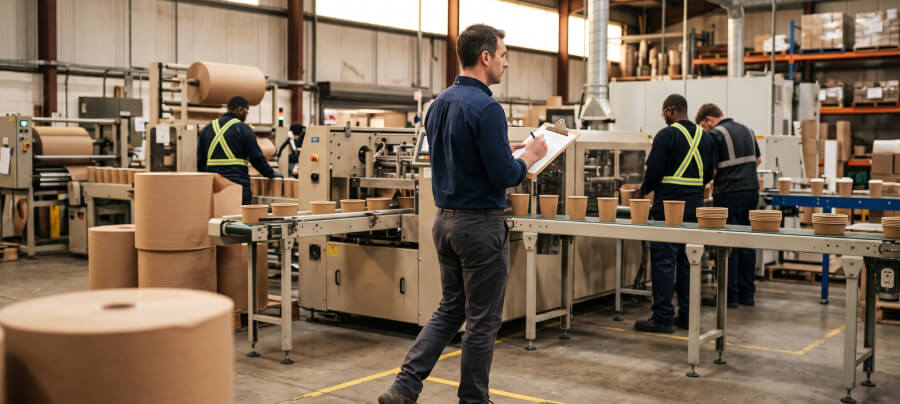
A buyer schedules a factory visit for kraft containers, gets walked through the line by a sales rep, listens to a rundown of the equipment, and that’s it.
Beyond a vague sense that things “looked fine,” there’s nothing concrete to point to afterward. A walkthrough like that doesn’t actually verify a supplier’s real manufacturing capability.
For a full framework on evaluating a supplier’s overall standing (financials, contract terms, complaint handling), see Evaluating Kraft Paper Container Suppliers: 6 Key Indicators.
This guide focuses on what to look at specifically during the visit itself: production equipment, the manufacturing process, and QC and food hygiene, turned into a concrete checklist so a factory tour stops being a formality.
How to Read Production Line Equipment for Real Capacity
Whether the equipment matches actual order needs is the most basic checkpoint on a visit, and also the one most often skipped.
Does the Equipment Model and Capacity Match the Quote
The capacity numbers on a quote should match what’s actually on the floor, the equipment count and model.
If a supplier’s quote mentions three production lines but only one is running on the visit, with the other two buried under clutter or clearly idle for a long stretch, that capacity number on the quote is likely theoretical rather than what the supplier can actually deliver. Worth asking directly for each machine’s daily output and watching its actual running speed, then checking that against what the supplier says verbally.
Staffing per shift is worth asking about too. A machine running at full spec doesn’t mean much if there aren’t enough trained operators to keep it running consistently across shifts, and a supplier that’s vague about headcount per shift is often stretching the same crew across more equipment than they can properly manage.
Is Raw Material Storage Zoned Properly
Raw material storage without proper zoning, different batches and materials stored together, raises the risk of cross-contamination or mix-ups.
This matters more for kraft containers than it might seem, since the coating materials commonly used are chemicals that shouldn’t share space with unrelated raw materials.
Worth walking into the storage area directly during the visit to check whether labeling is clear and whether batches follow a first-in-first-out system, rather than only looking at storage photos the supplier provides back in the office.
Pest control signage and traps in the storage area are another quick tell, a facility that takes contamination risk seriously usually has a visible pest control schedule posted, not just a service contract mentioned in passing.
What to Watch for in the Production Process
Each station in the production process is a concrete data point on how stable a supplier’s process actually is, and it carries a lot more weight than a verbal description from sales.
How to Check Each Station: Coating, Printing, Molding
Kraft container production typically runs through cutting, molding, coating, and printing stations.
Worth spending extra time at each one during the visit, watching whether the operation looks consistent or whether every worker does it a little differently. If the same station shows a big gap in method between shifts, that station’s process likely isn’t standardized yet, which can affect quality consistency once production scales up.
How material moves between stations is worth watching too. Half-finished containers sitting exposed on open carts between the coating and printing stations, for instance, pick up more dust and handling damage than material that’s covered or moved through in enclosed trays, a small detail that adds up across a full production run.
Is a Standard Operating Procedure Posted on the Line
A stable factory usually posts a standard operating procedure (SOP) at the relevant station, with workers following it rather than relying on individual habit.
Worth checking whether these SOPs are actually posted on the wall and whether the content matches what’s happening on the floor. If the SOP says one thing and workers are doing another, that document is likely there for audits rather than actually guiding daily production.
Worth asking, too, how a new worker gets trained on a given station. A factory that can describe a specific onboarding process, shadowing an experienced operator for a set period before working solo, for example, tends to hold process consistency better than one where new hires are handed the SOP sheet and left to figure it out.
Quality Control and Food Hygiene Checkpoints
Where QC checkpoints sit and how hygiene is managed on the floor directly reflects whether a supplier’s quality standards come from a real system or from a last-minute spot check before shipping.
Is the QC Station Placed at the End of the Line
If QC only spot-checks a handful of pieces right before shipping, there’s no chance to catch a mid-process problem before it turns into a full batch of defects by the time an inspection finally happens.
A sturdier setup places QC checkpoints at key stations throughout the line, right after coating and after printing, for instance, rather than saving all the verification for the last step. Worth asking directly where the QC checkpoints are located and watching what the QC staff are actually checking for.
It’s also worth asking what happens to a batch once a defect turns up mid-process. A supplier with a real QC system can usually describe a specific hold-and-review procedure, pulling the affected batch, tracing it back to a cause, and documenting the fix. A vague answer here, something like “we just watch closely,” is a sign the checkpoint exists on paper more than in daily practice.
On-Site Hygiene Management and Sanitation Records
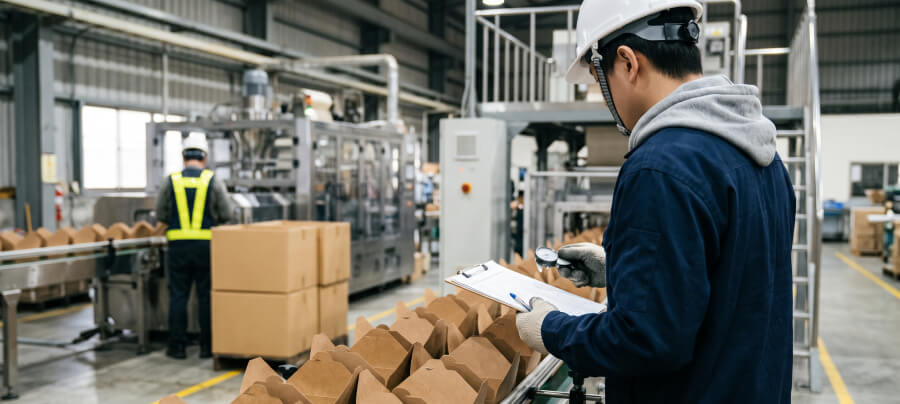
Kraft containers are a food-contact material, so on-site hygiene management is one of the checkpoints worth covering too, including whether staff wear masks and gloves, whether equipment and work surfaces are sanitized on a regular schedule, and whether sanitation records are available to review.
If a supplier can’t produce those records, or the hygiene on the floor doesn’t match what’s shown in the display area, that gap usually says more about actual hygiene standards than a paper certification does.
Worth also noticing where finished containers get stored before shipping. A finished-goods area that’s enclosed and off the main floor traffic path holds up better than one sitting open next to raw material handling or foot traffic, where dust and contamination risk are higher even after the product has already passed QC.
Can the Factory Show Registration and Certificates On the Spot
Basic documents like factory registration and a food business registration number are worth requesting on the spot during the visit, rather than only reviewing scanned copies a supplier sends over.
If a supplier hesitates or can’t produce them, or the address on the documents doesn’t match the facility being visited, that’s worth pressing further on. This matters more than it might seem for containers heading into markets with stricter food-contact documentation requirements, where a mismatch discovered later can hold up a shipment at customs rather than just being an inconvenience during the visit.
What to Prepare Before and After the Visit
A visit’s value isn’t limited to the hours spent on-site, preparation beforehand and follow-up afterward matter just as much for whether the trip actually informs a decision.
What to Request Before the Visit
Before scheduling a visit, worth requesting a factory floor plan and a rundown of the line layout from the supplier ahead of time, then comparing it against the actual flow on-site.
Bringing a written list of what to observe also helps avoid getting steered by the sales rep and missing something originally planned to check.
Worth deciding ahead of time, too, whether the visit will be announced or unannounced. A scheduled visit gives a supplier time to tidy up and prep a best-case run, which still has value for confirming equipment and layout, but an unannounced or lightly-scheduled visit (arriving a bit earlier than planned, for instance) tends to show a more accurate day-to-day picture of how the floor actually runs.
How to Read a Supplier That Declines an In-Person Visit
If a supplier declines an in-person visit, or only offers an edited promotional video instead of arranging an actual walkthrough, that itself is a warning sign worth pressing on before placing an order: ask directly whether a walkthrough of the line can be arranged.
For larger orders or a planned long-term relationship, worth also asking the supplier for a third-party audit report as an alternative check when an in-person visit isn’t possible.
A vague reason for declining, “the facility is under renovation” or “our schedule doesn’t allow visitors right now,” is worth following up on with a specific alternative date rather than dropping the request. A supplier that keeps deflecting a rescheduled request, as opposed to one that’s genuinely tied up with a legitimate reason, is usually the one with something to hide.
How to Organize Notes After the Visit for Comparison
Right after the visit, worth writing up the key observations the same day, equipment models, capacity comparison results, QC station locations, hygiene conditions, rather than relying on memory later.
When comparing multiple factories, a consistent note format makes the comparison more objective, instead of deciding based on a vague sense of which one “felt” more professional.
A few photos taken during the visit, with the supplier’s permission, are worth keeping alongside the written notes too. A photo of the actual QC station or the SOP posted on the wall is a much more useful reference two weeks later than a mental impression, especially when the decision comes down to comparing two or three factories that all made a reasonable first impression in person.
A factory visit turns up far more than a supplier’s pitch or paperwork ever will: whether the equipment matches the quote, whether the process is standardized, whether QC and hygiene are actually enforced.
These are the details that end up determining how stable quality holds up once production scales, and they only show up on the floor. Bringing this checklist along and going through it item by item beats scoring a factory on memory after the fact.
Full Checklist at a Glance
| Category | Checklist Item |
|---|---|
| Production Equipment | Does equipment model and capacity match the quote, and does the number of running lines match what was described |
| Is raw material storage zoned properly, with batches handled on a first-in-first-out basis | |
| Production Process | Is the operation consistent across coating, printing, and molding stations, with no major gaps in method between shifts |
| Is a standard operating procedure (SOP) posted on the line, and does it match what’s actually happening on the floor | |
| QC and Food Hygiene | Are QC checkpoints distributed across key process stations, not just a spot check right before shipping |
| Are sanitation records complete, and does the hygiene on the floor match what’s shown in the display area | |
| Can the factory produce registration and relevant certificates on the spot | |
| Before and After the Visit | Has a factory floor plan and line layout been requested ahead of the visit |
| Is the supplier willing to arrange an actual walkthrough, or only offering an edited promotional video | |
| Are written notes completed the same day as the visit, for comparing against other factories |
For distributors evaluating whether to build a long-term relationship with an OEM factory, this equipment and process checklist is just one part of it, capacity planning, IP protection, and exclusivity terms matter too for that longer-term decision. For buyers evaluating plant fiber containers, the audit priorities are similar but not identical, see “Plant Fiber Container Supplier Audit: 4 Key Checkpoints Before Your Factory Visit“.