


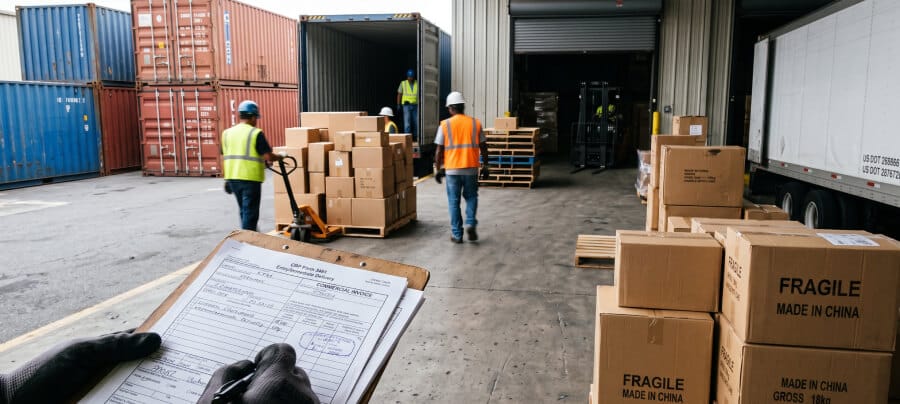
Importing food containers from Taiwan into the US usually doesn’t get stuck because the process itself is complicated. It gets stuck because food containers as a category have a few specific trigger points that most general export-clearance guides don’t call out.
Most “US customs clearance guides” cover generic cargo procedures: ISF filing, tariff classification, document checklists. That content matters, but food containers also involve FDA food contact material review and classification disputes around container materials, and those details are what actually determine whether a shipment gets held up at customs.
This guide is organized around the three stages a buyer actually goes through: what to confirm with suppliers at the inquiry stage, the clearance issues specific to containers, and what to watch for at the warehousing stage, rather than just reproducing a generic customs document checklist.
The Inquiry Stage: Getting Clearance-Ready Information Into the Supplier’s Quote
A lot of buyers only discover their supplier can’t provide the documentation customs needs after the shipment is already on the water, and by then it’s too late to coordinate with the sailing schedule.
The safer approach is to settle these requirements during the inquiry stage, so the supplier prepares them alongside the quote.
Three Things Worth Requesting at Quote Stage
First is the supplier’s suggested HTS classification code. Final classification responsibility sits with the buyer and customs broker, but a supplier with US market experience usually knows which code similar products have cleared under before, and that knowledge saves the broker a lot of confirmation time.
Second is an FDA food contact material declaration, essentially the supplier’s proof that the containers meet US food contact material requirements. This isn’t a finished-product test report.
It’s the supplier’s written assurance about material sourcing and production standards, and it’s far faster to get this prepared at quote stage than to chase it down after the shipment reaches port.
Third is a certificate of origin, which matters especially when the container material involves composite inputs, plant fiber containers, for example, can draw raw material from multiple origins. Whether the supplier can clearly document each component’s origin directly affects how quickly customs review moves.
If you’re still evaluating OEM suppliers, our earlier guide, How Distributors Should Evaluate a Taiwan Kraft Paper Container OEM Factory: 5 On-Site Due Diligence Checks, covers how to confirm whether a factory has real export-to-US track record, specifically Check 5 on export and cross-border readiness.
The Customs Stage: Two Reasons Food Containers Most Often Get Held Up
Food container clearance issues are usually not about missing paperwork. They’re usually one of these two review steps specific to food containers.
PGA Review: Why FDA Food Contact Material Triggers Extra Scrutiny
Beyond its own review, US Customs routes certain shipments to the relevant federal agency, a Partner Government Agency (PGA), based on product type.
Because food containers come into direct contact with food, they’re likely to be routed to the FDA for food contact material review. Not every shipment gets flagged for this, but once it is, clearance time stretches out noticeably.
Whether this step goes smoothly comes down to whether the FDA food contact material declaration prepared at the inquiry stage is complete, which is exactly why it’s worth settling at quote stage rather than scrambling for documentation after a shipment gets routed to PGA review.
HTS Classification: Common Disputes Across Paper, Plastic, and Plant Fiber Containers
Different container materials can fall under different tariff rates and review requirements, and the line between paper, plastic, and plant fiber (sugarcane bagasse, bamboo fiber, etc.) containers isn’t always as straightforward as sorting by material alone.
Composite materials or coated containers are especially prone to landing in classification gray areas.
Misclassification isn’t just a matter of back taxes. In serious cases it can be treated as a false declaration, affecting how future shipments get reviewed. This is also why it’s worth asking suppliers for their classification history on past US shipments at the inquiry stage, a documented track record is more reliable than re-judging it from scratch every time.

The 3 Most Common Clearance Mistakes
The first mistake is missing the ISF filing window. The US requires Importer Security Filing to be completed at least 24 hours before the vessel loads.
If the supplier sends shipping information too late, the buyer’s customs broker has little room to meet that deadline, and missing it can mean anything from fines to the shipment being held at port.
The second mistake is treating food containers like generic cargo and overlooking the possibility of PGA referral, so when the FDA asks for supporting documents, the buyer discovers they were never prepared, and the whole shipment sits at port waiting on paperwork.
The third mistake is reusing an old tariff classification without reconfirming it against any changes to the container’s material or construction.
If a supplier changes a material formulation or adds a coating layer, the classification may need to change with it, and carrying over last shipment’s classification unchanged is an easy way to get flagged for inconsistency during inspection.
The Warehousing Stage: What to Watch for Once Food Containers Reach US Storage
Once goods clear customs, many buyers treat warehousing as a pure logistics step. But for packaging products like food containers, there are a few details at the warehousing stage that are easy to overlook.
Humidity control in storage deserves particular attention, especially for paper and plant fiber containers.
Extended exposure to high humidity can cause warping or reduced structural strength, and this kind of quality change usually doesn’t show up the moment goods arrive. It tends to surface after a period of storage, often by which point the supplier’s claims window has already closed.
Batch tracking is another detail that’s easy to skip. A single purchase order of containers may actually span several different production batches. If storage location isn’t recorded by batch at intake, tracing the affected inventory range later, if a quality issue turns up in one batch, becomes a much slower process.
Stacking also deserves attention. Food containers tend to be lightweight but bulky, and applying standard cardboard-box stacking height and methods to them can easily deform the containers at the bottom of a stack. This is worth communicating clearly to warehouse staff at intake.
How Long Should the Whole Process Take
Looking at the three stages together, planning for timing matters more than reacting as things come up. For inquiry-to-shipment preparation, budget 2 to 3 weeks for the supplier to prepare the suggested HTS classification and FDA declaration.
Ocean transit to a US port typically runs 3 to 5 weeks depending on the route. Customs clearance, assuming complete documentation and no PGA referral, usually finishes within a few business days, but any inspection or document request can stretch that to 2 weeks or more.
Adding these stages together for procurement scheduling holds up far better than working off a vague “about a month” estimate.
Importing food containers from Taiwan follows roughly the same structure as importing any other cargo. The real difference comes down to the two trigger points specific to food containers: PGA review and HTS classification. Handle both of those at the inquiry stage, and the customs and warehousing stages become the easiest parts of the process to control.
If you’re curious about current US market demand for Taiwan kraft paper containers, we’ll be covering that in an upcoming piece, US Market Trends for Kraft Paper Takeout Containers: What Buyers Need to Know in 2025. Stay tuned.