


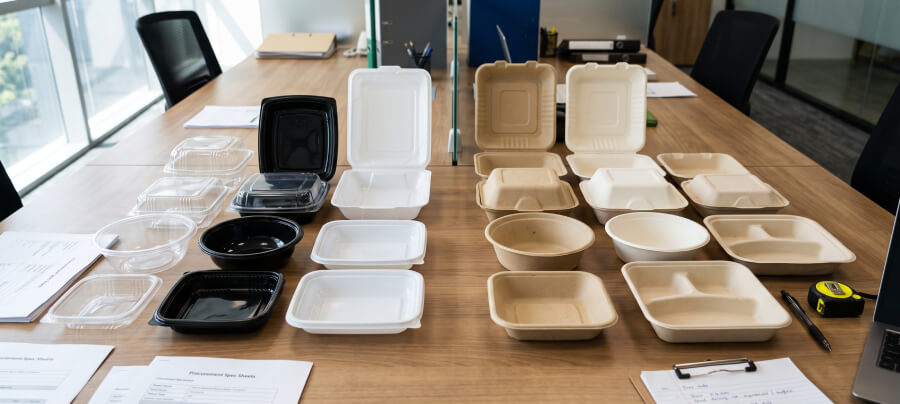
When it comes to going green on food containers, most brands default to an all-or-nothing switch, replacing every plastic container with plant fiber or another eco material in one move.
The instinct makes sense, but in practice it usually runs into cost pressure. The transition either stalls out, or the brand pushes through a full switch and eats the hit to the procurement budget.
An all-or-nothing switch isn’t actually the only option. Mixed sourcing, plant fiber for some product lines and plastic for others, is the third path most discussions skip over. This guide focuses on how to decide the mix ratio, not on repeating the basic plastic-versus-eco-material comparison.
If you haven’t decided whether to switch from plastic to plant fiber at all, our earlier piece, Plant Fiber Containers vs Kraft Paper Containers: Which One Fits Your Procurement Needs?, covers the material-level comparison first. Come back to this guide once you’ve settled on the material direction and are ready to figure out the mix.
Why an All-or-Nothing Switch Isn’t the Only Option
The conversation around going green tends to get framed as binary: either fully embrace eco materials or get labeled as not taking sustainability seriously.
But for most buyers, cost sensitivity and consumer visibility vary a lot across product lines. Applying the same material standard to every product is actually the least efficient approach.
This binary framing also tends to push buyers toward one of two outcomes. Either the transition gets shelved entirely because the full-switch price tag looks too steep, or it goes through on paper but quietly gets scaled back once the budget hit becomes real.
A mixed approach sidesteps that trap by making the scope of the switch a deliberate decision from the start, rather than something that gets walked back under pressure later.
How to Decide Which Product Lines Keep Plastic and Which Switch to Plant Fiber
The core test for a mixed strategy is whether a given product line’s packaging is something the consumer actually sees and forms an impression from, not simply which department has more budget room.
In practice, it’s worth starting with a list of your current product lines and tagging each one’s consumer visibility as high, medium, or low. That list becomes the basis for deciding switch order and running the cost math later, and it holds up far better than going by gut feel.
High-Visibility Product Lines the Consumer Sees Directly Should Switch First
Takeout and delivery packaging, the kind consumers handle directly and sometimes photograph and share, gets the clearest brand benefit from an eco material, and it’s also the part of the business most likely to get scrutinized for whether sustainability claims actually hold up. These product lines are worth prioritizing for the plant fiber budget.
Internal or Back-of-House Product Lines Can Stay on Plastic
Containers used for internal warehouse turnover or back-of-house prep are something the consumer almost never sees or touches directly.
Keeping these on plastic and redirecting the savings toward front-facing product lines gets more out of the overall transition than spreading a limited budget evenly across everything and doing every line halfway.
Durability matters here too, not just visibility. Back-of-house containers often go through more handling cycles, stacking, transport between storage and prep areas, repeated reuse in some operations, and plastic’s structural consistency tends to hold up better under that kind of wear than plant fiber does. Keeping these lines on plastic isn’t just a budget call. It’s often the more practical material fit as well.
This same test applies within a single product line too. Take takeout boxes as an example: the portion used for dine-in, where the consumer sees the packaging arrive at the table, carries different visibility pressure than the portion fulfilled purely through a delivery platform, where the consumer sees the food but never the physical packaging. It’s worth splitting that further rather than treating the entire takeout box category as one decision unit.
The Cost Math Behind Setting a Mix Ratio
Once you’ve decided which product lines to prioritize, the next step is figuring out what ratio actually balances the ESG upside against the cost burden, rather than picking a number based on gut feel.
The math works like this: calculate the incremental cost of switching all high-visibility product lines (the unit price gap between plant fiber and plastic, multiplied by that product line’s annual order volume), then compare it against the budget increase your brand can accept.
Work backward from there to find the actual range and ratio of product lines you can switch. If switching every high-visibility line still fits within budget, extend into medium-visibility lines next, continuing until the cost increase approaches your ceiling.
Run this exercise line by line rather than as one blended average across the whole product portfolio. A blended number can hide a lot.
A high-volume line with a small unit price gap and a low-volume line with a large one can average out to something that looks affordable overall, while the low-volume line alone would have blown past budget if switched on its own. Breaking the math out by product line catches that before it becomes a surprise on the actual invoice.

The point of this logic is that the mix ratio isn’t a permanent decision made once. As plant fiber unit prices drop with higher order volumes, or as plastic restrictions tighten in a given market, the same cost math run again periodically lets the ratio scale up gradually rather than locking in a fixed target from day one.
In practice, it’s worth setting a fixed cadence for rerunning this math, every six months, or whenever you renegotiate with a supplier, for example, since plant fiber pricing can shift faster than expected once order volume scales up. Going too long without rerunning the numbers risks underestimating how much further you could actually extend the switch.
Regulatory changes are worth tracking on the same schedule. A market that tightens single-use plastic restrictions partway through the year can shift the calculation just as much as a supplier price change, since a product line facing an imminent plastic ban effectively has its cost comparison overridden by compliance risk, regardless of what the unit price math says on its own.
Supplier Conditions to Confirm Before Adopting a Mixed Strategy
Mixed sourcing puts different demands on a supplier than sourcing a single material. It’s worth confirming upfront whether a supplier can reliably supply both plastic and plant fiber at once, rather than splitting the order across two separate vendors and adding coordination overhead.
The same cross-material evaluation logic applies when assessing suppliers here. How Do You Evaluate a Food Container Supplier? 8 Questions That Apply Across Materials covers the framework, and it’s worth adding “can this supplier reliably supply multiple materials at once,” a need specific to mixed sourcing, to that existing checklist.
It’s also worth confirming whether lead times hold up when a supplier switches between materials on your orders. Mixed sourcing means placing orders for two materials in the same stretch of time, so a supplier’s production scheduling flexibility is another point worth evaluating.
A supplier that runs both material lines on the same production floor, rather than outsourcing one of them to a subcontractor, tends to handle that scheduling overlap more smoothly, since there’s no second party’s capacity to coordinate around.
For the logic behind assigning different materials to different product lines in the first place, see Food Container Buying Guide: Kraft Paper, Plant Fiber, and Plastic Compared, which takes this further by walking through how to actually set the ratio.
Worth noting: once a mixed strategy is up and running, how to write that decision logic into an ESG report and communicate it to stakeholders is a separate topic on its own. We’ll have a dedicated piece covering that, it’s outside the scope of this guide.
Mixing plastic and plant fiber sourcing ultimately isn’t about picking a material. It’s about figuring out which product lines deserve the green transition budget first, then using the cost math to find a ratio that’s actually workable. Compared to the cost shock of a full switch, or missing out on brand upside by not switching at all, a mixed strategy gets the most ESG value out of a limited budget.