



Kraft paper, plant fiber, and plastic all tend to land on the same shortlist when sourcing food containers, but researching each material separately takes time, and it’s easy to get stuck in one material’s spec details before ever seeing the full picture. A procurement team new to the category often ends up reading three separate spec sheets from three separate suppliers, none of which are built to be compared against each other.
This guide skips the deep technical dive into any single material and starts with a quick three-material comparison matrix instead, so you can see where the three actually differ on the metrics that matter before deciding which one to research further. Think of it as the step before the deep dive, not a replacement for it.
Kraft Paper, Plant Fiber, and Plastic: A Quick Comparison Matrix
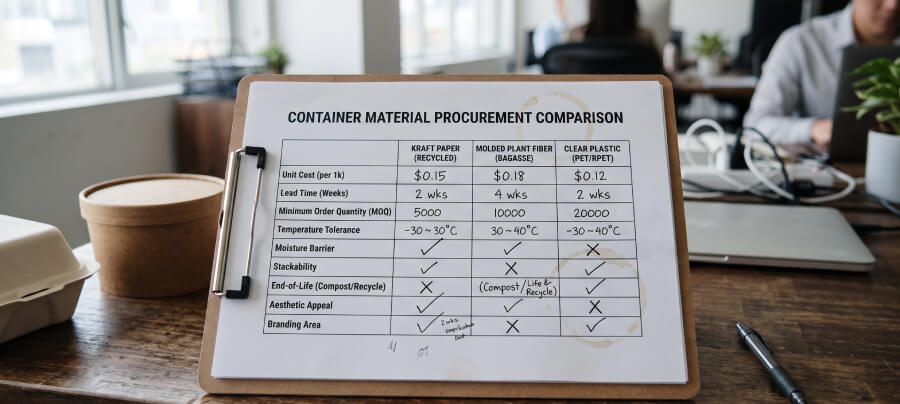
The three materials differ on raw material source, heat resistance, appearance, cost, and customization flexibility. The table below lines up seven key metrics side by side for a fast first pass.
| Metric | Kraft Paper | Plant Fiber | Plastic |
|---|---|---|---|
| Raw material | Wood pulp (kraft/sulfate process) | Agricultural byproducts like sugarcane bagasse and bamboo fiber | Petroleum-based resins (PP, PET, PS, and similar) |
| Heat resistance | Moderate, handles brief contact with hot food once PE-coated | Good, most grades go in the microwave | Depends on the resin, PP highest, PET and PS weaker |
| Appearance | Natural texture, prints with sharp, clear color | Coarser, molded texture | Can reach high clarity, close to a glass-like look |
| Eco-friendly perception | Above average, recyclable | Highest, most grades meet biodegradable and compostable standards | Weaker, and single-use plastic restrictions keep tightening in some markets |
| Price level | Mid-range | Mid-to-high | Usually the lowest of the three |
| Customization flexibility | High print flexibility, no real color-count limit | Print sharpness limited by the material’s surface texture | High flexibility on molds and color |
| Typical use case | Takeout and delivery for brand-conscious chains | Hot food, brands built on a sustainability story | Retail display, short-term test orders |
The table is only a first-pass filter. Actual specs still depend on the individual supplier’s product data, and material category is just a starting point for narrowing the shortlist.
Price level is worth a caveat too. The gaps in the table reflect unit pricing at moderate order volumes, and all three materials see that gap narrow as order size grows, since tooling and setup costs spread across more units. A quote at 500 units and a quote at 50,000 units can tell a very different story even within the same material, so treat the table’s price ranking as directional rather than fixed.
Worth noting: while plant fiber generally carries the most positive eco-friendly perception, all three materials can meet food safety and environmental standards given the right certification and disposal path. A perception gap doesn’t equal a compliance gap, so it’s still worth requesting the actual certification documents rather than judging compliance by material name alone.
Customization flexibility deserves a bit more explanation too. Kraft paper and plastic both print with good flexibility, holding up well on color count and detail. Plant fiber’s more visible surface texture limits print sharpness, so if a brand logo needs fine lines or gradients, it’s worth requesting a printed sample on plant fiber before committing, rather than assuming print quality carries over evenly across materials.
“Good” or “moderate” heat resistance in a comparison table like this one is a category-level generalization, and actual performance still varies by wall thickness, coating, and how long the container sits in contact with hot food. A supplier’s actual heat test data settles that question far more reliably than the material name alone.
Which Situations Fit Kraft Paper
Kraft paper works well for mid-range purchases that need to balance brand feel against cost, especially for takeout and delivery, where the consumer sees the packaging directly. Kraft paper’s natural texture and print quality usually deliver solid brand recognition.
For high-volume orders in a market where single-use plastic restrictions are tightening, kraft paper carries lower compliance risk too, which is why plenty of brands switch to it from plastic in the first place, especially delivery platforms or chains under pressure to keep their packaging image in check. Kraft paper’s cost-to-value ratio is usually the easiest case to make internally, since the brand upside is visible on every order that goes out the door, not just in an internal report.
Kraft paper also tends to be the easiest material to source at scale, since the supplier base is broad and raw material supply is comparatively stable, which matters for a buyer placing large, recurring orders who needs confidence in year-round availability rather than just a good price on the first order.
Before locking in specs, our earlier piece, First-Time Kraft Container Buying Guide: MOQ Negotiation, Spec Confirmation, and Sampling, walks through the fuller first-time purchasing process.
Which Situations Fit Plant Fiber
Plant fiber works best for brands with the highest bar for eco-friendly credentials, particularly ones built around a sustainability story where the customer base already cares about packaging’s environmental footprint. Plant fiber containers generally meet both biodegradable and most compostable certifications, giving it the strongest eco-friendly case of the three materials.
Plant fiber also holds up well on heat, making it a fit for hot food or microwave-ready use. The tradeoff is that customization flexibility usually falls short of kraft paper, and print sharpness has its own material-driven ceiling.
Supplier availability is worth checking early too. The plant fiber supplier base tends to be more concentrated than kraft paper’s, so lead times and MOQ requirements can run less flexible, especially for a first order.
If plant fiber is already the decided direction, Plant Fiber Container Sourcing Guide: Specs, Certifications, and Minimum Order Quantities covers the full spec and certification detail.
Which Situations Fit Plastic
Plastic usually wins on unit price, display clarity, and customization flexibility, making it a fit for limited budgets or anything needing a clear container for retail display. Short-term test orders also tend to favor plastic, since it keeps the sunk cost of a material switch to a minimum, which matters for a buyer testing a new product line who isn’t ready to commit to a specific material long term.
Plastic’s challenge is a weaker eco-friendly perception, and single-use plastic restrictions keep tightening in a number of markets, so it’s worth checking the regulatory direction in the target market before committing to a large, long-term order.
That regulatory risk matters more the longer the contract runs. A short trial order carries limited exposure if a ban lands mid-run, but a multi-year supply agreement takes on that risk for the full contract term, which is worth weighing against the upfront cost savings before signing.
Plastic itself splits further into PP, PET, and PS, each with its own heat resistance, clarity, and cost profile, so Food-Grade Plastic Containers: A Complete Buying Guide to PP, PET, and PS is worth a read to settle which resin fits first.
Mixed Sourcing: Using Different Materials for Different Product Lines
Plenty of buyers don’t pick just one material. They assign materials by product line instead, plant fiber or kraft paper for hot food items, clear plastic for retail display items, so each line gets the material best suited to it rather than forcing one material to cover everything and losing performance somewhere along the way.
The tradeoff with mixed sourcing is added supplier management complexity. Finding a supplier that covers multiple materials at once can save the coordination cost of juggling lead times and quality standards across several vendors, which makes it worth confirming upfront when evaluating suppliers.
Forecasting also gets trickier once a product line runs on more than one material, since each material can carry its own lead time, minimum order threshold, and seasonal supply pattern. A buyer running mixed sourcing across several product lines is usually better off staggering reorder points by material rather than assuming every line restocks on the same schedule.
The cross-material evaluation logic that applies here is the same regardless of which materials are involved. How Do You Evaluate a Food Container Supplier? 8 Questions That Apply Across Materials covers the fuller supplier evaluation framework that isn’t tied to a single material.
None of kraft paper, plant fiber, or plastic wins across every purchasing situation. Use the comparison matrix to get the general direction first, then dig into the spec details of whichever material actually fits the business need, rather than locking in one material early and finding out later it doesn’t fit. That order, matrix first, spec details second, tends to save more time overall than working backward from a single supplier’s pitch.