


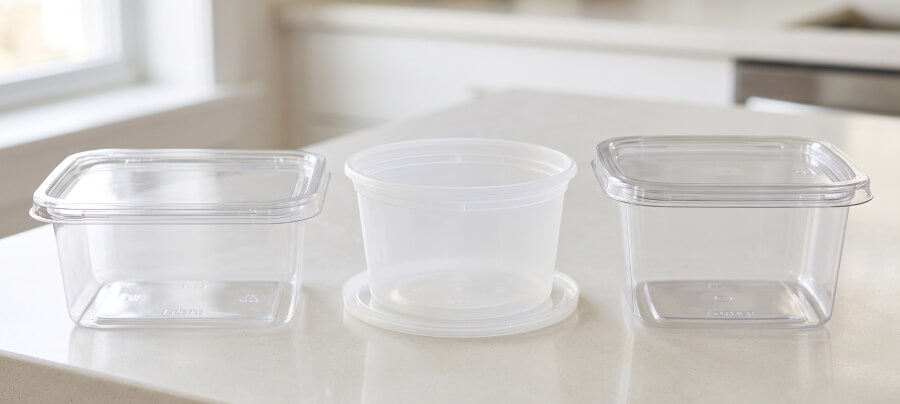
A supplier’s spec sheet for food-grade plastic containers often lists PP, PET, and PS side by side, with prices and appearance close enough that it’s tempting to just pick based on price or whatever’s in stock. Then the sample arrives, and the material turns out wrong for the job, hot food warps the container, or the clear, glass-like look you wanted just isn’t there.
PP, PET, and PS are three completely different plastic resins, with real differences in heat resistance, clarity, chemical stability, and cost structure. This article doesn’t repeat the cross-material comparison across kraft paper, plant fiber, and plastic. It focuses on these three common plastic resins specifically, laying out the fundamental differences so you can pick the right material direction before locking in specs. If you haven’t settled on how the overall purchasing process works yet, our earlier piece, B2B Food Container Procurement SOP: 8 Steps from RFQ to Delivery, walks through the general process, and you can plug straight into that framework once the material’s settled.
What Sets PP, PET, and PS Apart at the Basic Level
The three materials have different chemical structures, which directly determines each one’s heat ceiling, clarity ceiling, and what kind of food it actually suits.
PP’s Heat Resistance and Chemical Stability
PP (polypropylene) handles heat the best of the three, generally holding up to brief contact above 100°C, and most PP containers go straight into the microwave. Its chemical stability also runs higher, making it less reactive with oils and acidic foods.
PP containers typically come out translucent or matte, rarely reaching the full clarity of glass. For hot food containers or microwave-ready meal boxes, where direct heating is part of the use case, PP is usually the first choice among the three. It’s also the material most often used for soup containers, deli tubs, and reusable meal prep boxes, cases where the container needs to survive repeated reheating without warping.
PET’s Clarity and Strength
PET (polyethylene terephthalate) stands out for high clarity, giving containers a glass-like transparency, with decent impact resistance that holds up against cracking. It’s the common material behind beverage bottles, salad boxes, and clear takeout containers on the market.
PET’s heat resistance falls well short of PP’s. Microwaving isn’t generally recommended, and extended high-heat exposure tends to warp it or release off odors. For refrigerated, cold-food, or display-oriented packaging, PET’s clarity advantage matters more than its heat performance.
PET also carries an edge on the recycling side. It’s labeled resin code 1, one of the most widely accepted plastics in municipal recycling programs, which matters for buyers whose customers or end markets care about a container’s recyclability rather than just its price.
PS’s Cost and Practical Limits
PS (polystyrene) usually runs the lowest cost of the three, rigid and easy to mold, but the material is brittle, with weaker impact resistance that makes it prone to cracking in transit. Its heat resistance is also the weakest of the three, tending to release odors or deform under high heat.
PS commonly shows up in two forms, foam (what most people call Styrofoam) and rigid clear plastic. Foam PS already faces restrictions or outright bans in a number of markets, from individual US states and cities to broader national policies, and that list keeps growing, so before ordering, it’s worth confirming the current regulatory status for PS containers, foam in particular, in your target market, rather than finding out after the order ships that it can’t legally be sold there.
For buyers still weighing whether PS is worth the risk given how the regulatory landscape keeps shifting, it’s worth asking whether the low unit cost still holds up once you factor in the chance of a mid-contract ban forcing a switch to a different material.
Heat Performance: Which Material Fits Microwave, Hot Food, or Refrigerated Use
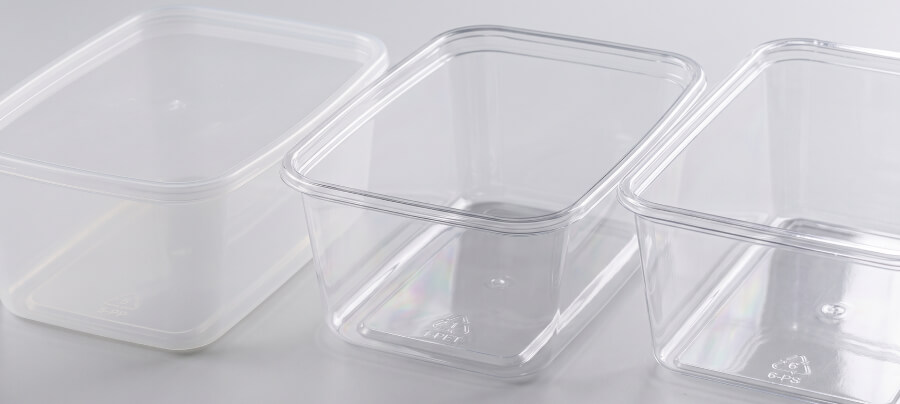
The general heat resistance order runs PP highest, PET in the middle, PS lowest, but the actual temperature and duration a container can handle depends on the specific test data a supplier provides. Material category alone is only a first-pass filter.
For hot food or microwave-ready use, where direct heating is part of the job, PP is usually the practical choice. For refrigerated, cold-food, or room-temperature display use that doesn’t involve heating, PET’s clarity advantage tends to matter more than heat performance. PS fits best as a simple, single-use container for brief food contact, not for anything that gets heated or needs to hold up over time.
Delivery adds another layer to this. A container that only needs to survive a short window at the counter faces different stress than one that sits in a hot bag for a 30-minute delivery ride, so it’s worth thinking through the container’s actual time at temperature, not just the peak temperature it touches, when deciding how much heat resistance actually matters for a given order.
Worth noting: even containers labeled the same PP grade can show different heat performance data from one supplier to the next. Before placing an order, it’s worth asking the supplier directly for actual heat test reports rather than judging by material name alone.
Mixing materials within a single product is also worth considering rather than treating the choice as all-or-nothing. A PP base paired with a PET lid is common for containers that need to go from the microwave to a display shelf, since the base handles the heat and the lid handles the clarity. Confirm with the supplier whether that combination is available before assuming a single material has to cover the whole container.
Clarity and Appearance: Which Material Fits Display Packaging
For retail display use, where the buyer wants the contents visible to the end consumer, PET offers the clearest option of the three, with rigid PS a distant second. PP’s translucent finish doesn’t suit packaging built around product visibility.
A brand that cares about both display appeal and heat performance is worth evaluating separately: use PET for refrigerated display items and PP for hot food that needs heating, rather than forcing one material to cover both and sacrificing one function to save on sourcing complexity.
Lighting and shelf placement affect how much that clarity difference actually shows up to the end customer too. Under strong retail lighting, PET’s clarity reads clearly next to PP’s more clouded finish, but in a dimmer cooler case or a delivery bag the two can look closer than the spec sheet suggests. Worth checking under the actual display conditions the product will sit in before paying a premium for clarity that might not be as visible as expected.
Food Safety and Regulatory Checks: What Each Material Needs Verified
All three materials can meet food-contact safety standards, but the testing focus differs by material, worth confirming separately when reviewing a supplier’s certification documents. For a step-by-step approach to verifying whether those certification documents are actually genuine once you have them in hand, we’ll have a dedicated article covering that soon.
Because PP commonly sees high-heat use, its testing focus usually centers on heat stability and migration testing, checking whether the material releases chemicals into food under high temperature. PET’s testing focus, beyond general food-contact safety, also covers material stability under repeat use, since consumers sometimes reuse PET containers rather than disposing of them after one use. For PS, beyond standard safety certification, it’s worth separately confirming whether the foam variant complies with plastic restriction or ban rules in your target market. This is an area where regulations shift quickly, so it’s worth re-checking before every large order rather than relying on information from a previous purchase.
It’s also worth double-checking that a supplier’s PP containers are actually PP and not being confused with polycarbonate, a different plastic entirely that has drawn scrutiny over BPA content in some markets. The two can look similar on a spec sheet shorthand, but they’re not interchangeable, and a mislabeled material can create a compliance problem that only surfaces after the order has already shipped.
A Decision Framework: Choosing by Use Case, Budget, and Regulatory Market
Before settling on a material, work through three questions: will the container ever be heated, does it need to be clear for display, and does the target market restrict or ban any of these plastic materials. Cross-referencing the answers to these three questions usually narrows things down to the right material direction.
For a limited budget and a simple use case, like single-use cold takeout, PS’s low cost is worth considering, provided the regulatory status checks out first. For a use case that needs to handle both heat and durability, PP is generally the safer bet. For anything built around display appeal and retail presentation, PET’s clarity advantage is hard to replace with anything else.
Order volume and shelf life matter here too. A buyer testing a new product line with a short initial run has more room to try PS for the cost savings, since the regulatory exposure only applies to that one batch. A buyer signing a long-term supply contract is taking on that regulatory risk for the life of the contract, which tends to tip the calculation back toward PP or PET even when PS looks cheaper on paper.
Once the material direction is settled, it’s worth ordering a small batch of samples before committing to a full order, loading them with the actual food they’ll hold and leaving them at the actual use temperature for a realistic stretch of time, rather than deciding purely off a supplier’s spec sheet. Spec sheet numbers come from lab conditions, and those don’t always line up with how a container actually gets used. A container that holds up fine in a controlled test can still fail once it’s handling the actual grease, moisture, or stacking pressure of a real delivery run.
Choosing the right material is only the first step. If your sourcing scope goes beyond plastic, say you’re also weighing kraft paper or plant fiber in a three-way comparison, we’ll have another article covering that soon.
None of PP, PET, or PS is universally better than the others. The differences come down to heat resistance, clarity, and cost structure, each suited to a different use case. Confirming the actual use case first, then matching it against what each material offers, does more to avoid a mid-negotiation material mismatch than choosing based on price or whatever’s in stock, and it saves the far more expensive mistake of discovering the wrong material only after the first full production run has already shipped.