


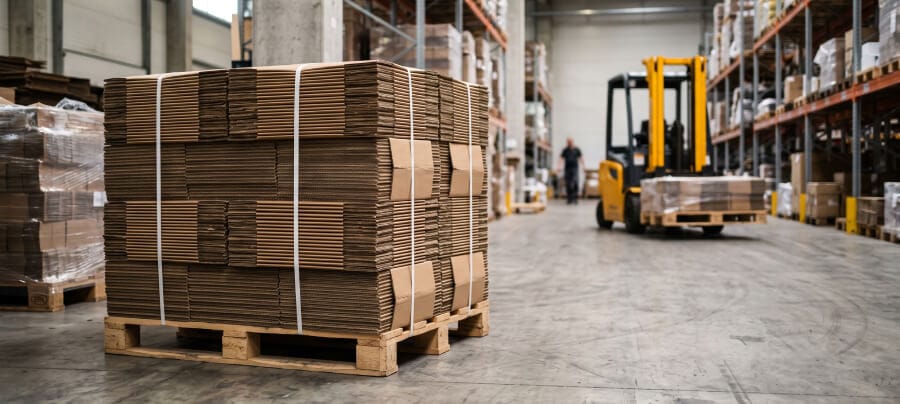
Kraft paper containers’ overall advantages compared to plastic and EPS foam are already covered in depth in How to Choose Restaurant Takeout Packaging: 5 Key Advantages of Kraft Paper Containers, so this piece won’t repeat that ground. What we’re covering here is what typical B2B buyers actually run into after placing a bulk order: how to size your warehouse space, how to load pallets, how to control humidity, and how to manage inventory turnover.
None of this shows up when you’re ordering small quantities, but the moment your order scales up, any one of these that gets overlooked shows up directly in your storage costs.
Why Storage Efficiency Matters More at Scale
When you’re ordering small quantities, storage was never a variable procurement decisions had to account for; a few extra boxes stacked in a corner made no difference either way. Once order volume scales up to a full container load or a season’s worth of inventory, warehouse space becomes a real, visible cost: every extra square meter of storage is rent or opportunity cost you’re paying for, and every inefficient handling route is extra labor cost.
For distributors and bulk retail channels, this cost usually gets overlooked more easily than unit price differences do, yet it shows up clearly at year-end reconciliation, especially since warehouse rent and labor costs both get adjusted annually. Without periodically recalculating this, that hidden cost creeps up year after year without anyone noticing.
Another commonly underestimated variable is seasonal demand swings. Takeout and delivery packaging volume typically spikes during peak seasons for chain restaurants, summer beverage season or the year-end dining season, for example, and if your warehouse planning is based only on average monthly usage, the concentrated restocking before peak season can easily exceed the space you planned for. That’s why storage planning shouldn’t be based on a single month’s numbers; it needs to look at a full year of usage patterns.
Flat-Packed vs. Assembled: How to Calculate the Real Volume Difference
The biggest storage advantage of box-style kraft paper containers comes from the fact that most styles ship flat and only get assembled at the point of use, which is completely different from PP plastic or EPS foam containers that already arrive as fixed, rigid structures.
A fixed rigid structure takes up the same volume whether in transit or in storage; there’s no way to compress it through stacking, which is exactly why the same container tonnage holds far fewer plastic units, driving up the freight cost allocated to each container.
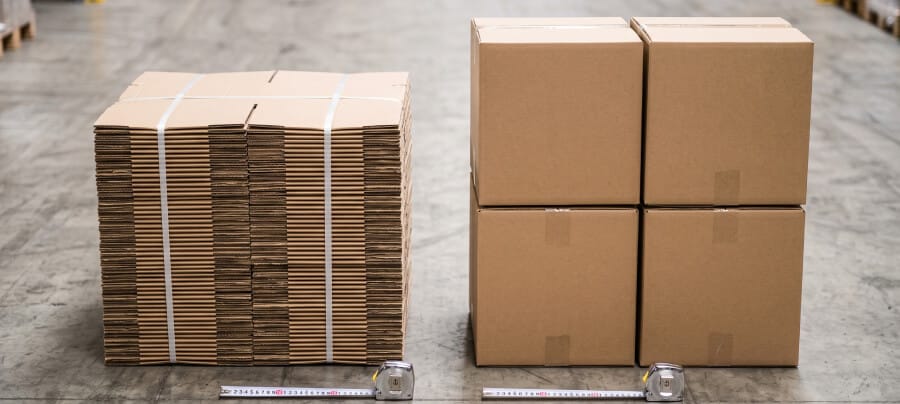
Based on general packaging industry data, flat-packed volume typically runs about 10 to 20% of the assembled volume, which works out to a 5 to 10x compression ratio. That said, this is general packaging industry data, not a ratio measured specifically for food containers; the actual compression ratio varies by container depth and structural design, with deep containers typically compressing less efficiently than shallow ones.
When ordering, ask your supplier directly for the actual outer carton dimensions in both flat-packed and assembled states; doing your own math from those numbers will be more accurate than relying on a supplier’s verbal claim of ‘saves space,’ and closer to your actual order than applying an industry average.
Take common food packaging like salad boxes or takeout containers as an example: the same container or the same pallet can carry back several times more product in flat-packed form, and for distributors handling overseas shipping or long-haul delivery, the difference in freight allocation becomes very noticeable.
Pallet Loading and Space Planning in Practice
Warehouse space needs can be worked out backward from pallet capacity. 100 by 120 centimeters is the standard pallet size commonly used in Asian export trade. Start by confirming your supplier’s outer carton dimensions, then calculate how many cartons fit per pallet layer and how many layers a pallet can stack, which gives you the total cartons one pallet can actually hold.
The logistics industry generally targets 80% or higher space utilization per pallet as the benchmark; anything below 70% counts as a clear waste of space, worth revisiting by rearranging carton orientation or adjusting carton dimensions. From there, divide your estimated monthly usage by the cartons per pallet to get the number of pallets you’ll need, then add the aisle space and clearance required between pallets; a conservative estimate typically runs 1.3 to 1.5 times the raw footprint.
This math doesn’t need to be precise to the decimal point, but it’s worth doing at least once before placing a large order. Once you know roughly how many pallets of space you need, check that against what your warehouse can actually hold.
If the two numbers don’t line up, that’s your signal to negotiate split deliveries with your supplier ahead of time rather than finding out you’re out of space when the shipment arrives; renting emergency overflow storage almost always costs more than planning ahead.
How Warehouse Humidity and Storage Conditions Affect Kraft Paper Containers
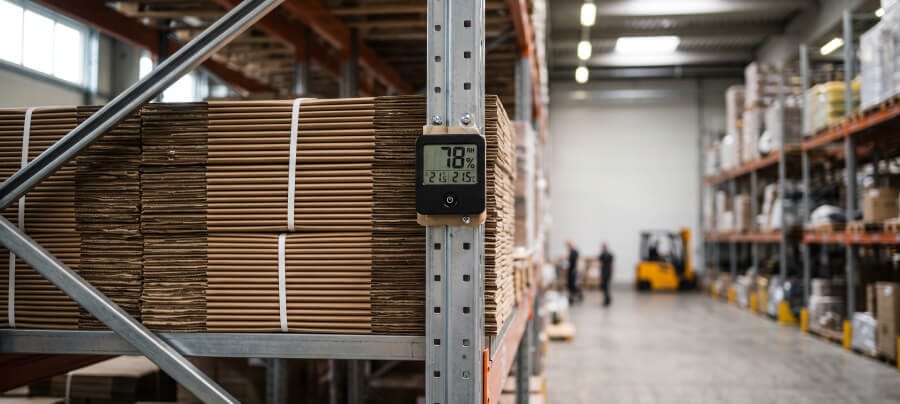
Paper-based materials absorb moisture by nature. Poor humidity control can cause kraft paper containers to soften, warp, or even develop mold before they’re ever used, and the risk is more pronounced in Taiwan, where summer humidity regularly exceeds 70%, if the warehouse doesn’t have dehumidification in place.
Two common international testing standards in the corrugated industry, TAPPI T402 and ASTM D4332, both use 50% relative humidity at 23°C as the baseline condition; the further humidity drifts above that baseline, the more the board’s structural strength systematically declines. According to Fibre Box Association data, corrugated board loses 50 to 60% of its stacking strength once it reaches equilibrium at 90% relative humidity.
In practice, you don’t need to hold warehouse humidity at exactly 50%, but keeping relative humidity between 50 and 55% is a reasonable target. Keep containers elevated off the ground during storage (pallets already do this), and avoid direct contact with the floor or exterior walls, since walls are more prone to condensation from temperature differences.
If your warehouse already stores other food products or packaging materials, humidity control equipment is likely already in place to some degree, but it’s still worth evaluating whether the specific storage area for kraft paper containers has good airflow, and avoiding corners where moisture tends to accumulate.
If your warehouse doesn’t have large-scale dehumidification, adding a localized industrial dehumidifier or placing desiccant packs around the pallets can meaningfully reduce humidity risk in that specific area, at a much lower cost than installing a central dehumidification system for the entire warehouse, a good option for small to mid-sized storage spaces.
Beyond humidity, warehouse temperature matters too: paper containers stored long-term in hot, poorly ventilated conditions can see their heat-resistant coating degrade prematurely even without direct contact with a heat source, so it’s worth keeping storage areas away from direct roof exposure or equipment that generates heat.
Balancing Order Batch Size With Inventory Turnover
Bulk orders typically come with a lower unit price, but ordering too much at once ties up inventory capital and warehouse space, while ordering too often makes per-shipment freight less efficient. The two need to be balanced.
In practice, multiply your average monthly usage by your safety stock days to get a reasonable inventory level, then work backward from your supplier’s actual lead time to figure out when to place the next order, rather than waiting until stock runs low to order in a rush.
How many safety stock days to plan for depends on how reliable your supplier’s lead time is. For a supplier that frequently runs late, build in a wider safety stock buffer; for one with a consistent lead time, you can run a leaner inventory level and put that capital to work elsewhere. This is also why lead time reliability deserves more weight than unit price when evaluating a long-term partner.
If this is your first time negotiating a bulk order with a given supplier, here’s one thing worth keeping in mind: when negotiating MOQ discounts, also negotiate the possibility of split deliveries at the same time, so you don’t end up with more inventory than your warehouse can handle just to lock in a better unit price.
A 6-Point Warehouse Checklist Before Placing a Bulk Order
Before placing a large order, it’s worth confirming the following points rather than discovering a problem after the shipment arrives:
- Current warehouse square footage and pallet capacity, and whether it can handle the added volume of the new order; you can get a rough estimate directly using the pallet math from earlier
- Whether your loading and unloading routes can handle a higher volume of traffic, especially during peak periods when inbound and outbound shipments overlap; narrow aisles or too many turns will make actual handling efficiency worse than what the square footage numbers suggest on paper
- Whether humidity control equipment is sufficient, particularly during Taiwan’s high-humidity summer months; without a large-scale dehumidification system, you’ll need at least a localized dehumidifier or desiccant plan
- Whether a first-in-first-out (FIFO) labeling system is in place, so older stock doesn’t get buried in the back and forgotten; paper containers stored too long can lose structural strength from prolonged moisture exposure even without visible mold
- Whether your supplier can accommodate split deliveries to reduce the impact of a single large shipment on your warehouse space; this is worth negotiating during the pricing discussion rather than bringing it up after the order is placed
- Whether your supplier can provide a food-grade material safety declaration or related certification documents, so you can file them all at once for a bulk shipment instead of requesting them batch by batch
If this storage space is already shared with other packaging materials, it’s worth noting that plant fiber containers follow similar humidity and shelf-life logic, so planning for both together tends to be more efficient than handling them separately.
No amount of warehouse planning can fully offset an order that’s simply too large for your actual storage capacity. If your assessment shows space is genuinely tight, negotiating a split delivery schedule with your supplier is usually more cost-effective than squeezing out extra storage space.
Over the long run, storage efficiency isn’t something you calculate once at the time of purchase and move on from. It’s an ongoing management item worth revisiting every time order volume shifts or warehouse space changes, especially for growing distributors or bulk retail channels, since a storage setup that worked last year may not still be adequate this year.
Reach out to the EasyPack team to talk through an ordering and delivery schedule that fits your storage capacity.
References: