


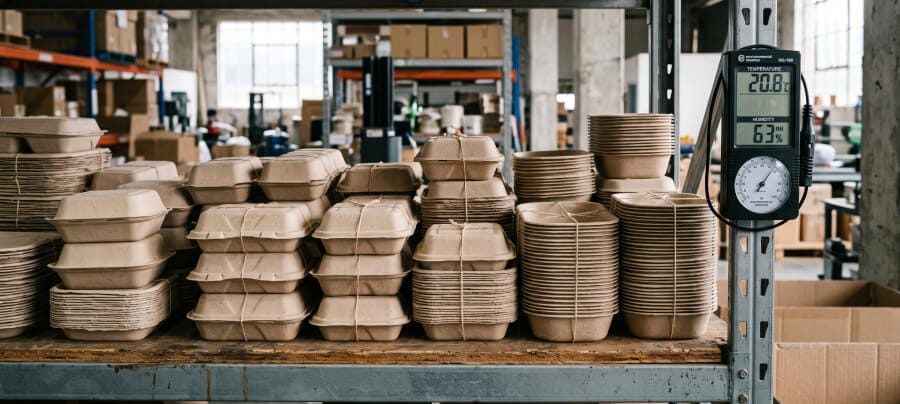
How long do plant fiber containers actually last? Our FAQ page already has a quick answer, roughly 1 to 2 years in a dry, cool, ventilated environment. This piece covers storage conditions, warning signs of degradation, and whether containers break down on their own in storage, the details that come up most often in practice. These questions rarely come up before a purchase. They usually surface once a batch has been sitting in the warehouse for a while, or a customer mentions the containers feel different than before, and by then some amount of waste or a complaint has typically already happened. Getting the logic straight ahead of time saves a lot of after-the-fact cleanup.
Shelf Life: The Specific Numbers
Properly stored plant fiber containers generally have a shelf life of 12 to 24 months from the manufacture date, though quality doesn’t hold steady right up to the last day of that window; it can decline gradually depending on storage conditions. Most suppliers recommend using containers within 12 months of purchase to keep the color and rigidity closest to how they left the factory.
Inventory held past 24 months, even if it still looks intact, is more likely to underperform in actual use, softening faster than a fresh container under hot food, for example. That’s a natural aging effect of the material, not a quality control issue with a specific batch. It’s worth building that timeline directly into your inventory management reminders rather than tracing it back after something goes wrong.
This follows similar storage logic to kraft paper containers. If you’re ordering both materials, you can plan warehouse space using Kraft Paper Container Stacking and Storage Efficiency: A 6-Point Warehouse Checklist Before Bulk Ordering alongside this one, since both materials have similar sensitivity to humidity and fit under the same management approach.
Humidity and Temperature: What Plant Fiber Containers Are Most Sensitive To
Plant fiber containers absorb moisture by nature, and humidity is the biggest threat to shelf life, more directly than temperature itself. Keep storage temperature between 15°C and 30°C, humidity as low as practical, and good ventilation, and avoid direct sunlight, which affects more than just appearance; over time it also makes the surface material more brittle. The following signs mean storage conditions aren’t right and the warehouse environment needs an immediate check:
- Soft or spongy texture
- Warping or bending at the edges or base
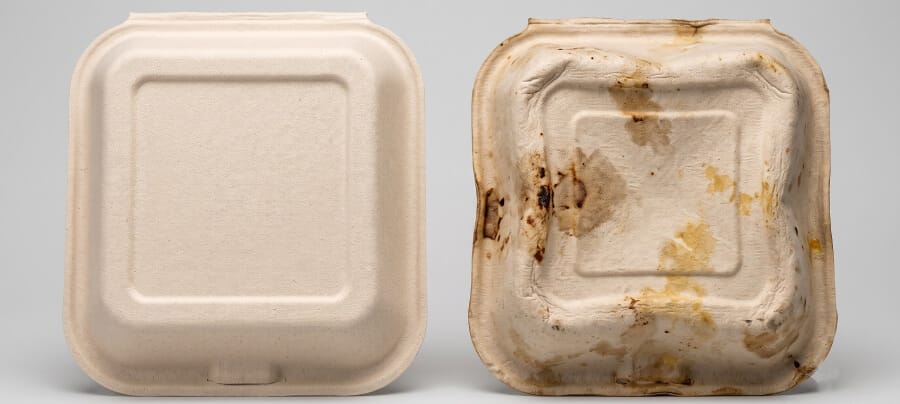
- Yellowing or uneven coloration
- Surface spots caused by moisture exposure
If several of these signs show up on the same batch, the entire storage environment has a problem, not an individual container defect; it’s worth re-checking the whole storage area rather than just pulling the affected pieces. Plant fiber has a looser structure than plastic, and moisture gets in faster than most people expect.
In Taiwan’s hot, humid summers especially, a warehouse without basic dehumidification or ventilation will see quality decline noticeably faster than storage in a drier climate, even within the normal shelf-life window.
Does Storage Cause Them to Break Down?
Many buyers new to plant fiber containers worry that sitting in a warehouse might slowly break them down the way composting does. That concern actually conflates two completely different environmental conditions.
Breaking down a plant fiber container requires the high heat, high humidity, and microbial activity of an industrial composting facility all at once; under those controlled conditions, full breakdown typically takes 60 to 90 days. A normal warehouse runs far below the temperature and humidity industrial composting requires, so normal storage doesn’t trigger breakdown at all, which is exactly why shelf life is defined by quality decline, not by the start of decomposition.
What actually accelerates quality decline is the humidity and temperature issue covered above, not any inherent tendency of the material to break down. This distinction matters for how you talk to customers too: if a downstream buyer or end consumer asks whether containers that have been in storage a while have started breaking down, you can explain directly that industrial composting requires high heat, high humidity, and microbial activity that a normal warehouse simply doesn’t have. That’s not a sales pitch; it’s a real materials-science distinction, and explaining it clearly builds more trust than glossing over it.
Practical Warehouse Placement
Keep plant fiber containers on pallets at least 15 centimeters off the ground rather than directly on the floor, since ground moisture works its way up into the bottom layer of containers first. Keep the storage area ventilated and avoid sealed, airless corners, where moisture builds up without being noticed.
If the same space also stores kraft paper containers or other paper-based packaging, the placement logic can be shared; there’s no need to plan two separate storage routines. Keep outer cartons sealed rather than opening them early for loose storage; the carton itself provides some moisture and dust protection, and opening it early exposes the outermost containers directly to the warehouse environment, speeding up quality decline.
First-in-first-out inventory management matters more for plant fiber containers than for plastic, since the shelf life is shorter. Without clear labeling of intake date and batch, it’s easy to discover during a stock count that a batch has already passed its recommended use window.
Do Different Plant Fiber Materials Store Differently?
Sugarcane bagasse, bamboo fiber, and rice husk, the three common plant fiber materials, follow broadly the same storage logic: all are sensitive to moisture, heat, and direct sunlight. Actual fiber density and wall thickness affect how sensitive a given product is to humidity, with denser, thicker-walled containers typically holding up longer than thin-walled ones.
Bagasse containers absorbing moisture easily is a well-established, widely recognized trait in the industry, especially without an added coating, which is exactly why humidity management matters more for bagasse specifically. Real-world storage data for bamboo fiber and rice husk containers is comparatively limited; if you’re evaluating either material, it’s worth asking the supplier directly for their own storage test results rather than assuming bagasse’s numbers apply.
When ordering, ask your supplier directly for the shelf-life data they’ve actually tested for that specific product line rather than applying one generic number, especially for large-volume orders or less stable outdoor storage conditions, where this confirmation step matters more. We’ll cover a fuller spec comparison across bagasse, bamboo fiber, and rice husk in a future piece if you’re evaluating all three.
A 6-Point Shelf-Life Management Checklist
After placing a bulk order for plant fiber containers, it’s worth building the following habits so inventory doesn’t sit past its shelf life or degrade unnoticed:
- Label every incoming batch with its intake date and the supplier’s recommended use window, so you can quickly identify batches approaching their limit during a stock count
- Measure warehouse humidity regularly, checking more often during Taiwan’s high-humidity summer months, and confirm any dehumidification equipment is actually working
- Follow first-in-first-out shipping order so older batches don’t get buried behind newer ones; move older stock forward in the pick path when new inventory arrives
- Periodically spot-check the oldest batches in stock for the degradation signs covered above, checking more frequently as a batch nears its shelf-life limit
- Before placing a bulk order, confirm your actual usage cycle so you don’t stockpile past the recommended use window; if usage patterns aren’t predictable yet, order a moderate batch first and scale up once demand stabilizes
- Keep outer cartons sealed rather than opening them early; for stock checks or spot inspections, check from a single carton rather than opening the whole batch into loose storage
If this is your first time placing a bulk bagasse order, supply consistency and quality reliability are worth watching too, and we’ll cover that topic in a dedicated piece down the road. Good shelf-life management isn’t just about avoiding waste for the buyer; it also directly affects how much your downstream customers trust your quality.
If a complaint comes in about containers feeling different or softening faster under hot food, tracing it back usually points to a storage issue rather than a manufacturing defect, and even when the supplier did everything right, it still ends up affecting the trust between you and your end customer.
Treat shelf life and storage conditions as a fixed part of your procurement process rather than something you deal with after a problem shows up. The communication costs and write-off costs you save over time are usually bigger than expected.
Reach out to the EasyPack team to talk through a plant fiber container ordering plan that fits your storage conditions.
References: