


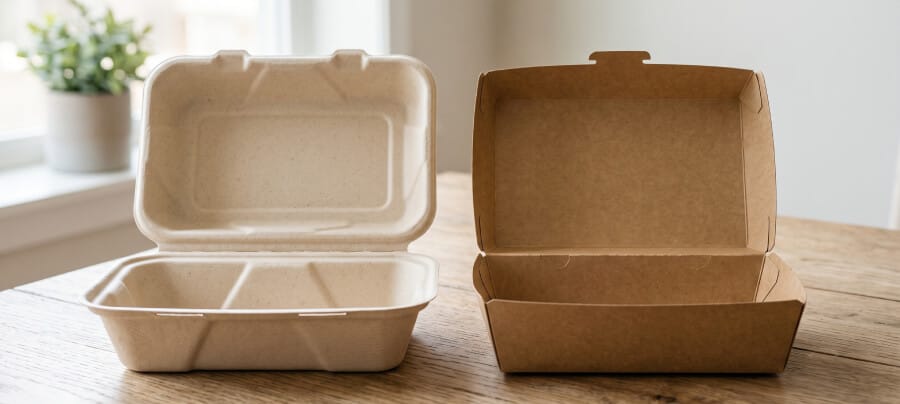
Plant fiber containers and kraft paper containers differ most fundamentally in their raw material: kraft paper is a wood pulp product, while plant fiber (commonly bagasse) is an agricultural byproduct of the sugar industry.
This raw material difference carries through to decomposition characteristics, heat, oil, and water resistance, appearance, and procurement cost, ultimately affecting which packaging material fits your business better.
This piece looks at each decision point separately, helping you judge, based on your business type (chain restaurants, supermarket deli counters, brand delivery, exports to the US and Europe), whether to go with plant fiber containers or kraft paper containers, or use both paper materials across different product lines.
Material Differences: From Raw Material to Manufacturing Process
Kraft paper containers are made from wood pulp, processed through the kraft paper process (the sulfate pulping method) into paperboard, then molded or laminated into containers.
This process gives kraft paper two defining traits: long fibers and high strength, and because the raw material comes from timber, the upstream supply chain can be traced back to forest management certification.
Plant fiber containers (the bagasse type) are made from the fiber residue left over after sugarcane juice extraction, an agricultural byproduct of the sugar industry that requires no additional logging or tree planting.
This is exactly why the raw material sourcing logic behind bagasse plant fiber containers is completely different from kraft paper: kraft paper certification focuses on where the wood came from and whether it was sustainably logged, while bagasse is about reusing something that would have been discarded as agricultural waste anyway.
This difference shows up directly in certification: kraft paper containers can obtain FSC certification, proving the wood pulp source meets sustainable forest management standards; bagasse plant fiber containers, since the raw material isn’t wood, generally can’t get FSC certification on their own, and can only be labeled “FSC Mix” when combined with FSC-certified wood pulp.
If your procurement contract or a customer explicitly requires FSC certification, that’s a regulatory and compliance requirement that will directly affect your material choice, so confirm it in advance rather than waiting until inspection to discover the plant fiber containers can’t show an FSC mark.
Worth noting: FSC certification is about raw material traceability, which is a completely different matter from food safety certifications such as FDA-related regulations or SGS test reports, both materials can separately provide the corresponding food safety documentation, so don’t conflate the two.
If you want to understand the differences within plant fiber containers themselves (bagasse, bamboo fiber, rice husk), we’ll cover a more complete material-by-material comparison in a future piece.
Environmental Claims and Decomposition Differences
Both kraft paper and plant fiber containers are biodegradable, recyclable eco-friendly packaging, but the actual decomposition path and speed aren’t quite the same, and industry test figures for the two materials vary. Treat the numbers below as approximate ranges, actual decomposition speed depends heavily on whether the container is coated, the composting facility’s conditions, and ambient humidity and temperature.
Uncoated kraft paper decomposes relatively quickly in a moist, oxygen-rich composting environment; but food containers, to resist oil and water, are mostly coated with PE lamination or a water-based coating, which extends decomposition time considerably, a PE-laminated kraft paper container mixed into general waste or the recycling stream is, in practice, very unlikely to truly biodegrade, and doesn’t really count as recyclable either.
Bagasse plant fiber containers, under industrial composting conditions, decompose fully within roughly 45 to 90 days across most sources, with most styles maintaining basic oil and water resistance without an extra lamination, which is one reason plant fiber containers are often positioned as more thoroughly compostable and breaking down more naturally.
That said, both materials share the same important precondition: full decomposition within the timeframes above requires the high heat, high humidity, and microbial conditions of an industrial composting facility.
Decomposition in ordinary home composting or a natural environment takes considerably longer, and this is worth being clear about when communicating environmental claims to customers, to avoid the misunderstanding that it will just decompose on its own if thrown in the trash.
Practical Differences in Heat Resistance, Oil and Water Resistance, and Microwave Use
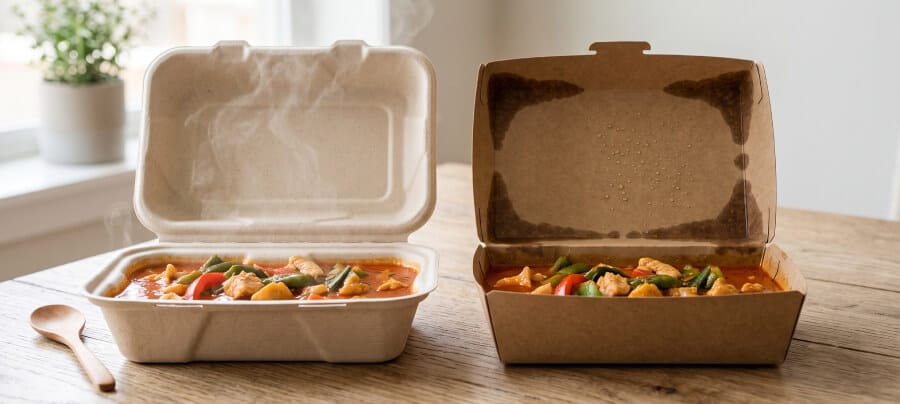
This is the difference most easily overlooked during procurement, but with the biggest impact on actual use. Kraft paper fiber on its own has limited oil and water resistance; food-grade kraft paper containers need an added PE lamination or water-based barrier coating to withstand broth, grease, and sauces, without a coating, kraft paper containers exposed to moist or greasy food easily leak and soften.
Plant fiber containers (the bagasse type), because of their higher fiber density and tighter structure, naturally have a degree of oil and water resistance and heat resistance, and can usually handle typical hot food, fried items, and saucy dishes, which is why plant fiber containers are often used for soups, curries, and fried food, though very greasy or long-held meals still depend on that style’s test results.
For microwave use, both materials can generally be microwaved as long as there’s no metal content and the supplier explicitly labels the product as microwave-safe.
But if a kraft paper container has a laminate or uses metallic ink in printing, you’ll need to confirm the material details with the supplier separately, you can’t judge purely by the material category kraft paper or plant fiber, it depends on the actual product’s coating and printing specs. For custom-printed samples, it’s worth sending them for testing before committing to a large order.
As for heat tolerance, the two materials have a similar range and can both handle typical hot food, light meals, and salad temperatures. But if your business serves near-boiling soup, it’s worth asking the supplier directly for that specific product’s heat-resistance test data rather than relying on a general impression of the material.
How Are Plant Fiber Containers Tested for Heat, Oil, and Water Resistance? What to Check Before You Buy
Testing a plant fiber container for heat, oil, and water resistance means two separate checks that the manufacturer or a third-party lab runs on the finished product: performance tests, which show whether a container holding takeout soup or fried food will soften or leak, and food contact safety tests, which show whether anything harmful can migrate from the container into the food. A general impression of the material can’t replace the report for the specific container you plan to buy.
How Is the Heat Resistance of Plant Fiber Containers Tested?
There is no single global test standard for the heat resistance of plant fiber containers. A common approach is to pour hot water or hot oil into the container, let it sit, and then check for warping, softening, or leaks, for example with 95°C (203°F) water for 30 minutes.
Exact conditions vary by manufacturer and customer, so the report should state the test temperature and time. If you are comparing against PP plastic containers at high temperatures, look at measured numbers rather than assuming the two perform alike. Microwave heating needs its own test, checking for warping, discoloration, or smoke after heating, and a general heat-resistance result can’t stand in for it.
Which Tests Cover Oil and Water Resistance?
For oil resistance, paper and plant fiber packaging is often tested with TAPPI T 559, the grease resistance test also known as the Kit Test, which drops solutions of increasing strength onto the surface and records how long they take to soak through; a higher rating means better oil resistance.
For water resistance, the Cobb test (run under ISO 535 or TAPPI T 441) measures how much water the material absorbs in a set time, and lower absorption means better water resistance. Beyond these two material tests, it’s worth requesting a leak test on the finished container: fill it with real takeout food or water, let it sit, and check the base and seams for seepage.
That test comes closest to how your customers will actually use the container. Custom-printed or differently sized versions can behave differently because inks and coatings change the results, so they need their own tests rather than reusing the report for the standard version.
What Does Food Contact Safety Testing Cover?
Food contact safety testing checks whether a plant fiber container can pass harmful substances into food.
In Taiwan, containers need to meet the Ministry of Health and Welfare’s sanitation standard for food utensils, containers, and packaging; in the US, buyers refer to FDA food contact regulations (21 CFR); and in the EU, Regulation (EC) No 1935/2004 is the basic framework. Buyers often ask for these documents as international certifications.
Reports commonly list heavy metals such as lead and cadmium, evaporation residue (which simulates migration after soaking in different food types), fluorescent whitening agents, and PFAS. PFAS shows up because some plant fiber containers have used fluorinated treatments for oil resistance, so buyers now usually ask for PFAS-free test results.
Food contact testing is separate from biodegradable or compostable certification, and one can’t substitute for the other. Which tests apply depends on your target market and product type, so confirm with the lab and your customer before sending samples. For how to verify certification documents and PFAS-free claims, see our Plant Fiber Container Buying Guide.
How Do You Read the Test Report Once You Have It?
When the report arrives, check four things. First, that the sample name and model match the exact product you plan to buy. Second, that the test date is recent enough, since an old report has limited value. Third, that the test conditions (temperature, time, and soaking liquid) match how you will actually use the container.
Fourth, that the report comes from a certified third-party lab such as SGS, or a lab accredited by the Taiwan Accreditation Foundation (TAF) or under ISO/IEC 17025. If any condition is far off or any result fails, ask the manufacturer to retest, and don’t rely on the word “pass” alone.
A report only covers the batch of samples that was tested, so batch-to-batch consistency depends on pre-shipment inspection and a track record over repeat orders, and you can request samples to test yourself. To confirm in person that a manufacturer has its own testing equipment and quality control process, pair the report with our Plant Fiber Container Supplier Audit checklist.
Differences in Appearance and Brand Image
Kraft paper containers have a natural yellowish-brown fiber tone with an industrial, handmade feel, an appearance that has built up a long-standing eco-friendly packaging association in the market, so consumers seeing kraft-colored packaging tend to associate it directly with environmental friendliness and naturalness.
Plant fiber containers (the bagasse type) have a natural off-white to light gray fiber tone, closer in texture to molded pulp. In recent years, as the reusing agricultural waste narrative has gained more traction in ESG communication, plant fiber containers tend to carry more weight in brand stories built around circular economy and waste reuse.
If your brand leans toward the retro industrial visual language of pour-over coffee, artisan baking, or traditional markets, kraft paper’s appearance fits better; if your brand’s key message is that you use what would otherwise be thrown away as agricultural waste, a natural plant fiber container tells that story more convincingly.
This difference might look like a purely marketing consideration, but in B2B procurement decisions, container appearance often directly shapes the end consumer’s first impression of the brand, it’s worth discussing alongside procurement specs rather than deciding on cost or function alone.
Compared to plastic containers, both materials have a considerably lower overall carbon footprint, which is the shared baseline that lets both be classified as eco-friendly packaging.
Procurement Cost Considerations
Generally speaking, plant fiber containers (the bagasse type) cost more to procure than kraft paper containers, mainly because the plant fiber pulping and molding process involves a few more steps than kraft paper’s laminating process, and bagasse’s seasonal availability and supply chain scale aren’t as mature as wood pulp’s yet.
The actual price gap varies noticeably depending on container thickness, size, custom printing, and order quantity, it’s worth asking suppliers directly for quotes on both materials at the same spec and quantity and comparing them side by side, rather than budgeting off the rough impression that plant fiber is more expensive.
This matters especially for bulk orders or long-term contracts, where the actual per-unit gap can narrow considerably at scale, which is exactly why many chain restaurant buyers are willing to spend the time comparing quotes item by item.
Which Business Fits Plant Fiber? Which Fits Kraft Paper?
Putting the differences above together, a few common real-world business scenarios line up with one material or the other:
- Your main products are takeout soup, curry, fried food, and other high-oil, high-moisture items, and you want to reduce coating use and cut back on plastic further: plant fiber containers’ natural oil and water resistance is the bigger advantage
- Your brand leans into a traditional, handmade, industrial visual language, pour-over coffee or artisan bakeries, for example: kraft paper containers’ appearance fits the brand tone better
- A customer or contract explicitly requires traceable FSC certification with a certificate to show, common with US and European chain brands and major retail channels: kraft paper containers have a clear path to FSC certification
- Your brand’s ESG messaging centers on reusing agricultural waste in a circular economy: plant fiber containers’ raw material story is more persuasive
- Budget is limited, you need to order in bulk, and you have no particular requirement on the material itself: kraft paper containers generally cost less to procure, though it’s still worth comparing actual quotes
- You run multiple product lines at once, hot food alongside light salads, for example: using both paper materials separately for different items fits actual usage better than forcing a single material across the board
If your business fits several of these scenarios at once, you don’t have to pick just one, many chain brands use both materials across different product lines: plant fiber for soups, kraft paper for light salads or items that need printed brand identity. This mixed procurement approach adds a bit of complexity to the buying process, but lets every product line use the material best suited to it.
Not sure which material to start planning your product line around? Reach out to the EasyPack team, we can offer specific material recommendations based on your product type, target market, and budget.
References: