


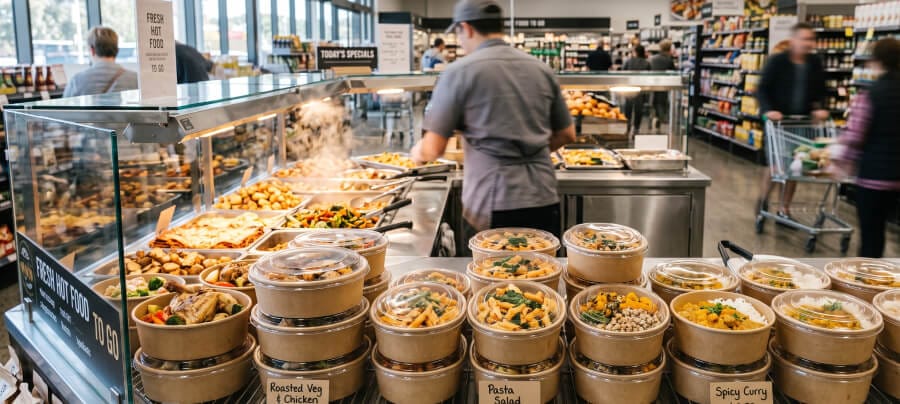
Supermarket and hypermarket deli sections have been pushed in the same direction by two things over the past few years. Plastic restrictions keep narrowing where plastic containers are allowed, and display quality directly affects whether customers are willing to pay more for freshly prepared food, something a discount coupon cannot fix.
Kraft paper containers are showing up in more and more deli sections because of this, and it is not just a simple material swap. It addresses regulatory pressure, display presentation, and cost at the same time.
This piece looks at how kraft paper containers are actually used in supermarket and hypermarket deli sections, to help buyers and store managers who are still weighing the switch figure out which items to start with and what to watch for when choosing specs.
Three Drivers Behind Kraft Paper Adoption in Deli Sections
The push toward kraft paper containers in deli sections comes from three directions: plastic restrictions, display presentation, and room to raise prices on prepared food. It is not driven by a single factor.
Taiwan’s EPA has rolled out phased restrictions on single-use tableware and disposable plastic items, and bento shops, supermarkets, and other foodservice operators are increasingly required to offer paper or alternative materials for freshly prepared food, boxed meals, and fried items. Kraft paper containers are currently one of the easiest alternative materials to source and customize through existing supply chains. For more on the material itself and how it is made, see What Are Kraft Paper Food Boxes? Materials, Manufacturing Process, and Eco Trends Explained.
Similar pressure is not unique to Taiwan. UK supermarket chain Sainsbury’s announced in 2019 that it would cut plastic packaging use in half by 2025. That pledge covers packaging across the business rather than deli sections specifically, but it reflects the same broader direction retailers worldwide are moving in, and the logic lines up with what is driving kraft paper adoption in Taiwan’s deli sections.
Beyond regulation, display presentation is a more direct driver. Kraft paper’s natural color and texture create a “made fresh, handmade” visual impression more easily than clear plastic does. This matters in practice: the same fried chicken looks different to customers in a kraft paper box than in a clear plastic one, and the first impression of freshness is not the same. Some operators use this to justify higher prices on prepared food, letting the visual quality of the packaging support a higher price point.
The third driver is category expansion within deli sections themselves. Supermarket deli sections have grown from simple boxed meals into salad bars, bakery counters, and soup stations. More categories mean more varied packaging needs, and kraft paper containers, because they can be customized across different sizes and window designs, fit multiple categories more easily than fixed-spec plastic containers can.
More chain restaurants known for handmade, fresh-made food have been opening near supermarkets in recent years. Deli sections are no longer just competing with other supermarkets, they are also competing with these chains, so packaging presentation has become part of a deli section’s brand image and part of what keeps customers coming back, not just a cost line item.
Kraft paper containers are also a recyclable paper material (note: containers with a plastic lamination are not recyclable). The recycling stream for paper containers is simpler than for composite plastic containers, which is a factor some hypermarkets weigh alongside the display and regulatory drivers.
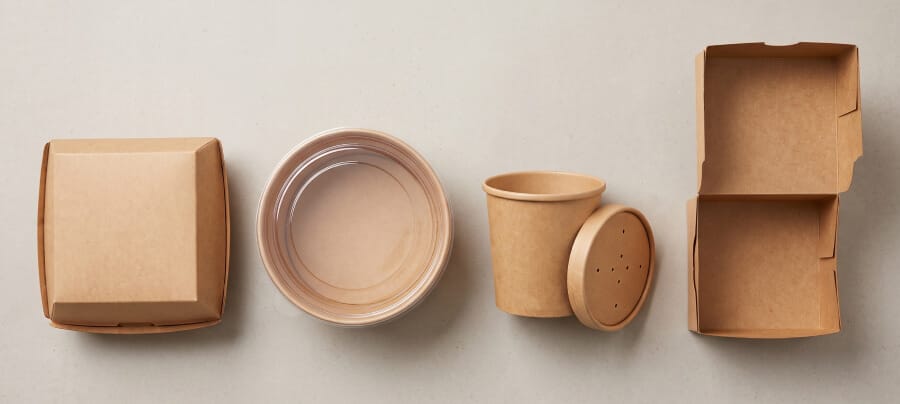
Common Kraft Paper Container Applications in Deli Sections
Common kraft paper container applications in deli sections fall into four categories: hot food and boxed meals, salad bar items sold by weight, soup and stew, and bakery items. Each category has different requirements for heat resistance, leak resistance, and seal quality.
| Application | Common Items | Key Selection Points |
|---|---|---|
| Hot Food / Fried Items | Fried chicken, croquettes, boxed meals, grilled items | Higher paper weight, works with a clear lid so customers can see the food, grease-resistant coating |
| Salad Bar (Sold by Weight) | Mixed vegetables, salads, cut fruit | Tight-fitting lid, keeps liquid from leaking, stacks easily for weighing |
| Soup / Stew | Soups, stewed dishes | Needs a lamination or liner to resist leaks, holds up at hot food temperatures |
| Bakery | Bread, pastries, sandwiches | Window design, breathable without trapping moisture, print quality matters most |
What Kind of Kraft Paper Container Works Best for Hot Food and Fried Items?
For hot food and fried items, choose a heavier paper weight with dense fiber structure. For high-fat items like fried chicken or croquettes, do not rely on the paper alone for grease resistance. A grease-resistant coating or liner works better and keeps oil from soaking through and staining the display shelf or the packaging itself over time.
Many deli sections pair these containers with a clear plastic lid so customers can see the food directly. This paper-plastic combination is common in deli sections. If you also need to evaluate plastic lids or plastic containers for your deli section, see “Plastic Container Options for Supermarket Deli and Salad Displays” for more detail.
Salad bar items sold by weight need the opposite priority: lid fit matters more than paper thickness. Mixed vegetables and cut fruit release liquid easily, and if the lid does not seal well, liquid leaks out during stacking or transport and gets on the shelf or other packaging.
For soup and stew, choose containers with a lamination or liner built in. Plain kraft paper without one carries a higher risk of leaking with high liquid content dishes.
Bakery items are simpler. The priority is window design and print quality. Breathability matters here to keep moisture from building up and affecting texture, a different concern than the leak resistance needed for the other categories.
Some hypermarkets also order kraft paper gift boxes or carry bags for holidays like Mid-Autumn Festival and Lunar New Year, used for prepared food gift sets. This need follows different logic than everyday deli packaging. Print appearance and handle or window design usually matter more, and order volume tends to jump right before the holiday, so it is worth scheduling proofs and printing with your supplier early rather than adding a rush order at the last minute.
Advantages and Limits of Kraft Paper Containers in Deli Sections
The biggest advantage of kraft paper containers in deli sections is baseline grease and water resistance plus display presentation. The limits center on how they hold up in refrigeration and how well they resist leaks with high liquid content items. These two things should be evaluated separately so you do not misjudge where the material fits.
Kraft paper with higher fiber density has some inherent grease and water resistance without needing an extra coating for typical hot food. The corners hold their shape well and stand up to repeated handling, so containers do not collapse when stacked, which works well for the multi-tier shelving and weigh stations common in deli sections. The display advantage was covered earlier and will not be repeated here, but it is worth noting that this visual quality advantage shows up clearly at weigh stations, where a kraft paper container with a handwritten price tag creates a “made today” feel more easily than a clear plastic one.
Will Kraft Paper Containers Soften in a Refrigerated Case?
Kraft paper containers without a moisture-resistant coating can soften after sitting in a refrigerated or semi-open cold case for an extended period. They do not stay completely rigid, and this is something suppliers do not always mention upfront. Before ordering, confirm directly with your supplier whether the material has a moisture-resistant coating, and test a sample in refrigerated conditions for at least a full day rather than judging performance at room temperature alone. For soups and other high liquid content dishes, plain kraft paper carries a higher leak risk and usually needs a lamination, liner, or a separate plastic inner container.
How Should Hypermarkets Choose Kraft Paper Containers?
When hypermarkets buy kraft paper containers, five factors matter most: paper weight and thickness, whether there is a moisture-resistant coating, stacking strength, custom printing feasibility, and certification documents. Missing any one of these can mean finding out the container does not work only after a large order has already shipped.
- Paper Weight and Thickness: For hot food, choose a heavier paper weight to avoid the container losing shape under heavier boxed meals or fried items.
- Moisture-Resistant Coating: For items displayed in refrigerated or semi-open cold cases, a coating is a requirement, not a nice-to-have.
- Stacking Strength: Deli shelf space is limited, and the corners need to hold up under stacking. Test this with an actual stack before ordering.
- Custom Printing Feasibility: Chain hypermarkets usually need consistent branded printing. Confirm minimum print quantities and color accuracy with your supplier before placing an order.
- Certification Documents: Get a food-contact material safety declaration and FDA or local food safety authority certification together, before ordering, not after the shipment arrives and something is missing.
What Certification Documents Should You Confirm Before a Large Order?
Before placing a large order for kraft paper containers, get a food-contact material safety declaration from your supplier at minimum, along with FDA or the relevant local food safety authority’s certification. If your deli section also has export or cross-border e-commerce needs, confirm PFAS-related material declarations as well, to avoid delays from missing documentation once the product is ready to launch.
Cost and ROI Before You Switch
Kraft paper containers typically cost more than plastic containers of the same size. Before switching, run a small trial with a single item rather than replacing packaging across the entire deli section at once.
Most hypermarket operators report that kraft paper containers run one to two times the price of plastic ones, with the actual gap depending on size and print requirements. Get a quote from your supplier directly rather than estimating your total deli section cost from a single item’s price difference.
A more practical approach is to pick one or two items first, boxed meals or salad containers, for example, and run a small trial. Watch customer response and actual usage rates before deciding whether to expand to other categories. This phased approach also makes it easier to gauge real cost and benefit without taking on the risk of a full switch all at once.
If your deli section is part of a chain, and you need to buy kraft paper, plastic, and custom printed materials at the same time, consolidating with a single supplier is usually more efficient than negotiating with several separately.
Switching to kraft paper containers in a deli section does not have to be all or nothing. You can roll it out by category, starting with the items where the presentation difference is most noticeable, then testing and expanding from there.
EasyPack offers custom printing and bulk manufacturing for kraft paper containers, with a full range of sizes and paper weights. Contact our sales team to discuss specs and pricing for your deli section’s specific needs.