


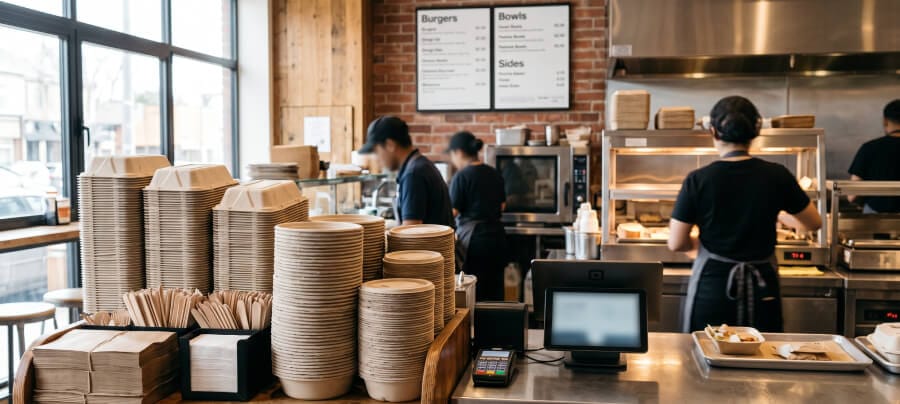
If you’ve noticed more chain restaurants and delivery brands recently swapping plastic containers for off-white bagasse plant fiber ones, that’s not a single brand’s marketing gimmick. It’s the combined result of regulatory pressure, customer perception, and corporate ESG procurement requirements pushing in the same direction. This piece breaks down what’s actually driving this trend, to help buyers who are still on the fence judge whether it’s a passing fad or a long-term shift worth planning for.
Plant Fiber Foodservice Demand Is Growing
According to a market report from Future Market Insights, the global bagasse tableware market is worth roughly USD 3.1 billion in 2026 and is projected to reach USD 6.4 billion by 2036, a compound annual growth rate of about 7.5%, with quick-service restaurants (QSRs) expected to account for 52.1% of total demand in 2026, one of the fastest-growing buyer segments. The report attributes this growth to plastic-restriction regulations, demand for coating-free PFAS-compliant materials, and rising acceptance of compostable tableware in foodservice.
That figure won’t necessarily register directly for small and mid-sized foodservice operators in Taiwan, but it reflects a real shift: plant fiber containers have moved from a niche eco-friendly option to a mainstream procurement category for large chain systems, and supply chain maturity and capacity are rising along with it. Custom options for both paper and plant fiber packaging are also more developed than they used to be, so getting in now isn’t too early for buyers who haven’t made the switch yet.
Regulatory Pressure: The Force Behind the Shift
Taiwan’s EPA has rolled out phased restrictions on single-use tableware and disposable plastic items, and bento shops, restaurants, and other foodservice operators are increasingly required to offer paper or plant fiber alternatives.
The EU has two layers of regulatory pressure: the SUP Directive (2019/904/EU) bans specific single-use plastic products, and the newer Packaging and Packaging Waste Regulation (Regulation (EU) 2025/40, PPWR) has applied in full since August 12, 2026, setting a clear limit that food-contact packaging cannot exceed 25 ppb in PFAS concentration, an even more direct impact for foodservice businesses with export needs or international brand partnerships.
Beyond the plastics restrictions themselves, PFAS-related regulations have also been tightening across multiple markets in recent years. Many paper containers have historically relied on fluorinated coatings to achieve grease and water resistance, and those coatings are increasingly being phased out under new rules. Plant fiber containers (especially the bagasse type) have inherent grease and water resistance thanks to their higher fiber density, so they don’t necessarily need an extra coating to meet the new standards, one reason they’re relatively well-positioned in this round of regulatory change.
For foodservice operators who haven’t been directly required to switch materials yet, these regulations typically don’t take full effect overnight, they tend to start with specific counties or specific product categories before gradually expanding.
Waiting until a regulation formally covers your own business before evaluating suppliers tends to compress the time available for sampling and testing, so getting a head start on understanding plant fiber container specs and supplier options effectively spreads out the time cost of compliance in advance.
Consumer Perception: A Brand Image Driver
Consumer acceptance of compostable, biodegradable packaging is broadly positive, but there’s also a clear knowledge gap. A survey conducted in late 2022 by the Composting Consortium and the Biodegradable Products Institute, covering 2,765 respondents, found that while consumers broadly support the environmental case for compostable packaging, they lack clear understanding of how to actually dispose of it, and often confuse it with regular recyclable packaging.
The takeaway for foodservice operators is this: switching to plant fiber packaging on its own sends a positive brand signal, but without clear disposal labeling or explanation, customers’ environmental perception tends to stay at the surface level of “this looks more eco-friendly” without translating into correct disposal behavior.
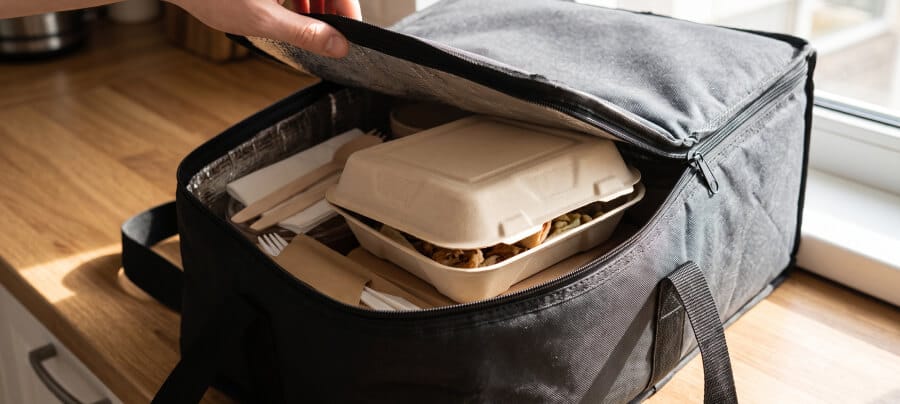
For delivery platform orders, the unboxing moment is itself an extension of the brand touchpoint. Plant fiber containers’ natural color and texture genuinely tend to leave a better impression than plain transparent plastic containers at this point in the experience, which is one real reason they’ve been incorporated into brand packaging strategy.
ESG Procurement Pressure Is Rising
If your customers are chain retail networks, corporate cafeterias, or businesses connecting into international brand supply chains, you’ll find they’re increasingly asking suppliers for carbon footprint data or proof of eco-friendly materials, and packaging choice is gradually becoming part of bid qualification. This pressure isn’t foodservice operators choosing to switch packaging on their own, it’s flowing down from upstream in the procurement chain, and rising inquiries about plant fiber containers largely reflect exactly that.
Requirements passed down from upstream like this usually come with specific documentation needs, such as compostability certifications (ASTM D6400, EN 13432) or material safety declarations. Simply switching packaging without being able to produce the corresponding documents can still cause problems during formal bidding or contract renewal reviews. It’s worth treating “switching materials” and “preparing the corresponding certification documents” as two steps of the same task, rather than switching packaging first and circling back for documentation later.
Plant Fiber’s Edge: Grease and Water Resistance Without Coating
Plant fiber containers (the bagasse type) naturally have a degree of grease and water resistance thanks to their higher fiber density and tighter structure, handling typical hot food and greasy dishes without needing an extra coating or lamination. Under increasingly strict PFAS coating regulations, this trait gives plant fiber containers more flexibility on the compliance side, which is one reason they’re making it onto procurement shortlists.
This trait doesn’t mean plant fiber containers are the right fit for every scenario, different materials each suit different situations. If you’re also evaluating kraft paper containers and want the full comparison on heat resistance, cost, and appearance, see Plant Fiber Containers vs Kraft Paper Containers: Which One Fits Your Procurement Needs?
Common Concerns: Food Safety, Heat Resistance, Microwave Use
Before adopting plant fiber containers, most foodservice operators ask about three things first: food safety certification, heat resistance, and whether they’re microwave-safe. For food safety, ask suppliers directly for a food-contact material safety declaration and confirm whether it’s passed FDA or the relevant local food safety authority’s certification.
Heat resistance varies by product spec, so it’s worth testing samples before ordering in bulk rather than relying on a general impression of the material. For microwave use, confirm the product has no metallic printing or coating concerns, and custom-printed versions should be tested as well.
What This Means for Buyers
This trend is being pushed by regulation, consumer expectations, and corporate procurement all at once, it isn’t a short-term marketing fad. For buyers who are still on the fence, it’s worth understanding plant fiber containers’ actual specs and supplier landscape ahead of time rather than reacting only once a regulation formally takes effect or a customer makes a demand, that gives you more room on your adoption timeline and a better shot at negotiating favorable terms.
If you’re just doing an initial evaluation, you don’t need to switch your entire product line at once. Starting with a single item, soup or high-fat entrée containers, for example, in a small trial run lets you observe customer response and real-world performance before deciding whether to expand to other items. This phased approach also makes it easier to evaluate actual impact without taking on the risk of a full-batch purchase all at once.
Reach out to the EasyPack team to learn more about bagasse plant fiber container specs and how to plan your adoption.