



The most common sticking point on a first plant fiber container purchase isn’t finding a supplier, it’s not being able to read the numbers on the spec sheet, or telling which of a long list of certification names actually matter, leaving the buyer to just go along with whatever the supplier’s sales pitch says.
This guide doesn’t cover negotiating price or running a purchasing workflow, it covers the three basics first: specs, certifications, and MOQ, so a buyer can read a product on their own rather than depending entirely on what a supplier says.
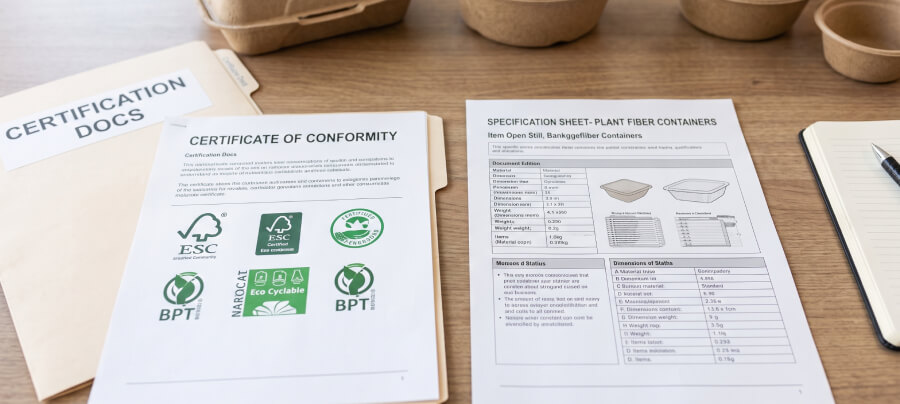
How to Read a Plant Fiber Container Spec Sheet: The Fields That Matter
Spec sheet fields look standardized, but what each number actually means directly affects how the container performs in real use.
What Paper Weight Actually Tells You About Load-Bearing and Heat Resistance
Paper weight refers to the material weight per unit area, a higher number means thicker material, which usually also means better load-bearing and heat resistance, but at a higher cost too.
Two containers of the same capacity can carry different paper weight numbers from different suppliers, and even when they look similar, the actual load-bearing performance can differ. Worth asking the supplier for the specific weight number directly at the purchasing stage, rather than relying on adjectives like “reinforced” or “durable.”
Paper weight is usually expressed in grams per square meter (gsm), and a heavier gsm isn’t automatically the right choice either.
A container built for a light salad or a dry pastry doesn’t need the same paper weight as one meant to hold a heavy, high-moisture entree, and paying for unnecessary weight just adds cost without a matching benefit. Worth matching the paper weight to the actual food being packed rather than defaulting to the heaviest option available.
Where Buyers Mix Up Capacity and Outer Dimensions
A spec sheet commonly lists both capacity (500ml, for instance) and outer dimensions (diameter, height), and these two sets of numbers are easy to confuse.
The capacity number is the reference for how much food the container holds, while the outer dimensions determine whether the container actually fits into an existing shipping box, insulated bag, or display shelf. Before a first order, worth confirming which set of numbers actually matters for the specific need, so capacity isn’t fine while the container doesn’t physically fit existing equipment.
Lid compatibility is another dimension detail that gets overlooked. A container’s rim diameter needs to match its lid exactly, and switching to a different supplier partway through a product line, even for the “same size” container, can produce a rim that’s a few millimeters off and no longer seals properly with existing lid stock. Worth requesting the exact rim dimension, not just the labeled size, when sourcing a replacement or additional supplier for an existing product line.
Certifications Come in Many Names, Sort Out Which Ones Actually Matter
Plant fiber containers carry a lot of certification names, but not every one of them relates directly to food safety, sorting out what each certification actually covers avoids paying for one that isn’t needed, or missing one that actually is.
What a Food-Contact Safety Certification Confirms
FDA, ISO 22000, and Taiwan’s TFDA are certifications that confirm whether the container material meets food-contact safety standards, this is the most basic and most necessary certification category for plant fiber containers.
Worth requesting the test report behind the certification directly and checking that the product listed on the report matches the product actually being sourced, rather than just looking at the certification badges listed on a supplier’s website.
Worth also checking which market a certification actually applies to. FDA covers the US market, while a buyer sourcing for the EU or another region needs the certification relevant to that market specifically, a supplier holding FDA certification alone doesn’t automatically mean the product is cleared for sale everywhere.
Compostability Certification Is a Separate Question From Food Safety
BPI, ASTM D6400, and EN 13432 are compostability certifications, they confirm whether a product can biodegrade under specific conditions, a completely separate certification system from food-contact safety. Passing a compostability certification doesn’t mean a product meets food safety standards, and the reverse is true too.
If a brand’s marketing claims both “food safe” and “compostable,” both certification types need to be confirmed separately, having one doesn’t automatically cover the other.
How to Confirm PFAS-Free Isn’t Just a Supplier’s Claim
PFAS-free (free of per- and polyfluoroalkyl substances) has become a specific point of concern for buyers in recent years, but a supplier saying “our product is PFAS-free” verbally isn’t something to take at face value. Worth requesting a third-party lab’s PFAS test report directly and checking that the report date matches the actual product batch.
For a full breakdown of food packaging certifications (FDA, ISO 22000, PFAS-free, and more), see Food Packaging Certifications, Global Compliance & Safety Reports, which covers the full range of certification and test report information.
How MOQ (Minimum Order Quantity) Works, Before Placing an Order
MOQ is often the single biggest sticking point on a first plant fiber container purchase, especially for a buyer still in a small-batch testing phase who hasn’t committed to ongoing purchasing yet.
MOQ Isn’t a Fixed Number, Here’s What Actually Drives It
Suppliers set MOQ to balance production scheduling efficiency, the higher the customization level (a specific color, custom printing, a special size, for instance), the higher the MOQ tends to run.
A supplier’s existing standard spec usually comes with a lower MOQ by comparison. Before ordering, worth confirming whether the need is for a standard item or a custom one, since that directly affects whether a lower MOQ is even negotiable.
Raw material batch size plays into this too, especially for plant fiber. A supplier that runs pulp processing in fixed batch sizes may set MOQ around what a single raw material batch can produce, rather than around printing or molding setup costs the way a plastic or kraft paper supplier might.
Worth asking directly what’s actually driving a given MOQ number, since the answer affects which negotiation angle is worth trying.
How to Negotiate a High MOQ on a First Order
If a supplier’s standard MOQ exceeds the budget or need for a first order, worth asking whether existing stock is available in a smaller quantity, or whether the supplier offers a sample-plus-small-trial-order arrangement, testing the product and the working relationship on a smaller scale first before committing to a larger, long-term order, rather than committing to a quantity that isn’t confidently backed yet on the first try.
Three specific angles are worth trying. First, a blanket order: agree to a larger total volume with the supplier, but request staggered deliveries (the total volume split into quarterly shipments, for instance), the supplier gets volume certainty while the buyer keeps each individual shipment small.
Second, simplify the order: strip out customization (a single color instead of multi-color printing, an existing mold instead of a modified one), which lowers the supplier’s production cost and usually loosens the MOQ threshold along with it.
Third, if the volume genuinely can’t be met, offer to accept a slightly higher unit price, giving the supplier reasonable margin on a smaller order tends to raise their willingness to accept it.
What to Verify Once the Spec Sheet and Certification Documents Are in Hand
Having the spec sheet and certification documents in hand doesn’t mean the buying process is done, checking those documents against the actual sample received matters just as much.
How to Check a Sample Against the Spec Sheet
When a sample arrives, worth comparing the paper weight and dimension numbers on the spec sheet directly against the physical sample, rather than judging by feel and calling it “close enough.”
If the sample a supplier provides doesn’t match the spec sheet numbers, that’s something to clarify before full production, not after a large shipment has already arrived and the mismatch shows up too late.
A digital scale and a set of calipers make this comparison far more precise than eyeballing it. Weighing the sample and measuring its dimensions against the spec sheet takes only a few minutes and turns a subjective impression into a number that can be pointed to directly if a discrepancy needs to be raised with the supplier later.
Certification Expiration Dates and Applicable Products Need to Match Up
Certification documents usually come with an expiration date and a defined scope of applicable products, worth confirming that the products listed on the certificate actually include the specific spec being sourced, and that the certificate is still within its valid period, rather than treating one certification document as a permanent blanket guarantee covering every product.
It’s worth keeping a copy of every certificate on file with its expiration date noted, rather than relying on the supplier to proactively flag a renewal. A certificate that quietly lapses partway through an ongoing purchasing relationship can go unnoticed for months if nobody’s tracking the date, and that gap only surfaces when a customer or a regulator asks for current documentation.
For structuring a stable, long-term supply relationship once a larger ongoing order gets decided on, see B2B Food Container Procurement SOP: 8 Steps from RFQ to Delivery, which covers the later steps of the purchasing process in more depth.
Buying plant fiber containers ultimately comes down to getting the specs and certifications basics straight first, so the decision doesn’t depend entirely on what a supplier says.
Once paper weight and dimensions make sense, certification types are sorted out, and the room to negotiate MOQ is understood, there’s an actual basis for comparing prices or negotiating a long-term relationship, rather than deciding on impression or a sales pitch.