


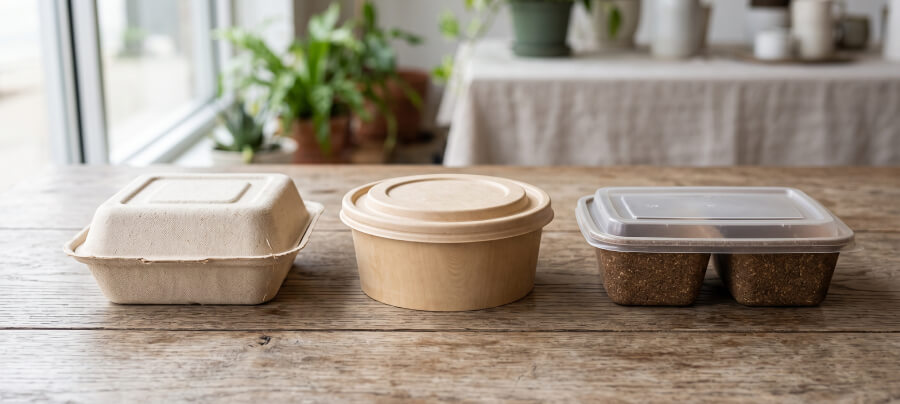
For the bigger-picture question of how plant fiber containers as a category stack up against kraft paper, see Plant Fiber Containers vs Kraft Paper Containers: Which One Fits Your Procurement Needs?, which covers the plant fiber category as a whole against kraft paper.
This guide goes one level deeper: the three raw materials commonly used within plant fiber containers, bagasse, bamboo fiber, and rice husk, how they differ from each other, and how to choose between them for B2B sourcing.
What Sets Bagasse and Bamboo Fiber Apart at the Raw Material Level
Bagasse and bamboo fiber are both plant fiber materials, but where they come from and how the fiber is structured are completely different, and that’s the root cause behind the differences in heat resistance and strength that show up later.
Bagasse Is an Agricultural Byproduct, Bamboo Fiber Comes From a Different Source
Bagasse is the fibrous residue left over after sugarcane stalks are pressed for juice in sugar production, an agricultural byproduct whose raw material cost tracks the sugar industry’s production cycle.
Bamboo fiber, on the other hand, is extracted from bamboo itself, the raw material comes from the bamboo plant directly rather than as a processing byproduct. The two materials follow different sourcing logic, which in turn affects supply stability and cost structure.
That sourcing difference matters for how a buyer should think about seasonality too. Bagasse supply follows the sugarcane harvest and milling schedule, while bamboo fiber sourcing follows bamboo cultivation and harvesting cycles, which run on a different calendar.
A buyer placing large recurring orders is worth asking each supplier directly how their specific harvest cycle affects raw material availability month to month, rather than assuming both materials face the same seasonal pattern.
The Fiber Characteristics Behind the Difference in Finished Performance
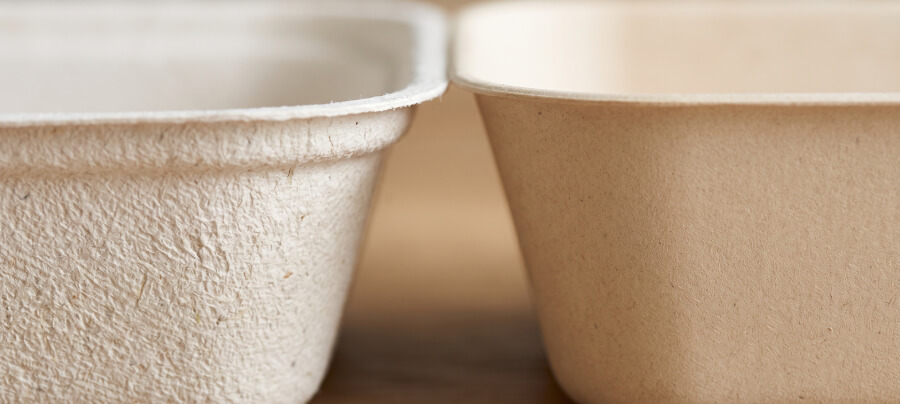
Bagasse fiber is shorter and fluffier, which gives a molded container a softer, thicker feel, that’s also why bagasse containers tend to have that noticeably substantial texture.
Bamboo fiber is longer and denser, producing a container with a firmer structure once molded, and the surface finish typically comes out smoother than a bagasse container’s. If surface finish or texture matters for a specific use case, worth understanding this fiber-level difference upfront rather than treating both as interchangeable just because they’re both labeled “plant fiber.”
This difference shows up in color too. Bagasse containers, with their coarser fiber, tend to come out a darker brown with visible fiber texture, while bamboo fiber containers, with finer fiber, tend to come out lighter in color with a more even texture. If color consistency matters for a brand, bamboo fiber containers are usually easier to control on that front.
Rigidity at the rim and lip is another practical difference worth checking during sampling. A bagasse container’s softer fiber structure can make the rim feel slightly less crisp, which matters if a lid needs a tight seal, while a bamboo fiber container’s denser structure generally holds a sharper rim edge.
Worth testing lid fit on both materials with the actual lid stock being used, rather than assuming rim performance from the material name alone.
Heat Resistance, Oil Resistance, and Strength: Bagasse vs Bamboo Fiber in Practice
The raw material differences ultimately show up in real-world container performance, which is what actually matters for a purchasing decision.
Which Holds Up Better for Heat and Microwave Use
Bagasse containers, with their fluffier fiber structure, generally insulate better, staying cooler to the touch when holding hot food, with fairly stable microwave performance.
Industry test data shows bagasse containers typically handle a heat range around 100 to 120°C, holding up fine on brief contact with hot food. Bamboo fiber containers, with denser fiber, conduct heat a bit faster, so the outside temperature climbs closer to the inside temperature more quickly when holding something hot.
For takeout hot food, bagasse containers are usually the safer starting point on insulation, though actual performance still varies with a supplier’s molding process and coating, worth requesting heat test data for both materials directly for comparison before ordering.
Wall thickness plays into this too, and it isn’t purely a function of the raw material. A bagasse container molded thinner than usual can lose some of its insulation advantage, while a bamboo fiber container molded thicker can close part of the heat-transfer gap. Worth checking wall thickness alongside the material type rather than assuming heat performance from the raw material name alone.
Which Holds Up Better on Strength and Load-Bearing
Bamboo fiber, with its denser fiber structure, typically holds a heavier load better than bagasse once molded, making it a better fit for heavier or higher-moisture food.
One supplier has tested a blended bagasse-and-bamboo-fiber material and found a tensile strength of 35.0 MPa, more than double that of standard bagasse tableware sold on the market, along with a clear improvement in water resistance (a 127° contact angle versus 93° for standard bagasse tableware) and oil resistance (grade 6 versus grade 4). That data point confirms bamboo fiber content genuinely pushes both structural strength and grease and water resistance up a level.
A bagasse container with insufficient paper weight is more prone to sagging under a heavier dish. For soups, rice bowls, or other heavier dishes, bamboo fiber’s structural strength is the more favorable choice, though the actual paper weight still needs confirming with the supplier rather than assumed from the material name alone.
Stacking strength is worth testing separately from single-container load-bearing too, especially for retail or delivery use where containers get stacked in a carton or a delivery bag. A container that handles a single serving of food fine can still buckle under the weight of several stacked units, so worth asking a supplier for stacking test data specifically, not just the single-unit load rating.
How Rice Husk Plant Fiber Containers Compare to the Other Two
Rice husk is another common plant fiber raw material, but its market presence is currently much smaller than the other two.
The Raw Material Characteristics of Rice Husk
Rice husk is the outer shell removed during rice processing, also an agricultural byproduct whose raw material cost tracks the rice production cycle.
Rice husk fiber contains a relatively high proportion of silica, which gives rice husk containers an edge in certain abrasion-resistance scenarios, but it also makes the raw material harder to process than bagasse or bamboo fiber, one reason the supplier base for rice husk containers is comparatively small.
Practical Limitations Common to Rice Husk Containers Right Now
Because of the processing difficulty and the limited supplier base, rice husk containers typically offer less flexibility on customization options (color, printing, special sizing, for instance) compared to bagasse or bamboo fiber containers, and the MOQ threshold tends to run higher too.
For a standard spec with minimal customization, rice husk containers are worth considering, but for anything involving significant customization, worth confirming a supplier’s actual production capacity and customization ability for rice husk specifically, rather than assuming it matches the flexibility of bagasse or bamboo fiber.
Lead times tend to run longer for rice husk too, since fewer suppliers means less production capacity available at any given time to absorb a new order. Worth building extra buffer into the timeline for a first rice husk order compared to what’s typical for bagasse or bamboo fiber, especially around peak demand periods when the limited supplier base gets stretched thin across multiple buyers at once.
Rice husk containers are currently concentrated among a handful of specialized suppliers, and negotiating room tends to be more limited compared to materials like bagasse or bamboo fiber that have more supplier options. Before committing to a large, long-term order, worth getting quotes and lead times from several suppliers rather than settling on the first one found.
How to Choose for B2B Sourcing Based on Business Needs
None of the three materials is universally better, which one actually fits depends on the specific business use case.
Which Material Fits High-Grease or High-Heat Dishes
For food that’s mostly high-grease or served hot, bagasse containers are usually the safer starting point on insulation, though it’s still worth confirming whether a supplier’s coating is specifically designed for grease resistance, rather than relying on the material’s natural properties alone.
Which Material Fits a Brand’s Visual Positioning
For a brand that leans toward a refined look and wants a smoother container surface, bamboo fiber containers usually come closer to that finish than bagasse, making them a better fit for a brand with higher visual presentation standards.
Supply Stability and Cost Considerations
Bagasse, with its larger raw material scale and broader supplier base, generally holds up better on supply for large, ongoing orders.
More on maintaining quality consistency at scale for bagasse lunch boxes is coming in a future guide, and the batch-quality-management logic there applies just as well to bamboo fiber containers sourced long-term.
Bamboo fiber and rice husk containers, with a more concentrated supplier base, are worth vetting for capacity planning and backup options before committing to a long-term relationship.
Bagasse, bamboo fiber, and rice husk each have strengths and weaknesses rooted in their raw material differences, bagasse insulates well and offers stable supply, bamboo fiber holds up structurally and finishes smoother, rice husk resists abrasion but offers less customization flexibility.
Getting these differences straight before ordering, and matching the material to the actual business use case, does more to avoid a costly material mismatch than comparing on price alone.