


Most carbon footprint guides you can find are either an introduction to the ISO 14067 standard, or a walkthrough of the full carbon audit process a large company runs toward formal certification.
That material is useful if you’re pursuing a carbon label. Most buyers are dealing with something simpler: you don’t need to pass formal verification, you just need a number accurate enough to put in your ESG report.
This guide covers the calculation side. The report structure itself, what sections it needs and how to fill them out, is covered in our earlier piece, How to Write an ESG Procurement Report for Food Containers: 4 Sections and 3 Common Mistakes.
The Lifecycle Stages a Plant Fiber Footprint Needs to Cover
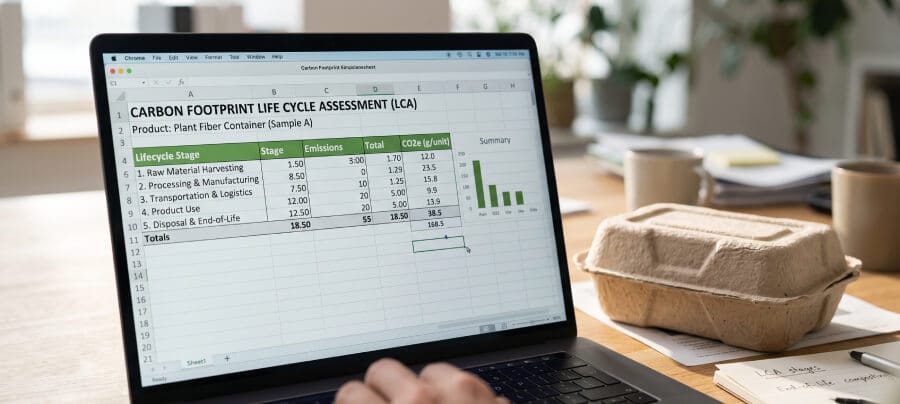
A full product carbon footprint calculation, following life cycle assessment (LCA) logic, usually breaks into five stages: raw material sourcing, manufacturing, transport, use, and disposal. Each stage has a different emissions source, and skipping one throws off the final number.
Raw material sourcing covers emissions from getting the plant fiber material (sugarcane bagasse, bamboo fiber, rice husk, and so on) up to the point before processing. Manufacturing covers the energy used in molding, drying, and printing.
Transport covers getting the product from the factory to your warehouse and on to the end user. The use stage is usually negligible for food containers, since the container itself doesn’t consume energy. Disposal covers composting or landfill emissions, and that stage is worth a closer look for plant fiber specifically, which the next section explains.
Two Calculation Challenges Specific to Plant Fiber
Should Agricultural Byproduct Emissions Count
Sugarcane bagasse is a byproduct of sugar production, which raises a question that’s easy to overlook: should upstream emissions from growing, harvesting, and processing the sugarcane get allocated partly to the bagasse container.
The common approach depends on whether bagasse is treated as the main product or a byproduct in the overall sugarcane process.
If bagasse counts as waste from sugar production, standard LCA convention assigns its emissions starting from zero, meaning the growing and processing emissions stay on sugar’s books, and the bagasse container only carries emissions from collection onward.
This treatment can make a plant fiber container’s footprint look noticeably lower than a material grown as a dedicated crop, but only if your supplier is genuinely using a sugar byproduct rather than growing bagasse as its own crop, which is worth confirming directly rather than assuming.
How to Handle the Composting Credit at End of Life
When a plant fiber container is composted, the process releases some carbon dioxide, but that carbon originally came from the atmosphere through plant growth (biogenic carbon), which is different in kind from the fossil carbon released by landfilled plastic.
The common calculation treats this biogenic carbon release as carbon-neutral and excludes it from the net footprint, counting only the energy used to run the composting facility itself.
This treatment isn’t fully consistent across standards. ISO 14067 and some industry guidelines handle biogenic carbon slightly differently, so it’s worth confirming which framework your reference calculation uses before comparing numbers with a supplier or a client, so you’re not each counting it a different way.
A Simplified Way to Estimate Without Full Certification
If your goal is just a number for an ESG report rather than a formal carbon label, you can use a simplified approach: take the emission factor for each lifecycle stage (public factors, or actual data your supplier provides for raw material, manufacturing, and transport), multiply by the corresponding weight or distance, and add them up for a per-unit footprint estimate.
This simplified logic isn’t as accurate as a formal LCA verification, but it’s good enough for internal decisions and report purposes.
The key is labeling it honestly as an estimate, not a third-party verified figure. For what to request from a supplier to run this calculation, see How Do You Evaluate a Food Container Supplier? 8 Questions That Apply Across Materials. The supplier qualification framework there applies just as well to requesting emission factors and raw material sourcing documentation.
Comparing Footprints Against Kraft Paper and Plastic Fairly
Buyers often compare carbon footprint numbers across materials by weight alone, and that comparison isn’t fair.
Plant fiber containers are usually heavier than an equivalent plastic container, so the per-weight footprint can look higher, but the actual material weight, wall thickness, and useful life all differ between materials. What actually matters is total footprint at equivalent capacity and use case, not emissions per gram.
The same logic applies from a cost angle: material choice was never going to come down to one metric. A good-looking carbon number doesn’t automatically mean the purchasing decision should follow it, durability, cost, and consumer perception all belong in the same weighing. For the fuller comparison logic across materials, see Food Container Buying Guide: Kraft Paper, Plant Fiber, and Plastic Compared.
What to Do With the Number Once You Have It
Once you have a footprint estimate, it typically goes into the quantified-results section of your ESG report, as one piece of evidence supporting the decision to switch to plant fiber, not the whole point of the report.
The report structure and the other sections it needs are covered in our earlier piece. This guide was only about where the number comes from.
Calculating a plant fiber footprint isn’t a matter of plugging numbers into one formula and moving on.
Agricultural byproduct attribution and biogenic carbon at end of life are both judgment calls that come from the material’s actual characteristics. Spend the extra time confirming your supplier’s raw material sourcing, and the number will hold up better when someone eventually checks it.