


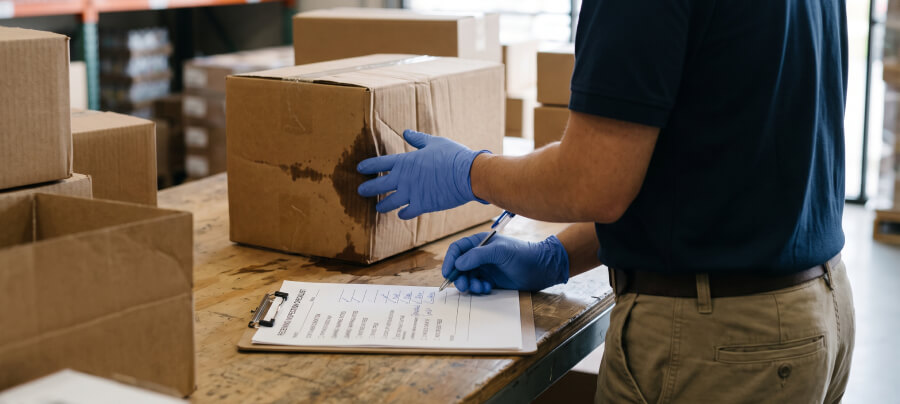
A kraft container arriving with leaks, warping, or softening usually isn’t down to a single cause, it’s more often a spec that was chosen wrong, quality control that wasn’t tight enough on the supplier’s side, or a use case that pushed the container past what it was actually designed to handle.
This guide doesn’t repeat the spec-selection points a standard buying guide covers, instead it works backward from the common problem symptoms, diagnoses the likely causes behind each one, and covers what to confirm at the purchasing stage to avoid them, rather than dealing with them after the shipment has already arrived.
1. Leaking Is One of the Most Common Complaints, Usually Down to Coating or Sealing
Leaking tends to show up with soups or high-grease foods, typically as liquid coming through the base or seams of the container.
Uneven Coating Application Is the Most Common Cause of Leaking
A kraft container’s grease and water resistance comes from its surface coating, and if that coating is applied unevenly or doesn’t reach the thickness needed for the intended use, liquid seeps through wherever the coating runs thin.
This kind of problem doesn’t always show up at the sampling stage, since a sample might happen to come from a well-coated batch, and the issue only surfaces once a production run uses a different batch of coating material.
Worth requesting a coating thickness test report from the supplier at the purchasing stage rather than relying on the coating type name alone.
This is also why a single approved sample isn’t always a reliable guarantee for an entire production run, coating consistency depends on how tightly a supplier controls their own process, and asking about batch-to-batch coating consistency testing, not just the coating spec on paper, gives a better read on how likely this problem is to recur.
Water-based coating and extrusion lamination perform differently on leak resistance too, water-based coating is more eco-friendly but its leak-resistance ceiling generally sits lower than lamination.
For items with high liquid content, worth confirming which coating technology the supplier uses before finalizing the material, and requesting test data specific to the actual food type being packed.
Incomplete Seam Sealing Is Another Common Cause
If a container’s seams aren’t fully bonded, liquid still leaks through the seam gaps even when the coating itself is fine.
When a sample arrives, worth filling it with water and letting it sit for a while before checking, rather than checking immediately, since a minor leak often takes some time to become visible.
Seam sealing quality also tends to vary more at the corners and folds than along a flat edge, worth paying closer attention to those specific spots during inspection rather than treating the whole seam as equally reliable just because most of it holds up fine.
2. Warping Usually Traces Back to Heat Range or Paper Weight
Warping tends to show up after a container holds hot food or goes through a microwave, with the container losing its original rigidity.
Getting the Heat Range Wrong Makes a Container Soften With Hot Food
Every kraft container has its own heat ceiling, and once the actual food temperature exceeds that ceiling, the container starts to soften and warp.
Without clearly confirming the heat tolerance number with a supplier before purchasing, it’s easy to end up with a spec mismatched to the actual use case. For the full method of confirming this kind of spec, see 5 Key Essentials Guide to Kraft Paper Food Containers For B2B Sourcing, which covers heat resistance and microwave safety in more detail.
Insufficient Paper Weight Cuts Into Load-Bearing Capacity
A container with lower paper weight is more likely to sag or collapse under heavier or higher-moisture food.
Two suppliers can quote what looks like the same capacity container using different paper weights, and the load-bearing performance ends up noticeably different even when the containers look similar, worth asking the supplier directly for the specific weight number at the purchasing stage.
Paper weight is not the only factor either, structural design like corner reinforcement and base thickness plays into load-bearing capacity too, so a lower-weight container with a well-reinforced structure can sometimes outperform a heavier-weight one with a weaker design, worth judging the container as a whole rather than by the weight number alone.
A simple test at the receiving stage: fill a sample with the actual weight of food it will hold, let it sit on a flat surface for ten minutes, and if the edges start to droop or the base sags slightly, that’s a sign the paper weight may not be enough for the load, a more reliable check than just pressing on it by hand.
3. Softening and Delamination Usually Point to the Material or Storage Environment
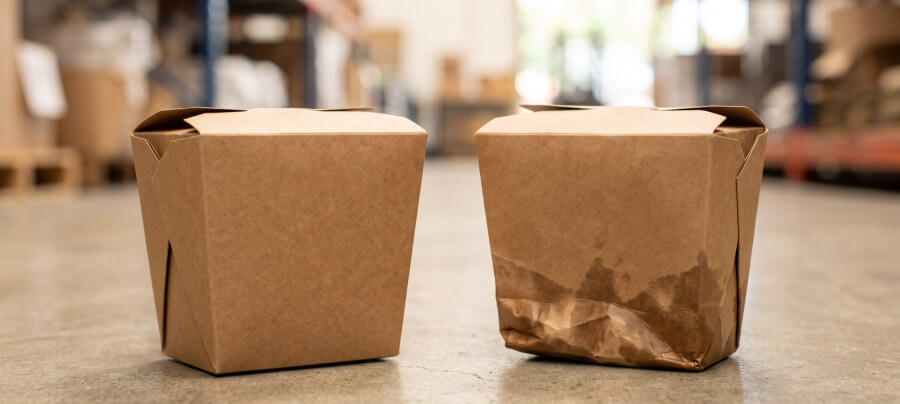
Softening and delamination differ from the previous two problems, they usually don’t show up during use, they surface after a period of storage.
High Humidity in Storage Accelerates Softening
A kraft container stored long-term in a high-humidity warehouse gradually absorbs ambient moisture and softens, even while still sealed and unused.
This is often mistaken for a product quality defect, when the actual issue is the storage environment. Worth periodically spot-checking the oldest batches in inventory to confirm whether the storage environment needs better dehumidification.
How a supplier packs a shipment affects post-storage condition too, if the outer carton isn’t properly moisture-proofed, the outermost containers can pick up moisture during transit or port handling even when warehouse humidity itself is well controlled. On a large shipment, worth spot-checking both the outermost and innermost containers and comparing their condition for a noticeable difference.
Poor Coating-to-Paper Adhesion Causes Delamination
If the coating doesn’t bond strongly enough to the paper itself, delamination or peeling can show up after a period of use, especially at spots that come into contact with grease or get flexed repeatedly.
This kind of issue often takes real use time to surface, so worth deliberately flexing and rubbing sample corners multiple times during sample testing to simulate actual use, rather than running a one-time test.
Adhesion issues also tend to correlate with how a supplier stores their coated paper stock before converting it into containers, stock left sitting too long or stored in poor conditions before production can already have compromised bonding by the time it becomes a finished container, a detail that’s hard to catch from the finished product alone but worth asking a supplier about directly.
4. Print Fading Usually Comes Down to Printing Process or Ink Choice
Print fading isn’t a structural quality issue, but it directly affects brand image and how customers perceive the product.
Poor Ink Adhesion Fades With Grease or Moisture Contact
If the ink used doesn’t adhere well, printed graphics tend to blur or fade once the container surface contacts grease or moisture.
Worth asking the supplier directly what type of ink they use at the inquiry stage, and requesting a test sample after actual grease contact rather than judging print quality only in a dry state.
Soy-based inks are common in food packaging and generally hold up well, but adhesion still depends heavily on how well the ink is cured during printing, not just the ink type itself, so a rushed production schedule that skips proper curing time can undercut even a good ink choice.
Print location affects fading risk too, printing on the inside of a container or an area in direct food contact fades far more than printing on the outside away from food contact. If branding needs to go on the inside, worth confirming separately whether the supplier has run a dedicated abrasion test for that specific location, rather than applying the same standard used for outside printing.
5. How to Handle a Quality Issue With a Supplier Once You Find One
Once a quality issue turns up in a shipment, the first step is confirming whether it’s an isolated batch issue or a defect in the spec itself, since that determines how to proceed and where responsibility lands.
Keep the Problem Samples and Document the Specific Symptoms
Don’t return or discard the entire shipment the moment a problem turns up, keep a few of the defective samples first and photograph the specific symptoms, leak location, degree of warping, this documentation becomes important evidence when discussing responsibility with the supplier.
If evaluating the supplier’s overall credibility down the line to decide whether to keep working with them, this kind of concrete record also gives an objective basis to work from. For specific indicators to evaluate supplier credibility, see Evaluating Kraft Paper Container Suppliers: 6 Key Indicators.
Also worth recording what proportion of the shipment is affected, the whole batch or just a few specific cartons, this information helps determine whether the issue traces back to a raw material batch or a specific production line or shift, information the supplier will need too when tracing the root cause.
Noting the exact production date or batch code printed on the affected cartons, where available, gives the supplier an even faster starting point for their own internal investigation, rather than having them search back through unlabeled inventory records to figure out which run the problem came from.
Test a Small Batch of the Adjusted Production Before Resuming Full Volume
If the supplier proposes a fix (switching coating material, adjusting the sealing process, for example), worth testing the adjusted result on a small batch first to confirm the issue is actually resolved before resuming the full order volume, rather than restoring the full order all at once and risking the same problem recurring at a larger scale.
During the small-batch test, worth testing under the same conditions that caused the original problem, packing the same high-grease or high-heat food, rather than switching to a milder test condition for acceptance, so the fix can actually be confirmed.
Kraft container quality problems mostly aren’t a case of the material being unsuitable, they’re usually a spec that didn’t match the actual use case, or a supplier’s process not being stable enough.
Rather than waiting for a problem to happen and dealing with it after the fact, it’s worth confirming the heat range, paper weight, and coating thickness numbers clearly at the purchasing stage, and testing samples under the actual use conditions rather than judging them by how they look.
For a first kraft container purchase with no pitfall experience to draw on yet, see First-Time Kraft Container Buying Guide: MOQ Negotiation, Spec Confirmation, and Sampling, and start with spec confirmation, getting every number nailed down clearly before a large shipment reveals a problem instead.