


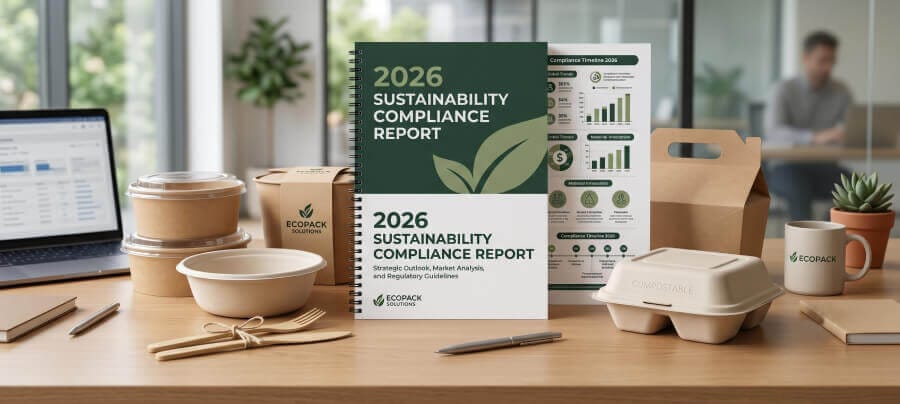
Global environmental initiatives have officially shifted from voluntary goals to mandatory compliance. For global food service procurement managers, understanding the legislative timeline is no longer optional—it is critical to mitigating financial risk.
The European Union’s Packaging and Packaging Waste Regulation (PPWR) officially entered into force on February 11, 2025. Its requirements will generally apply starting August 12, 2026, marking a countdown for every importer in the EU market. A major regulatory milestone follows in 2030, dictating that 100% of packaging on the EU market must be recyclable in an economically viable way. Simultaneously, Extended Producer Responsibility (EPR) laws across the United States are enforcing stricter accountability on producers for the entire lifecycle of their products.
Failing to meet these standards or using terms like “Biodegradable” incorrectly can result in severe “greenwashing” penalties. This guide provides a definitive framework to help you audit your existing materials and future-proof your supply chain.
Decoding Material Science: Which Option Fits Your Strategy?
To achieve compliance, buyers must first identify current packaging materials and assess their environmental impact against precise regulatory definitions.
| Material Category | End-of-Life Definition | Regulatory Status (EU & US) | EasyPack Recommended Solution |
|---|---|---|---|
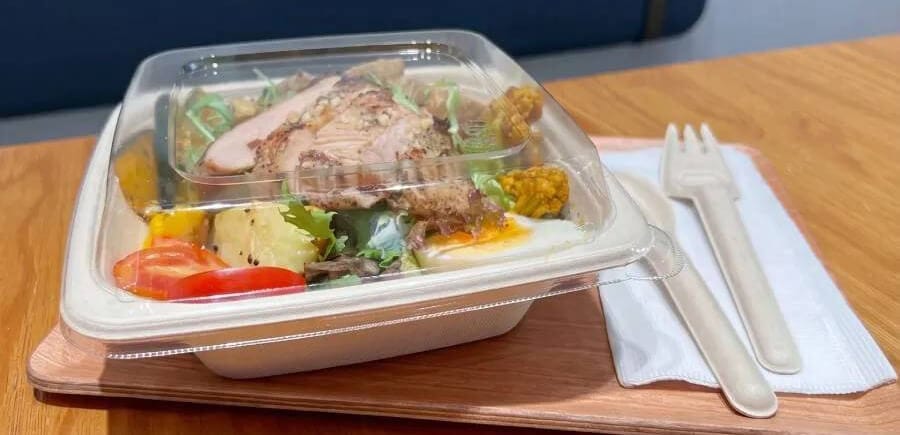
| Compostable | Breaks down into natural, nutrient-rich elements in 60-90 days within industrial facilities. | Highly Recommended. The gold standard for food-contaminated waste. Must hold verifiable BPI or DIN CERTCO certifications. | Sugarcane Bagasse Series (100% plant-based fibers). |
| Recyclable | Capable of being mechanically processed back into food-safe raw materials. | Accepted but Heavily Regulated. Strict structural labeling rules apply (e.g., California SB 343). | High-Grade rPET Series (Utilizes SSP loop; reduces energy use by 75%). |
| Biodegradable | Breaks down eventually via microbial action, but lacks a certified regulatory timeframe. | Warning Zone. Heavily restricted by the US FTC and EU directives due to high microplastic and “Greenwashing” risks. | Avoid uncertified claims. Transition to certified compostable or recyclable tracks. |
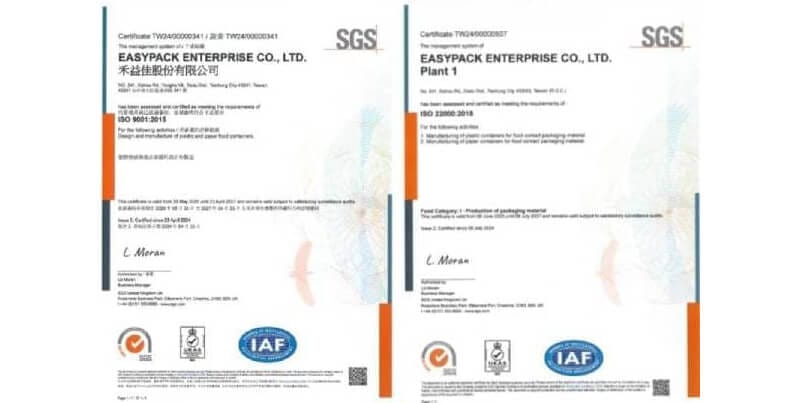
Risk Assessment & Compliance Checkpoint: To avoid greenwashing penalties and ensure strict food-contact safety, packaging must pass rigorous data validation. EasyPack mitigates these cross-border risks by manufacturing under audited ISO 9001 (Quality Management) and ISO 22000 (Food Safety Management) systems. Our molded plant-fiber products are backed by authoritative DIN CERTCO certifications and regular independent third-party laboratory audits. Furthermore, we provide certified PFAS-Free laboratory data to guarantee total fluorine levels remain well below the strict 100 ppm regulatory threshold enforced in California, New York, and Washington.
The 3Rs Evolved: Reduce, Reuse, Recycle—and Renewable
Achieving compliance requires a strategy built on the traditional “3Rs,” but modern global standards demand an operational look beyond just recycling:
- Reduce: The PPWR explicitly targets the minimization of excessive packaging volume and weight (often termed “cheat packaging”) to cut global material consumption.
- Reuse: Implementing standardized, high-durability reusable packaging models helps corporate chains eliminate single-use waste baselines entirely.
- Recycle: Packaging must be engineered from the molecular level to be easily sorted and integrated into existing municipal waste management infrastructures.
- Renewable (The Crucial Addition): True sustainability must center on resource renewability. Responsible sourcing ensures virgin wood fibers are derived exclusively from sustainably managed, certified forests (such as PEFC or FSC sources), protecting baseline ecosystems while providing a circular raw material resource.
Regional Compliance Analysis: The European Union (EU)
Europe’s packaging regulations are driven by the EU Commission’s Green Deal, requiring targeted procurement strategies based on regional waste infrastructures:
- Germany (The Organic Pioneer): Strict adherence to the VerpackG (German Packaging Act) is mandatory. Organic food brands and retail networks heavily prefer the natural aesthetics of unbleached brown kraft paper configurations backed by verified recycling metrics.
- The Netherlands (The Logistics Hub): The winning combination here is heavy-duty kraft packaging configurations paired with certified compostable coatings, ensuring containers withstand high transit volumes within a highly developed, fast-paced delivery ecosystem.
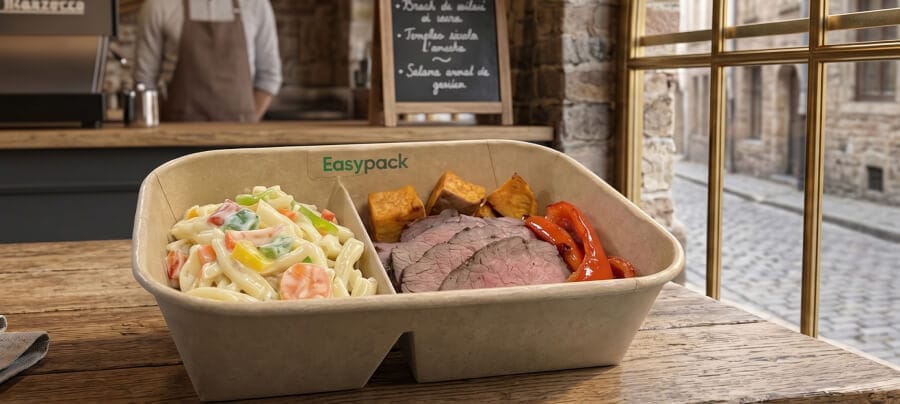
- France (Plastic Reduction Strictness): Retailers strongly favor bio-based materials and natural, organic appearances (like EasyPack’s molded sugarcane pulp series) to align with aggressive national plastic-elimination timelines.
- The Nordics: Swedish and Danish consumers demand maximum supply chain transparency and minimalism. Sourcing unbleached virgin fiber with documented low lifecycle carbon emissions is the absolute key to market entry.
Regional Compliance Analysis: North America
The North American market, guided by US EPA standards and state-level mandates, balances environmental compliance with intense urban operational demands:
- California (The Regulatory Leader): SB 54 aims to phase out single-use plastics by 2032. Simultaneously, the Sustainable Packaging Act (SB 1335) mandates that state-owned food service facilities utilize exclusively reusable, recyclable, or certified compostable packaging.
- PFAS Prohibitions: Multiple states, including New York and Washington, have strictly banned intentionally added PFAS (“forever chemicals”) in food packaging. Sourcing procurement managers must verify independent “PFAS-Free” lab metrics to avoid costly port-of-entry shipment rejections.
- New York (Urban Delivery Performance): In high-intensity metropolitan delivery environments, Structural Integrity is the primary operational priority. Heavy-duty engineered Kraft paper boxes are the preferred choice for their high vertical tensile resistance and compression strength inside third-party courier thermal bags.
B2B Sourcing Strategy: Reducing Transition Complexity
The most significant hurdle for enterprise procurement managers during a green transition is the switching cost and operational friction. To bridge this gap, EasyPack provides a comprehensive range of compliant product configurations designed for seamless supply chain substitution via Precise Volumetric & Structural Equivalents:
- Sugarcane Bagasse Collection (100% Compostable): Single/multi-compartment bento layouts, stackable salad bowls, and sushi trays. Engineered specifically for high-moisture, heavy-sauce culinary profiles.
- Kraft Paper Series (Eco-Aesthetic & Mechanical Strength): Square, rectangular, and round structural boxes, including sushi profiles with windows. Built for maximum load-bearing vertical stacking strength.
- rPET & Recyclable Series (Circular Plastic): Crystal-clear retail deli packaging and enterprise party platters manufactured from high-grade post-consumer recycled PET utilizing advanced Solid-State Polycondensation (SSP) loops.
- Microwaveable PP Solutions: Standardized reusable bento boxes and heat-resistant round injection bowls for commercial ready-meals.
- Specialty Functional Packaging: High-barrier fresh packaging configurations to significantly extend shelf-life under cold-chain environments.
By offering an engineered Standardized Volumetric Matrix, we ensure that your kitchen portion control, box dimensions, and menu layout remain perfectly consistent when transitioning between materials. For example, procurement leads can seamlessly substitute a legacy PP bowl with a Kraft paper bowl or a molded pulp bowl without resizing their outer delivery bags. Furthermore, we provide unique universal lid compatibility specifically for our sushi lines, allowing our high-clarity anti-fog rPET lids to fit perfectly on both legacy plastic sushi trays and our eco-friendly molded pulp sushi boxes. Combined with our patented Anti-Fog technology—which maintains absolute visual clarity for up to 48 hours in 4°C – 7°C retail displays—brands can aggressively prioritize both sustainability mandates and shelf-appeal revenue performance.
A Reliable Partner: Our 3-Step Customization & 7-Step QC Process
A Reliable Partner: Our 3-Step Customization & 7-Step QC Process
Transitioning your corporate packaging shouldn’t be a operational gamble. With over a decade of high-volume manufacturing experience, we act as a defensive compliance alliance for your brand. If you have specific proprietary product footprints in mind, our 3-Step Customization Process:
- Design Consultation
- Concept Discussion
- Product Sampling
ensures your exact manufacturing specifications are met with micro-level precision.
To guarantee zero defect rates on global distribution lines, every batch undergoes our rigorous 7-Step Quality Control Protocol:
- Design Control
- Order Review
- Incoming Material Inspection
- In-Process Inspection
- Finished Product Inspection
- Pre-Shipment Precision Audit
- Customer Satisfaction Tracking
Rather than relying on inaccurate manual testing, EasyPack utilizes specialized laboratory instrumentation to verify exact closure tightness and structural clamping force, guaranteeing secure transit performance.
Inside EasyPack’s Sustainable Manufacturing & Quality Control
Sustainable Packaging Compliance FAQ for Global Buyers
Q1: Are Kraft paper takeout boxes microwave-safe?
A: Yes, Yes, but only if they are engineered with the correct barrier technology. Kraft paper configurations integrated with high-performance food-grade coatings (such as PP linings) can be safely microwaved for short commercial reheating cycles. However, traditional legacy PE-coated or wax-lined paper boxes are not suitable for microwave heating. EasyPack provides clear, laboratory-certified microwave-safe guidelines across our specific Kraft and PP manufacturing lines.
Q2: What is the actual difference between “Compostable” and “Biodegradable”?
A: Timeframe, degradation environment, and toxicological residue. “Compostable” packaging breaks down into nutrient-rich organic elements within a strict regulatory timeframe (60-90 days in commercial industrial composting facilities) and leaves zero toxic chemical residues or synthetic fragments. “Biodegradable” simply means a substrate will break down via natural processes eventually—a vague timeline that could take decades and often leaves harmful microplastics behind. Global regulators now strictly demand certified compostable metrics (such as BPI or DIN CERTCO compliance) to approve eco-friendly claims.
Q3: Are your food packaging products PFAS-Free?
A: Absolutely. With strict bans on PFAS (“forever chemicals”) taking effect across the EU and major US states like New York, California, and Washington, EasyPack guarantees that our molded fiber and engineered kraft paper packaging undergoes independent third-party laboratory verification. We provide comprehensive analytical reports proving total fluorine levels remain well below the strict 100 ppm safety threshold.
Q4: Will switching to compliant sustainable packaging disrupt our current kitchen operations or delivery tracking?
A: Not when partnering with a multi-material manufacturer utilizing volumetric alignment. EasyPack utilizes a standardized dimension matching system. While lids are not universally interchangeable across completely different material categories due to natural fiber expansion boundaries, our structural bases—such as transitioning from a legacy PP container to a Kraft box or plant-fiber tray—are engineered with identical volumetric footprints. This ensures a seamless operational transition with zero disruption to your portion control, automated packing lines, outer delivery bag configurations, or high-density transit stacking.
Future-Proof Your Supply Chain Today
With PPWR enforcement applying in August 2026, regulatory compliance is a critical brand asset. Don’t wait for sudden legislative enforcement to halt your international distribution lines. Contact EasyPack’s compliance engineering team today to audit your existing packaging portfolio and request our latest Sourcing Compliance White Paper.
For a complete overview of our technical specifications, Download our Full Product Catalog here.