


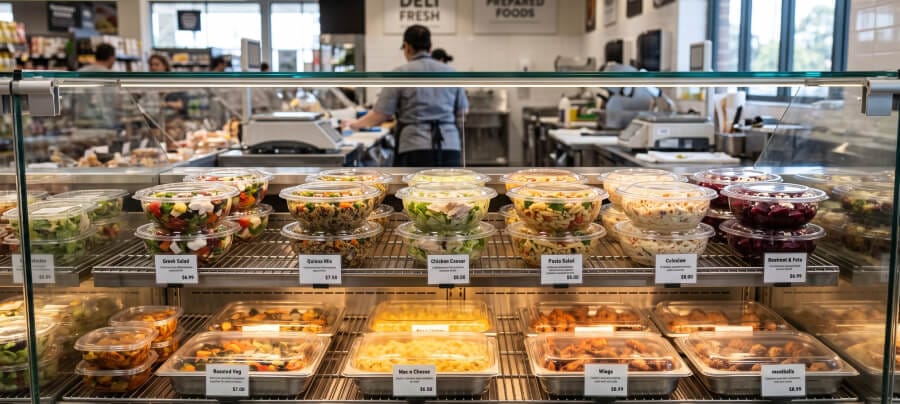
Deli sections and salad bars live or die on whether shoppers reach for the container. If the container isn’t clear enough, shoppers can’t tell how fresh the food looks. If the lid doesn’t seal well, liquid leaks out and gets on the shelf and other packaging. Both hurt sales directly.
This guide covers plastic containers for supermarket deli and salad bar use, specifically rigid, lidded containers, not thin plastic bags, which are a different product line with different selection logic. It covers material differences, clarity, seal quality, and what to confirm before ordering, to help buyers comparing specs skip the guesswork.
Why Plastic Containers Still Dominate Deli Sections
Plastic containers remain the standard choice for deli sections and salad bars for three reasons: clarity, cost, and weight. Kraft paper and other alternative materials still can’t fully replace what fresh food display needs.
Kraft paper container use in deli sections has genuinely grown in recent years, but salad bars sold by weight have a specific need: shoppers want to see at a glance what’s inside and how fresh it looks, and clear plastic still does that more directly than opaque paper. If you’re also evaluating kraft paper containers for your deli section, see Deli Section Packaging Solutions for Supermarkets and Hypermarkets: Kraft Paper Container Applications for more detail on mixing paper and plastic across categories.
Cost and weight are also practical factors. A plastic container is typically cheaper than a kraft paper container of the same size, and that gap widens fast at the volume a weigh-station salad bar goes through. Plastic is also lighter than paper, which matters for deli staff handling and restocking displays for hours at a time.
That doesn’t mean plastic is under no pressure. Plastic restriction regulations in Taiwan and the EU keep tightening, and some deli categories may fall under future restrictions. It’s worth tracking alternative material options alongside your plastic planning rather than locking into a single material.
In practice, many deli sections run a mixed strategy: clear plastic containers stay in the salad bar so shoppers can see the food, while kraft paper containers go into the hot food section for the combined regulatory and presentation benefit. Splitting materials by category works fine, there’s no need to force the entire deli section onto one material.
More chain restaurants built around fresh, made-to-order food have been opening near supermarkets in recent years too, and deli sections aren’t just competing with other supermarkets anymore. A salad bar’s presentation, clarity included, has become part of how a deli section holds onto customers who could just as easily walk into a restaurant next door instead.
Choosing the Material: PET vs. PP vs. PS
Deli sections commonly use three plastic materials, PET, PP, and PS. The differences come down to heat resistance, clarity, and cost.
What Is PET Best For in a Deli Section?
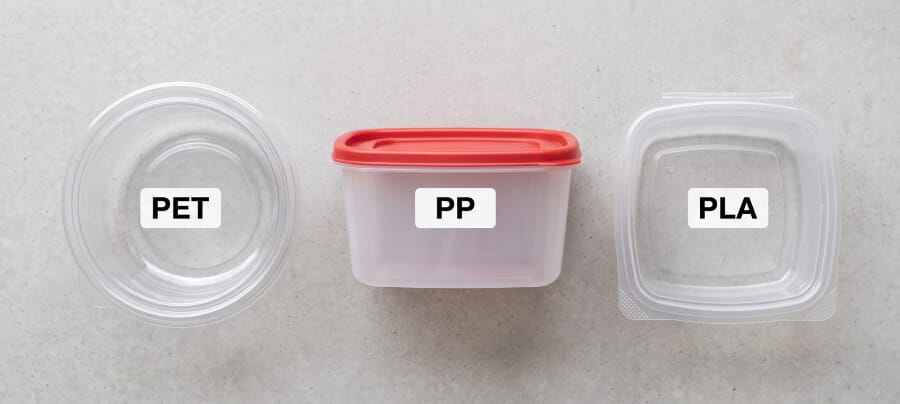
PET (polyethylene terephthalate) has the highest clarity and a rigid feel, making it the default choice for salad bars and cut fruit displays that need high transparency. Heat resistance is limited, generally stable from room temperature to slightly above, so it’s usually not suited to hot-off-the-line food and shouldn’t go in the microwave. Heating it risks warping and off-gassing.
What Is PP Best For in a Deli Section?
PP (polypropylene) has a wider heat range and can handle a standard household microwave, making it a fit for hot boxed meals or items that need reheating. Clarity runs slightly lower than PET, with a bit of a matte look, but still within an acceptable range for display, making it a common middle-ground choice for deli sections covering both hot food and salad. The tradeoff is that PP is a bit softer than PET, and a large filled container can flex slightly when picked up. Test the base’s support strength along with clarity before choosing.
What Is PS Best For in a Deli Section?
PS (polystyrene) is the lowest-cost option, but it’s brittle and has weaker heat resistance, making it suited to refrigerated or frozen short-term display rather than hot food or anything handled over a long period, where it risks cracking. PS containers also get more brittle at the corners in cold conditions, so handle them carefully near freezer cases in winter. Ask the supplier for cold-condition impact test data before ordering rather than relying on room-temperature drop-test results alone.
None of these three materials is a universal answer. A deli section carrying hot food, salad, and desserts side by side often ends up running all three at once, matched to what each category actually needs, rather than standardizing on a single material across the board.
Choosing Clarity: What Actually Affects Visibility
Clarity isn’t just about the material itself, it also depends on thickness, surface treatment, and how much of the surface is taken up by printing.
Thinner containers are generally clearer, but a container that’s too thin loses shape under weighing or stacking, so the two need to be balanced rather than just picking the thinnest option available. A matte or scratch-resistant surface treatment reduces clarity, so it’s worth checking an actual sample before ordering rather than judging from the material name on a spec sheet.
If the printed area takes up too much surface, it cuts into the visible display area. For custom-printed containers, confirm the print area won’t block the main viewing surface before finalizing the design.
Suppliers also don’t define “high clarity” consistently. Some containers labeled high clarity arrive with a faint yellow tint, and how much they yellow over time varies too, details a spec sheet usually won’t spell out. Ask for a sample and compare it under the actual display lighting rather than judging from a supplier’s product photos, since store lighting and camera-lit product photos can make the same material look noticeably different.
Why Do Plastic Containers Fog Up in a Refrigerated Case?
Refrigerated and frozen display cases have a big temperature difference between inside and outside the container, so condensation forms easily, showing up as a layer of foggy droplets that blocks visibility. This is especially noticeable on containers without anti-fog treatment. If your deli section displays mainly in refrigerated cases, choose a container with an anti-fog coating or film, and confirm with your supplier what conditions their anti-fog testing was actually done under, a sample that looks clear at room temperature won’t necessarily perform the same way in a refrigerated case.
Choosing Seal Quality: Lid Design and How to Test It
Seal quality comes down to how well the lid fits the container’s edge. Common designs are hinged lids (top and base connected as one piece), separate lids, and snap-fit lids, with seal quality increasing in that order and ease of use decreasing in the same order.
For items that release liquid easily, like mixed vegetables or cut fruit, a snap-fit lid or a gasket-sealed lid is the safer choice. For dry or low-moisture items, a hinged lid’s convenience is usually enough, there’s no need to trade away speed of use for seal strength you don’t need.
Delivery platform orders raise the bar on seal quality further. Containers go through more handling and jostling in transit, so even a hinged lid that performs fine on the shelf is worth testing separately for leaks after shaking before you assume it’ll hold up for delivery. Don’t carry over the same spec you use for in-store display without testing it.
How Do You Test Seal Quality for Salad and Deli Containers?
A practical test: fill the container roughly seven to eight tenths full with liquid or a saucy food item, close the lid, then flip it over or shake it and check the edges for leaking, this reflects real-world use far better than judging the lid by its appearance alone. It’s also worth running a stack test: stack filled containers three to five high and confirm the bottom container’s lid doesn’t deform or leak under the weight, which matters especially for the multi-tier display racks common in hypermarkets.
Run both tests on an actual sample rather than trusting a supplier’s written seal rating. A lid that’s rated for a good seal on paper can still perform differently once it’s holding real food at real fill levels, and the gap between the two only shows up once you test it yourself.
Matching Containers to Deli Categories: A Selection Table
Different deli categories need different levels of clarity and seal quality, so it helps to sort by category first, then match each one to the right material and design.
| Deli Category | Recommended Material | Clarity Need | Seal Need |
|---|---|---|---|
| Salad Bar (Sold by Weight, greens, cut fruit) | PET | High | Medium (snap-fit or gasket lid) |
| Hot Boxed Meals, Fried Items | PP | Medium | Low (hinged lid is enough) |
| Marinated/Dressed Salads, Sauced Items | PET or PP | High | High (snap-fit required) |
| Short-Term Refrigerated Display (desserts, sides) | PS or PET | High | Low |
Pre-Purchase Checklist
Beyond material, clarity, and seal quality, a few more specs are worth confirming before ordering plastic containers, so you don’t find out something doesn’t work only after a large order has already shipped. None of these four are visible from a spec sheet alone, they only surface once you ask directly or test a sample yourself.
- Heat range: For anything meant to go in the microwave, confirm the container’s heat tolerance is sufficient, to avoid warping or off-gassing during reheating.
- Certification documents: Ask your supplier directly for FDA or the relevant local food safety authority’s certification, and confirm whether the material is BPA-free.
- Custom printing feasibility: Chain hypermarkets usually need consistent branded printing. Confirm the minimum print quantity and whether the print area affects clarity before ordering.
- Stacking and storage space: Deli section storage space is usually limited. Confirm whether empty containers nest to save storage space and whether lids and bases can be stacked separately. This affects your restocking frequency and storage cost, and it’s easy to overlook early in the buying process, only to find storage space falls short once a large order arrives.
If your order volume is large enough to need cups, salad containers, and takeout boxes together, we’ll cover a fuller integrated procurement strategy in an upcoming article. If you want a full comparison of plastic lid materials first, see “Choosing OPS, PET, or PP Lids: Use Cases and Limits Restaurant Buyers Need to Confirm Before Ordering.”
There’s no single right answer for deli section container selection. A high-clarity material isn’t necessarily also well-sealed, and a strongly sealed design may not be as easy to use, so it’s worth getting a sample and testing it against your deli section’s actual use before ordering, rather than deciding from the numbers on a spec sheet alone.
EasyPack offers plastic salad containers and deli containers in a range of materials, with a full lineup of sizes and custom printing options. Contact our sales team for samples and to discuss specs and pricing for your specific items.