


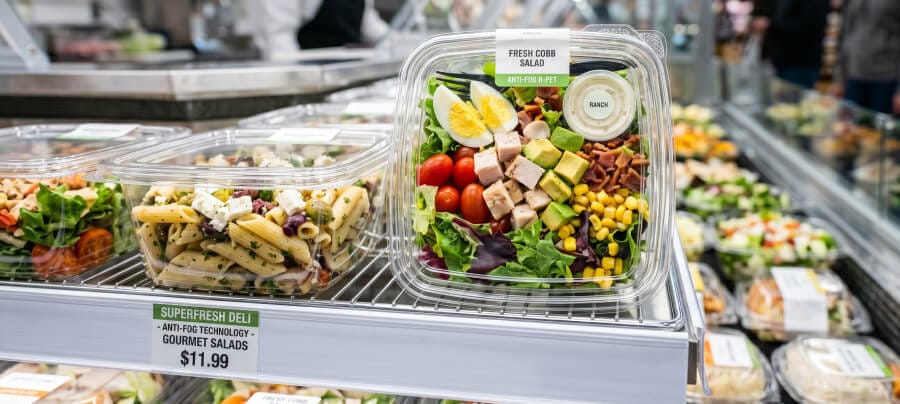
I. The Strategic Shift: Why rPET is Non-Negotiable for 2026 Retail
For a retail operations manager or procurement lead, the shift to rPET (Recycled Polyethylene Terephthalate) is no longer just a trend—it is a critical compliance shield. With the EU’s Packaging and Packaging Waste Regulation (PPWR) enforcing strict measures starting August 2026 , and Extended Producer Responsibility (EPR) laws sweeping across North America, businesses that fail to integrate recycled content face significant financial and reputational risks. Global food service giants and retail chains are aggressively phasing out virgin plastics to meet these stringent ESG (Environmental, Social, and Governance) targets. (If you are currently evaluating different material end-of-life options for your supply chain, read our Biodegradable vs. Compostable vs. Recyclable Food Packaging: A Complete 2026 Guide for Global Buyers)
But beyond regulatory compliance, the real question for buyers remains: Is rPET safe enough to protect your brand’s reputation and food integrity? This guide breaks down the manufacturing science, international safety standards, and real-world retail performance of rPET, proving why it is the ultimate choice for modern sustainable packaging.
II. From Bottle to Box: The “Super-Clean” Manufacturing Process
Understanding exactly how rPET is made is key to answering the safety question. High-grade rPET doesn’t just come from basic “recycling”; it is the product of a highly regulated, “Super-Clean” technological loop designed to eliminate contaminants.
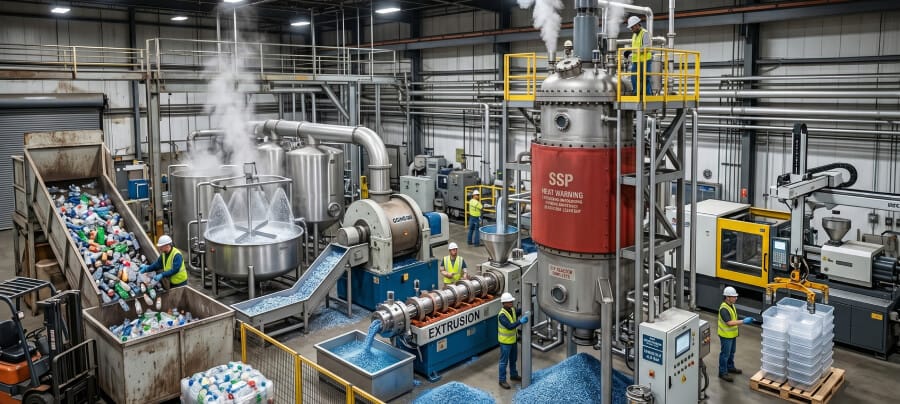
- Sorting & Cold/Hot Washing: Post-consumer PET bottles are collected and sorted by advanced infrared sensors to ensure material purity. They are then subjected to intensive cold and hot washing to completely remove adhesives, labels, and organic residues.
- Extrusion & Filtration: The clean plastic flakes are shredded, melted, and passed through ultra-fine micro-filters to remove microscopic physical impurities.
- SSP (Solid-State Polycondensation) – The Critical Safety Stage: This is the most crucial step for chemical safety. The PET resin is heated under a high vacuum or inert gas for several hours outside the extruder. This process achieves two indispensable goals:Molecular Re-linking:
- It restores the material’s Intrinsic Viscosity (IV), meaning it rebuilds the structural strength of the polymer chains to match that of virgin plastic. This ensures the final containers won’t crack or collapse under heavy stacking.
- Deep Decontamination: SSP technology effectively strips away Volatile Organic Compounds (VOCs) and Non-Intentionally Added Substances (NIAS) at a molecular level. This ensures that any chemical migration into food remains at a negligible risk level—strictly below 1.5 micrograms per person per day.
III. International Standards: The Guardians of rPET Safety
Retailers must understand the regulatory landscape to mitigate liability. A “food-grade” claim must be backed by rigorous global certification and scientific validation.
1. FDA Letter of No Objection (LNO)
In the United States, the Food and Drug Administration (FDA) reviews each recycling process individually. To prove safety, manufacturers must undergo a “Challenge Test.” In this test, plastics intended for recycling are intentionally contaminated with surrogate substances. If the recycling and decontamination process (like SSP) can successfully remove these high concentrations of simulated contaminants to safe levels, the FDA issues a Letter of No Objection (LNO). This is the gold standard for North American retail, ensuring the material is safe for direct food contact. EasyPack’s supply chain is fully compliant with FDA LNO protocols.
2. EFSA Scientific Opinions
In Europe, the European Food Safety Authority (EFSA) evaluates and authorizes rPET recycling processes. EFSA requires that at least 95% of the recycled content must come from food-contact applications. The residual concentration of contaminants in the recycled PET must remain below 3 mg/kg, ensuring that food exposure does not exceed 0.0025 μg/kg of body weight per day.
3. Inherently BPA-Free and Non-Toxic
Unlike certain plastics that raise toxicity concerns, PET—and consequently recycled PET (rPET)—is naturally BPA-free and contains no phthalates.
Crucial Safety Warning: No Microwave for rPET
Transparency builds B2B trust. While rPET is the ultimate sustainable packaging for chilled deli foods, fresh produce, and ambient products, it is not designed for microwave use or high-heat applications. Exposing rPET to extreme heat can cause deformation and potentially allow harmful chemicals to leach. For microwave heating purposes, procurement managers should switch to EasyPack’s Microwaveable PP container series.
▶ To explore a detailed toxicological breakdown and structural comparison between recycled substrates and conventional polymers, read our comprehensive industry evaluation: Is rPET Safe for Food Packaging? What Businesses Need to Know
IV. Technical Comparison: rPET vs. Virgin PET
Does choosing rPET mean sacrificing quality? Let’s look at the operational data:
| Technical Attribute | Virgin PET | High-Grade rPET (via SSP) | Retail Impact |
|---|---|---|---|
| Clarity | 92% Light Transmission | 90-91% Light Transmission | Minimal visual difference; maintains extreme “Shelf-Appeal.” |
| Tensile Strength | High | Comparable (restored via SSP) | Excellent durability and load-bearing stacking for supermarket shelves. |
| Food Safety | Standard | Certified via FDA LNO / EFSA | Both are equally safe for cold and ambient food contact. |
| Carbon Footprint | 100% (Baseline) | ~64% of Virgin PET | Significant boost to Corporate ESG scores (reduces CO₂ by 36%). |
| Energy Usage | 100% (Baseline) | ~25% of Virgin PET | Massive reduction in lifecycle energy cost (saves 75% energy). |
V. The Environmental ROI: Beyond the “Green” Label
The environmental benefits of rPET are not just marketing buzzwords; they are quantifiable assets for your company’s annual ESG reporting:
- Massive Energy Savings: Producing rPET from completely recycled materials consumes 75% less energy than manufacturing virgin plastic from scratch.
- Climate Action: Switching to rPET reduces carbon dioxide (CO₂) emissions by approximately 36%, helping global retailers reach Net-Zero goals faster.
- Closing the Loop (Circular Economy): By creating a market demand for rPET, retailers directly prevent post-consumer plastic bottles from entering landfills and oceans, operating within a true circular economy.
For a deeper dive into how regulatory bodies define “circularity”, explore our Biodegradable vs. Compostable vs. Recyclable Food Packaging: A Complete 2026 Guide for Global Buyers
VI. Real-World Applications: Boosting Retail Performance & Sourcing Strategy
rPET is versatile, but its true commercial power is seen in the Chilled Food & Deli packaging sectors, where visual presentation drives revenue.
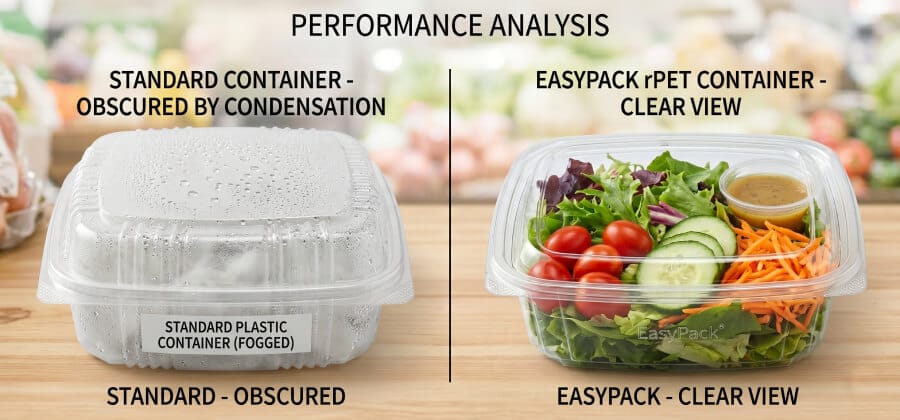
1. The Anti-Fog Advantage in Supermarkets
In chilled deli and salad displays (typically 4°C – 7°C), the biggest enemy of sales is condensation. When standard virgin PET lids fog up, the product looks stale, leading to increased food waste. EasyPack elevates its rPET Series by incorporating patented Anti-Fog Technology. This ensures that the lid remains crystal clear for up to 48 hours in chilled environments, directly boosting “impulse buy” rates by showcasing vibrant, fresh ingredients.
2. Sourcing from Taiwan (MIT) & The Supplier Audit Checklist
Partnering with an experienced “Made in Taiwan” (MIT) manufacturer like EasyPack eliminates middleman friction and ensures uncompromising safety through our rigorous 7-Step Quality Control protocol. To prevent non-compliant materials from entering your supply chain, we empower procurement managers with transparency.
Quality Checklist: What to Demand from Your rPET Supplier’s CoA (Certificate of Analysis):
- FDA LNO or EFSA Opinion: Proof of process-specific safety approval.
- IV (Intrinsic Viscosity) Values: Ensures the structural strength of the plastic has been restored.
- Moisture & Contaminant Levels: Verifies the effectiveness of deep decontamination.
- Migration Testing Reports: Ensures heavy metals and chemicals remain well below safe regulatory limits.
- Traceability Documents: Confirms the post-consumer origin of the resin and mass balance.
VII. Is Your Business Ready for the rPET Switch?
The safety of rPET food containers is a proven science. By partnering with a manufacturer that utilizes SSP decontamination, strictly follows FDA/EFSA regulatory standards, and provides transparent CoA documentation, retailers can secure their brand reputation while leading the market in sustainability.
Future-Proof Your Retail Shelf Today. Contact EasyPack to request a quote, audit our certifications, or order free samples of our crystal-clear, FDA-compliant anti-fog rPET packaging series.