


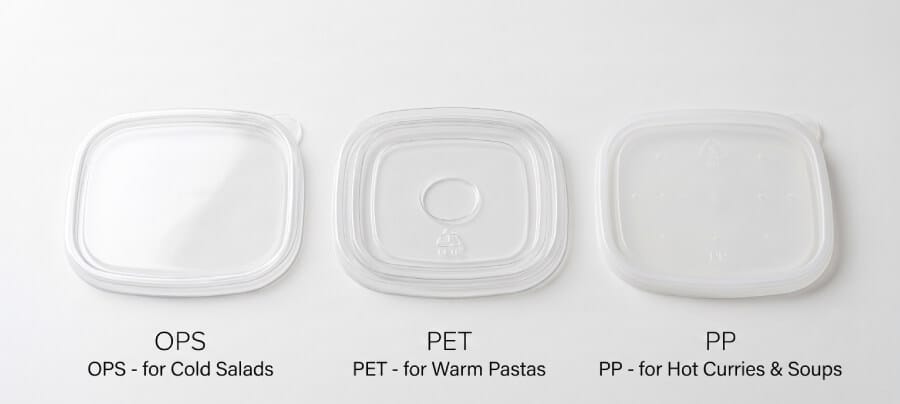
Food container lids may seem like a minor detail, but the wrong material choice or improper handling will cause problems from the first use. OPS lids have high brittleness and crack easily under certain handling conditions; PET lids have a heat resistance ceiling of only 60°C and may deform on direct contact with hot food; PP lids offer the best heat resistance, but many buyers are unaware this option exists.
Choosing the right material significantly reduces cracking rates and customer complaints. Choose the wrong one, and you are simply delaying the problem until after delivery. This article breaks down the actual performance limits of all three materials and explains which use cases each one fits, so foodservice buyers can confirm specifications before placing an order.
OPS Lids: Best Clarity for Cold Food and What to Know Before You Order
OPS is one of the most transparent lid materials on the market and clear in appearance, lightweight, and relatively low in cost. It is widely used as the standard lid for cold food takeout containers.
What Makes OPS Different
The high transparency of OPS allows customers to see the contents clearly the moment they receive their order, making it a common choice for items that require visual display such as salad boxes and fresh food platters. But a core weakness is built into the material: high brittleness and limited impact resistance. This is not a quality issue and it is a physical property of the material itself, and buyers need to design their handling processes around it.
What Causes OPS Lids to Crack
OPS lid cracking is in most cases not a material defect and it results from improper handling. The following are the most common causes:
- Twisting to open: OPS lids are designed for vertical snap-fit. Twisting applies lateral pressure directly to the lid rim and causes cracking. The correct method is to lift straight up.
- Heavy stacking: When multiple containers are stacked, if the lower containers bear excessive weight, the OPS lid rim takes the load first and develops cracks at the corners.
- Thermal shock: Removing a container from refrigerated storage and immediately filling it with hot food causes rapid thermal expansion and contraction in the OPS material, producing fine cracks.
- Pressing down on the lid: Pressing firmly on the center of the lid after closing applies direct pressure to the OPS surface and is a common cause of central cracking.
When to Use OPS Lids
- Cold food takeout: salads, sashimi, cold platter arrangements
- Desserts: cake slices, macarons, refrigerated sweets
- Cold drink short-distance delivery: bubble tea, juice
- Items requiring clear display, such as self-serve counters and on-site retail
Not suitable for: hot food service, long-distance delivery with heavy stacking, or items requiring microwave reheating.
PET Lids: More Durable Than OPS, But Not for Hot Food
PET has better impact resistance than OPS and is less likely to crack from impact during transport and delivery, making it the mainstream lid material for many food takeout containers. But PET has a critical limitation buyers frequently overlook: a heat resistance ceiling of approximately 60°C.
What Happens When PET Exceeds 60°C
When a PET lid contacts food or an environment above 60°C, the material begins to soften, the lid surface deforms slightly, and fit precision drops. Previously well-sealed lid rims may develop gaps, leading to sauce leakage or lids that no longer snap closed properly. Direct filling with freshly cooked hot food, or heat build-up inside a thermal delivery bag, are both common scenarios where this threshold is exceeded.
When to Use PET Lids
- Ambient temperature takeout: sandwiches, wraps, cold dressed dishes
- Cold drinks and beverage cup lids
- Display packaging for refrigerated prepared foods
- Items requiring long-distance delivery where the contents stay below 60°C
Not suitable for: hot soups, freshly cooked hot food, or scenarios requiring microwave reheating.
PP Lids: The Solution When Heat Resistance Is Non-Negotiable
When neither OPS nor PET can meet the heat resistance requirement, PP is the right choice. PP handles temperatures above 100°C, and whether the application is direct hot food service, a thermal delivery bag environment, or microwave reheating, a PP lid maintains structural integrity — no deformation, no loss of seal precision.
What Makes PP Different
Compared to OPS and PET, PP has slightly lower transparency and a mildly frosted appearance, but outperforms both in heat resistance and impact resistance. For operators serving hot food takeout, the difference in transparency typically has no practical impact on day-to-day needs.
When to Use PP Lids
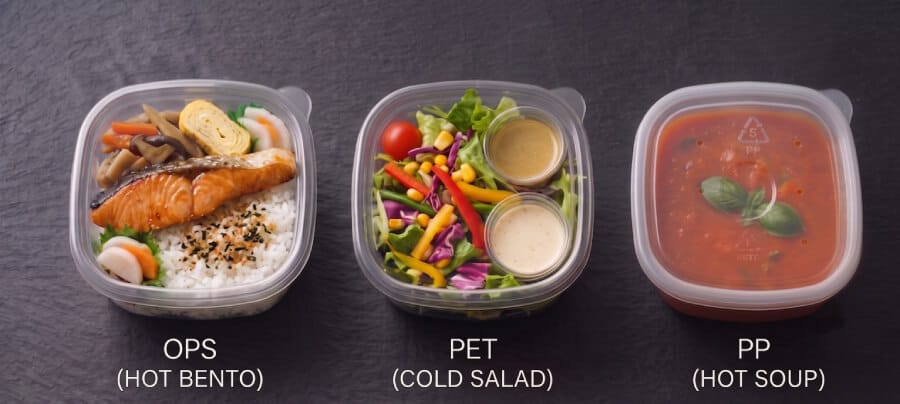
- Hot soups, stews, braised dishes, and other high-temperature liquid foods
- Bento boxes and hot convenience meal boxes
- Takeout items requiring microwave reheating
- Steamed foods, such as steamed egg, steamed fish, and steamed dumplings
- Takeout items delivered in thermal bags or warm environments
Purchasing advice: If any item on your menu requires heat retention or may exceed 60°C, specify PP lids directly and do not substitute PET.
OPS vs. PET vs. PP: Side-by-Side Comparison
| Specification | OPS | PET | PP |
|---|---|---|---|
| Transparency | Highest | High | Medium (slightly frosted) |
| Heat Resistance Ceiling | ~60-70°C | ~60°C | 100°C and above |
| Impact Resistance | Low (high brittleness) | Medium | High |
| Microwave Safe | No | No | Yes |
| Temperature Range | Cold food | Ambient to cold | Cold to hot |
| Relative Cost | Low | Medium | Medium to high |
Match Your Lid Material to Your Menu
- Salads, sashimi, cold platters: choose OPS and best transparency and lowest cost; confirm staff use the correct vertical opening method.
- Ambient temperature sandwiches, wraps, cold dressed dishes: choose PET and better impact resistance than OPS, well suited to long-distance delivery.
- Hot soups, stews, hot bento meals: choose PP — the only option that reliably handles temperatures above 60°C.
- Items requiring microwave reheating: choose PP, and print a microwave-safe symbol on the container.
- Long-distance delivery and heavy stacking: choose PET or PP and avoid OPS.
Common Mistakes to Avoid
- Using OPS lids for hot food: thermal shock causes lid cracking and the leading cause of returns and customer complaints.
- Twisting OPS lids open: OPS is designed for vertical snap-fit; twisting is the most common cause of operator-induced cracking and should be covered explicitly in staff training.
- Assuming PET is microwave-safe: PET cannot withstand high temperatures, will deform in the microwave, and creates food safety risks and do not use for items that require reheating.
- Mixing lids and containers of different materials: lid-to-container fit dimensions are designed per material; mixing materials may result in incomplete sealing and increased leakage during delivery.
- Substituting PET for PP on hot food items: a common cost-driven decision, but PET will deform above 60°C and this delays the problem rather than solving it.
Frequently Asked Questions (FAQ)
OPS and PET lids look similar. How do I tell them apart when sourcing?
The appearance is indeed similar. The most reliable method is to require the supplier to clearly state the material in the product specification sheet and confirm the resin identification code on the container base: OPS is marked “6” or “PS”; PET is marked “1” or “PETE”; PP is marked “5” or “PP”. Request samples before ordering and verify the code before placing an order.
Can PP lids be microwaved?
Yes. PP handles temperatures above 100°C and can be microwaved for short durations. Request a heat resistance test report from the supplier and have a microwave-safe symbol printed on the container so end users can identify it clearly.
Can the same container be used with lids of different materials?
Lid-to-container fit dimensions are designed to specific tolerances. Even if lids of different materials have similar outer diameters, differing thermal expansion coefficients can affect seal quality. Confirm that the lid and container are from the same supplier’s matched specification set, or conduct a physical fit test before placing a formal order.
We currently use OPS lids and want to reduce cracking. Should we switch everything to PET?
A blanket switch is not recommended. OPS still offers clear advantages in transparency and cost for cold food applications. In most cases, cracking can be significantly reduced by establishing correct handling SOPs — lift to open vertically, avoid heavy stacking, and keep away from hot food. Identify the primary cause of cracking first, then decide whether to revise the handling process, switch specific items to PET, or move hot food items to PP.
OPS, PET, and PP each cover a different part of the spectrum and there is no single best option for all scenarios. OPS suits cold food display; PET suits ambient temperature delivery; PP suits hot food and items requiring microwave reheating. Confirming the temperature requirement for each item on your menu and matching the lid material accordingly is the most effective way to prevent cracking and returns.
Before placing an order, request samples for your highest-temperature and highest-fat menu items and run physical tests first. Confirm the specification before submitting a formal order. Contact the EasyPack sales team to request lid samples across all three materials.