


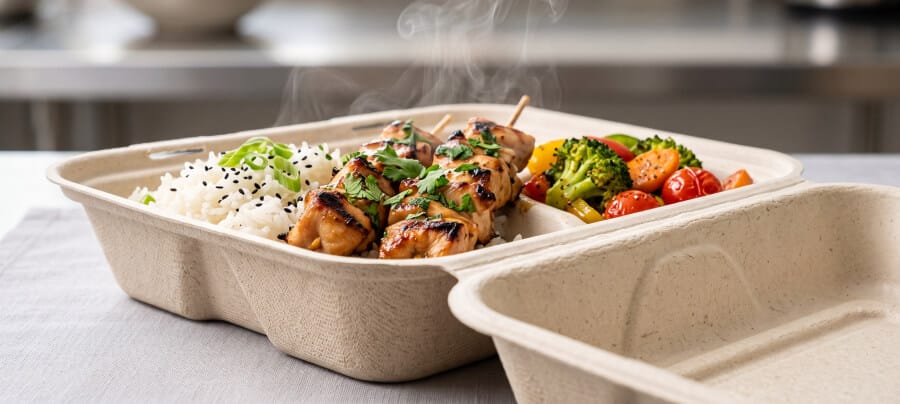
The Reliability Challenge in High-Volume Food Service
For global food service procurement managers and large-scale retail chains, transitioning to sustainable containers is no longer optional—but it comes with immense operational anxiety. The primary concern is rarely the environmental impact metrics; it is operational reliability. Can eco-friendly materials survive the rigorous logistical demands of high-frequency third-party delivery, intense commercial microwave heating, and prolonged supermarket retail display without structurally collapsing?
In the B2B packaging sector, “reliability” encompasses rigorous spill resistance, wide thermal tolerance, raw material supply chain stability, and absolute food-contact safety compliance. This strategic guide explores why molded Sugarcane Bagasse has emerged as the industry’s most dependable compostable packaging alternative, capable of satisfying both aggressive corporate ESG goals and the harsh physical realities of high-volume catering networks.
What is Bagasse (Sugarcane Pulp)?
Bagasse is the dry, organic fibrous residue remaining after sugarcane stalks are crushed to extract their juices for sugar production. While conventional wood-based paper pulp requires trees that take decades to grow and mature, sugarcane is a rapidly renewable agricultural crop with an intensive harvest cycle of just 10 to 12 months, minimizing its upstream environmental baseline. Through high-pressure automated thermoforming molds, these upcycled natural plant fibers are bound tightly into an inherently sturdy, rigid structure. The final result is a high-performance, eco-friendly food packaging solution that is 100% biodegradable and industrially compostable.
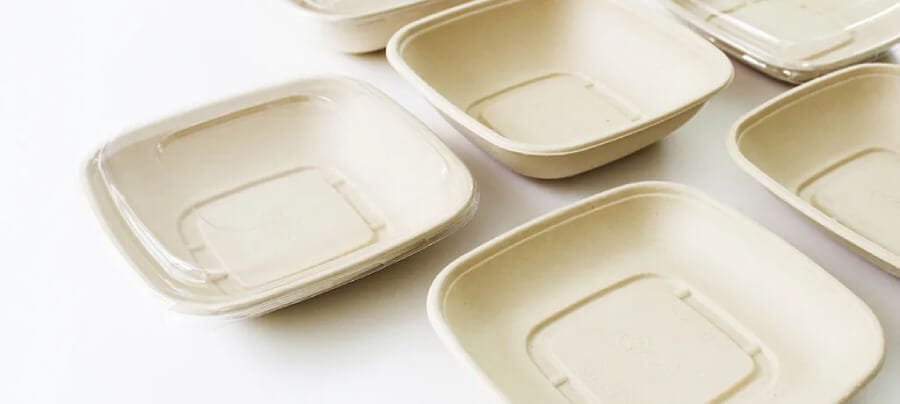
Decoding Performance: Bagasse vs. Industry Legacy Materials
To assist corporate procurement directors and operations managers in mitigating supply chain risk, the following technical matrix evaluates sugarcane bagasse against traditional industry substrates:
| Technical Attribute | Molded Sugarcane Bagasse | Polystyrene (Styrofoam) | Traditional Plastic (PET/PP) |
|---|---|---|---|
| Microwave & Oven Safety | -20°C to 210°C (-4°F to 410°F). Safe for commercial freezers, microwave reheating, and short conventional oven workflows. | Hazardous. Structurally single-layered; easily melts under heat and releases chemical toxins. | Material-Dependent. Only high-grade injection PP is safe for thermal reheating. |
| Structural Integrity | High Load-Bearing Capacity. Inherently rigid fiber grid makes it highly stackable. | Low. Flimsy construction; highly prone to collapsing under trapped moisture. | High. Possesses excellent mechanical tensile strength and safe stackability. |
| Sustainability Value | 100% Industrially Compostable. Fully degrades into organic soil nutrients within 60–90 days. | Non-Biodegradable. Permanent synthetic polymer; remains in landfills for 500+ years. | Recyclable. Technically capable of recycling, but real-world circularity rates remain limited. |
| Chemical Safety | PFAS-Free Green Options. Naturally non-toxic and contains no synthetic polymers. | High Chemical Risk. Severe hazard of chemical migration and toxic compound leaching under heat. | Leaching Risk. Potential risk of BPA, plasticizers, and phthalates in uncertified lower-grade lines. |
⚠️ Critical Sourcing Disclaimer: Actual conventional oven compatibility is strictly dependent on subsequent lamination material and lining specifications. While uncoated natural bagasse bases easily withstand extreme temperatures up to 210°C, configurations utilizing specialized barrier linings (such as conventional PE coatings) are not suitable for conventional oven baking.
Addressing Common Buyer Doubts
Is Bagasse Toxic?
Absolutely not. Sugarcane pulp consists entirely of natural cellulose and hemicellulose fibers and is inherently non-toxic and chemical-free. EasyPack ensures complete food-contact safety by manufacturing under strict ISO 22000 hygiene management systems and providing verified, independent laboratory certification guaranteeing total fluorine levels remain well below the 100 ppm regulatory threshold (PFAS-Free status).
Is Bagasse Flammable?
While uncompressed loose agricultural fibers are flammable, EasyPack’s finished molded food containers possess a remarkably high ignition point. This is achieved due to the extreme material density and compaction executed during our automated 180°C–200°C high-pressure thermoforming manufacturing process, ensuring total safety across professional commercial kitchen arrays.
EasyPack’s Bagasse Packaging: Engineered for Real-World Sourcing Performance
To bridge the gap between corporate sustainability mandates and hard bottom-line sales performance, EasyPack offers a specialized Sugarcane Bagasse Food Containers designed for demanding operational scenarios. A prime example of this engineering focus is our flagship 750ml Hexagonal Bagasse Salad Bowl, which highlights our factory’s advanced manufacturing capabilities:
- High-Standard Spill-Proof Engineering: We have engineered a practical solution to the biggest headache in third-party food delivery: transit leaks. EasyPack’s bagasse containers feature precision-machined rims designed to create a tight, snap-fit closure. While 100% airtight, leak-proof performance is unlocked via our pure plastic-to-plastic configurations, our cross-material pairings (such as fitting our high-clarity anti-fog rPET lids onto a sugarcane pulp base) provide industry-leading Spill-Proof performance, successfully eliminating accidental sauce or dressing spills during turbulent courier transits.
- Heavy-Duty Stackability & Load-Bearing: Rather than relying on simple manual checks, our products undergo strict automated instrument testing to verify single-piece vertical load resistance and stacked compression boundaries. This ensures that our stackable bowls and multi-compartment bento layouts maintain complete dimensional stability within delivery bags and do not collapse under trapped steam humidity.
- Extreme Temperature Elasticity: Engineered to perform flawlessly across a wider thermal envelope ranging from -20°C to 210°C (-4°F to 410°F), our uncoated bagasse containers seamlessly transition from industrial cold-chain freezers straight into commercial warming ovens or microwave setups.
- Multi-Compartment Bento Matrices: Deep-molded internal structural dividers prevent flavor crossover, grease bleeding, and liquid migration between side dishes—ideal for high-end corporate catering and meal prep workflows.
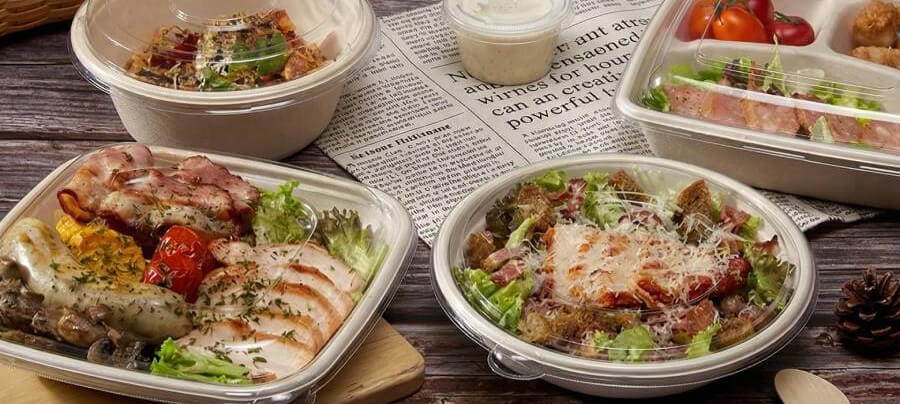
- Salad Bowls & Sushi Trays (Featuring Anti-Fog Technology): We pair our organic, natural plant-fiber bases with high-clarity rPET lids equipped with patented Anti-Fog coatings. This ensures the lid maintains 48-hour absolute visual transparency in 4°C–7°C refrigerated retail displays, directly maximizing impulse-buy rates at the point of sale.
- Portion & Sauce Cups: 100% industrially compostable structural alternatives to single-use plastic condiment and dipping cups, allowing chains to achieve complete plastic-free branding across their menu.
Global Sourcing & Supply Chain De-risking
Strategic enterprise buyers prioritize supply chain agility and price predictability above all else:
- Immunity to Oil Price Volatility: Unlike traditional petro-chemical plastics, agricultural bagasse raw material pricing is completely decoupled from crude oil markets, ensuring long-term price predictability and accurate quarterly margin forecasting for large restaurant chains.
- Standardized Sourcing Equivalents: Our advanced multi-material manufacturing capabilities (Molded Pulp, Kraft Paper, rPET, and PP) allow us to build standardized volumetric equivalents. This allows procurement leads to transition between material types (e.g., swapping a legacy plastic container for a bagasse or kraft alternative) with zero resizing costs for outer delivery bags or kitchen portioning tools.
- Comprehensive Regional Compliance: EasyPack’s entire bagasse portfolio aligns perfectly with the German VerpackG mandates, upcoming EU PPWR circular requirements, and North American state-level EPA sustainability acts.
Sustainable Bagasse Packaging Sourcing FAQ
Can you microwave and bake sugarcane bagasse food containers?
Yes. EasyPack’s molded sugarcane bagasse is highly heat-resistant, natively tolerating an extreme thermal range from -20°C up to 210°C (-4°F to 410°F). This makes our uncoated containers perfectly safe for both commercial microwave reheating and conventional oven applications without any risk of structural warping or chemical leaching. However, please verify if a specialized plastic lining has been added, as coatings like PE will alter oven compatibility.
Will bagasse containers become soggy when holding hot soup or heavy oils over long periods?
Natural molded plant-fiber possesses inherent microscopic pores, meaning uncoated pulp may experience minor softening over extended exposure to boiling liquids or heavy-grease profiles. To guarantee maximum structural stability and premium spill-proof performance under demanding menu conditions, EasyPack offers specialized PLA-lined sugarcane bagasse options. This plant-based biopolymer lining effectively seals the fiber grid against intense oil and moisture migration while keeping the entire packaging configuration 100% industrially compostable.
Does EasyPack provide verified PFAS-Free bagasse data?
Yes. We provide fully traceable, independent laboratory analysis reports ensuring total fluorine levels remain well below the strict 100 ppm safety threshold required under New York, California, and Washington state laws.
Conclusion: A Strategic Commercial Move
Transitioning to molded sugarcane bagasse is no longer just an environmental marketing gesture; it is a calculated, defensive business decision to eliminate regulatory compliance liabilities and improve delivery transit quality.
Contact EasyPack today to request your free sample kit, or download our full product catalog to explore how our standardized volumetric matrix and precision-engineered spill-proof lids can simplify your global packaging supply chain.