


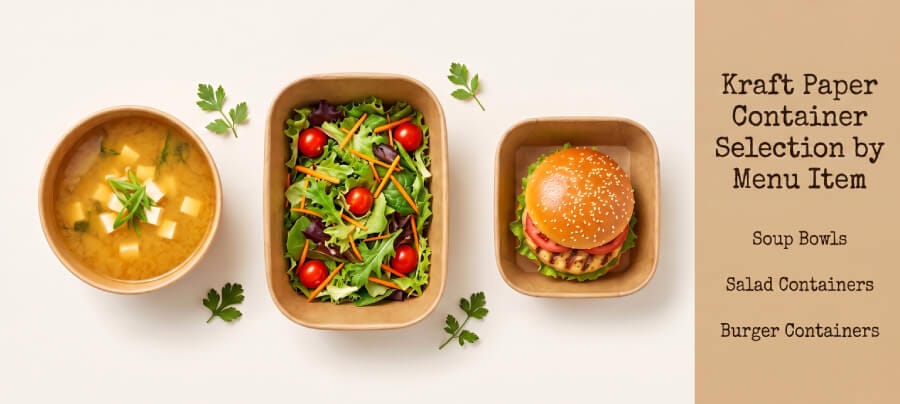
Once you have decided on kraft paper as your food packaging material, the next step is to evaluate container performance and the key factors are heat resistance and grease resistance, not the material itself. Choosing the wrong specification for a menu item leads to leakage, deformation, or customer complaints that no coating upgrade can fix after the fact. This guide breaks down the functional requirements for each container type so foodservice buyers can confirm specifications before placing an order.
Kraft paper containers are divided into six main categories by application and each with different structural designs and coating methods that directly affect performance. Wholesale minimums typically range from 6,000 to 20,000 units depending on the container type.
Kraft Paper Container Types: Specifications at a Glance
| Type | Sizes (ml) | Coating | Primary Use | Average MOQ |
|---|---|---|---|---|
| Kraft Paper Bento / Meal Box | 650 / 850 / 1000ml | PE or PLA coating | Bento meals, fried rice, dry meal sets | From 6,000 units |
| Kraft Paper Soup Bowl / Paper Bowl / Soup Cup | 350 / 500 / 750 / 900ml | PE coating (double-sided waterproof) | Soups, noodles, braised pork rice | From 6,000 units |
| Kraft Paper Salad Container | 500 / 750 / 1000ml | Uncoated or light moisture-resistant treatment | Salads, light meals, fruit | From 6,000 units |
| Kraft Paper Burger Container | Standard / Large burger | Food-grade grease-resistant paper liner | Burgers, sandwiches, paninis | From 10,000 units |
| Kraft Paper Cup | 8oz / 12oz / 16oz | PE coating (single or double-sided) | Hot drinks, coffee, soy milk | From 10,000 units |
| Kraft Paper Carrier Bag | S / M / L | Uncoated (pure paper) | Takeout bags, delivery supplementary packaging | From 6,000 units |
Functional Packaging Recommendations by Menu Type
The following provides functional kraft paper container recommendations by common menu item type, with key verification points highlighted for each.
Hot Soups / Noodle Dishes: Choose a Kraft Paper Soup Bowl
Soups have high liquid content and high temperatures, making them the scenario where kraft paper containers are most likely to fail. Products in this category are also referred to as paper soup cups, kraft soup cups, or eco paper bowls on the market, with capacities typically ranging from 500ml to 900ml. Choose a double-sided PE coating option and confirm the heat resistance rating is at or above 90°C. Request a leakage test report from the supplier showing the container filled with soup and held static for 30 minutes. Pair with a paper lid of the same material. When kraft paper is already the chosen material, a PP plastic lid is generally avoided as it creates visual inconsistency across the tableware set, but for operators focused on cost reduction, a plastic lid remains the last-resort alternative.
Dry Bento / Fried Rice: Choose a Kraft Paper Bento Container
Dry mains have relatively lower heat resistance requirements (70-80°C is sufficient), but demand high lid seal performance and stable stacking. Choose a snap-fit lid design and verify the precision fit between the lid rim and box body to prevent separation during vibration in transit. If the menu includes braised sauces or gravies, upgrade to a higher grease-resistance coating.
Salads / Light Meals: Choose a Kraft Paper Salad Container
Salad containers do not need high heat resistance, but do need moisture resistance. The uncoated option has the lowest cost, but if the vegetables have high water content or the product sits for more than 30 minutes, switch to a light moisture-resistant treatment. Salad container lids are less transparent than PET containers and if consumer visual display matters, consider a kraft paper base paired with a clear PET lid as a combination option.
Burgers / Sandwiches: Choose a Kraft Paper Burger Container
Burger items are high in fat, so the packaging priority is grease resistance, not waterproofing. Kraft paper burger boxes typically use a food-grade grease-resistant eco paper as the inner layer. When purchasing, confirm the Kit Rating (a grease resistance scale from 1-12 per TAPPI T559; ≥ 5 recommended for standard burgers; ≥ 7 for items with heavy sauces or cheese) and whether the ink used is food-grade. If custom labels or brand printing are needed, confirm the layout design with the manufacturer in advance to avoid compromising the grease-resistant coating.
Hot Drinks / Coffee: Choose a Kraft Paper Coffee Cup
Hot drink cups need both insulation and leak prevention. Double-wall kraft paper cups (PE coating on both inner and outer surfaces) insulate better than single-wall and are suitable for direct hand-holding. Common sizes are 8oz, 12oz, 16oz, and 600ml. For takeout and delivery, choose a dome lid design to prevent spillage in transit. If the brand emphasizes sustainability, a PLA-coated option is available, but confirm that composting facilities are accessible locally to ensure the environmental claims can be substantiated.
Heat Resistance and Grease Resistance: Two Specifications to Confirm Before Ordering
Regardless of which kraft paper container type you select, the following two specifications are the most important items to confirm before placing an order:
| Specification | Description | Recommended Standard | How to Verify |
|---|---|---|---|
| Heat Resistance Temperature | The maximum temperature at which the container stays firm and does not deform when filled with hot food | Soup bowls ≥ 90°C; bento boxes ≥ 75°C | Request a heat resistance test report or test with actual food items |
| Kit Rating (Grease Resistance Level) | Measures the ability of paper containers to resist grease penetration, rated 1–12 | Burger boxes ≥ 5; bento boxes ≥ 3 | Request a third-party test report from the supplier |
- Do not rely on visual inspection or pressing by hand: Kraft paper containers that look identical can have significantly different heat and grease resistance depending on the coating method used.
- Request actual fill tests with samples: Running a 30-minute static fill test with the highest-fat, highest-temperature items on your menu is the most reliable verification method.
- Confirm food safety of printing inks: If the interior of the container has printing, confirm that food-grade inks are used, compliant with Taiwan’s Act Governing Food Safety and Sanitation and the Sanitation Standards for Food Utensils, Containers, and Packaging.
Three Mistakes That Lead to Returns After Rollout
Based on direct experience working with procurement managers at chain restaurants, the following three mistakes most commonly lead to returns or re-purchasing after rollout:
- Mistake 1: Using a bento box for soup. Standard kraft paper bento boxes are waterproofed for sauces, not for large volumes of liquid soup. If the lid seal is insufficient, even a slight tilt will cause leakage – a common problem during delivery. Always use a dedicated soup bowl specification for soup items; do not substitute a bento box.
- Mistake 2: Assuming “eco material” means “microwave-safe.” PE-coated kraft paper containers are not recommended for microwave use. PLA-coated options can be microwaved briefly but have a lower heat resistance ceiling. If your operation offers in-store microwave reheating, inform the supplier before ordering and label the container clearly with microwave instructions.
- Mistake 3: Overlooking batch-to-batch consistency. The same container specification can vary between production batches in volume, lid fit precision, and print color. When placing orders, confirm the dimensional tolerance range and require a quality inspection report with each delivery.
EasyPack recommends reviewing the overall comparison of kraft paper containers against other materials before specifying and confirming the material decision first, then moving to specification selection, is a more efficient approach.
Frequently Asked Questions (FAQ)
What is the structural difference between a kraft paper soup bowl and a standard bento box?
Soup bowls use a double-sided coating, a deeper bowl body, and a reinforced rim to prevent liquid pooling and leakage at the edge. Bento boxes are primarily designed to resist sauces, with a shallower body and a lid that prioritizes snap-fit sealing. The two cannot be used interchangeably.
How should a restaurant choose between a kraft paper salad box and a clear PET salad box?
If customers need to visually inspect the ingredients before ordering, such as in convenience stores or self-serve counters – clear PET is the better choice. For online ordering, takeout, and delivery scenarios where visual display matters less, a kraft paper salad box reduces cost and maintains a consistent brand presentation.
What Kit Rating should I specify for a burger box?
Kit Rating is a grease resistance classification measured by the TAPPI T559 standard, with higher numbers indicating greater resistance. Kit Rating ≥ 5 is recommended for standard burgers. For items with heavy sauces or cheese, ≥ 7 is recommended. Request a TAPPI T559 test report from the supplier to confirm the grease resistance level meets your actual needs.
Do kraft paper coffee cups need a matching dedicated lid?
Yes. Use a paper lid of the same material or a matching design to ensure the snap-fit dimensions align. If using a plastic lid, confirm it meets food-grade standards and note the visual inconsistency of mixing materials.
Can a single restaurant consolidate all kraft paper specifications under one supplier?
Yes, and it is recommended. Consolidating wholesale purchasing under a single supplier ensures consistent paper color and print color matching across all specifications, and supports better MOQ and lead time negotiations. For smaller operations with lower volume needs, ask whether the supplier offers a mixed-SKU minimum order option. See the supplier evaluation criteria to assess whether your supplier has cross-specification integration capability.
Start with your highest-fat, highest-temperature menu item and if the container passes that test, it will handle the rest of your menu. From the leakproof coating on a soup bowl to the Kit Rating on a burger box, each specification exists for a reason tied to what’s inside. Getting the details right before rollout is significantly cheaper than discovering the failure in front of a customer.
Before placing an order, request sample testing for your highest-fat and highest-temperature menu items first, then confirm the specification before submitting a formal order. Contact the EasyPack team for samples across all specifications and custom printing quotations.
Reference: TAPPI T559 – Grease Resistance Test for Paper and Paperboard